




Date de publication : 28/11/2026
A marked entrance pane, a partition with dried-on residue or a meeting room with side lighting can make an office look neglected even when the rest of the maintenance is carried out correctly. That is why, when choosing essential equipment for
A marked entrance pane, a partition with dried-on residue or a meeting room with side lighting can make an office look neglected even when the rest of the maintenance is carried out correctly. That is why, when choosing essential equipment for office cleaning, it is worth considering productivity, finish quality and continuity of use, rather than simply gathering basic tools.
In professional environments, every tool should fulfil a specific task and work effectively with the others. The difference between an improvised kit and a well-configured system becomes clear over time in the time spent per workstation, the reduction in repeat cleaning and the ease of replacing consumables as they wear.
The equipment should start with the glass surfaces
Modern offices contain more glass than they did a few years ago: glazed façades, shopfronts, entrance doors, internal partitions, screens and meeting rooms. These surfaces are highly visible and particularly sensitive to poor working methods. An unsuitable cloth can leave lint; a worn squeegee blade can leave water lines; and a low-quality tool can force you to repeat the same job.
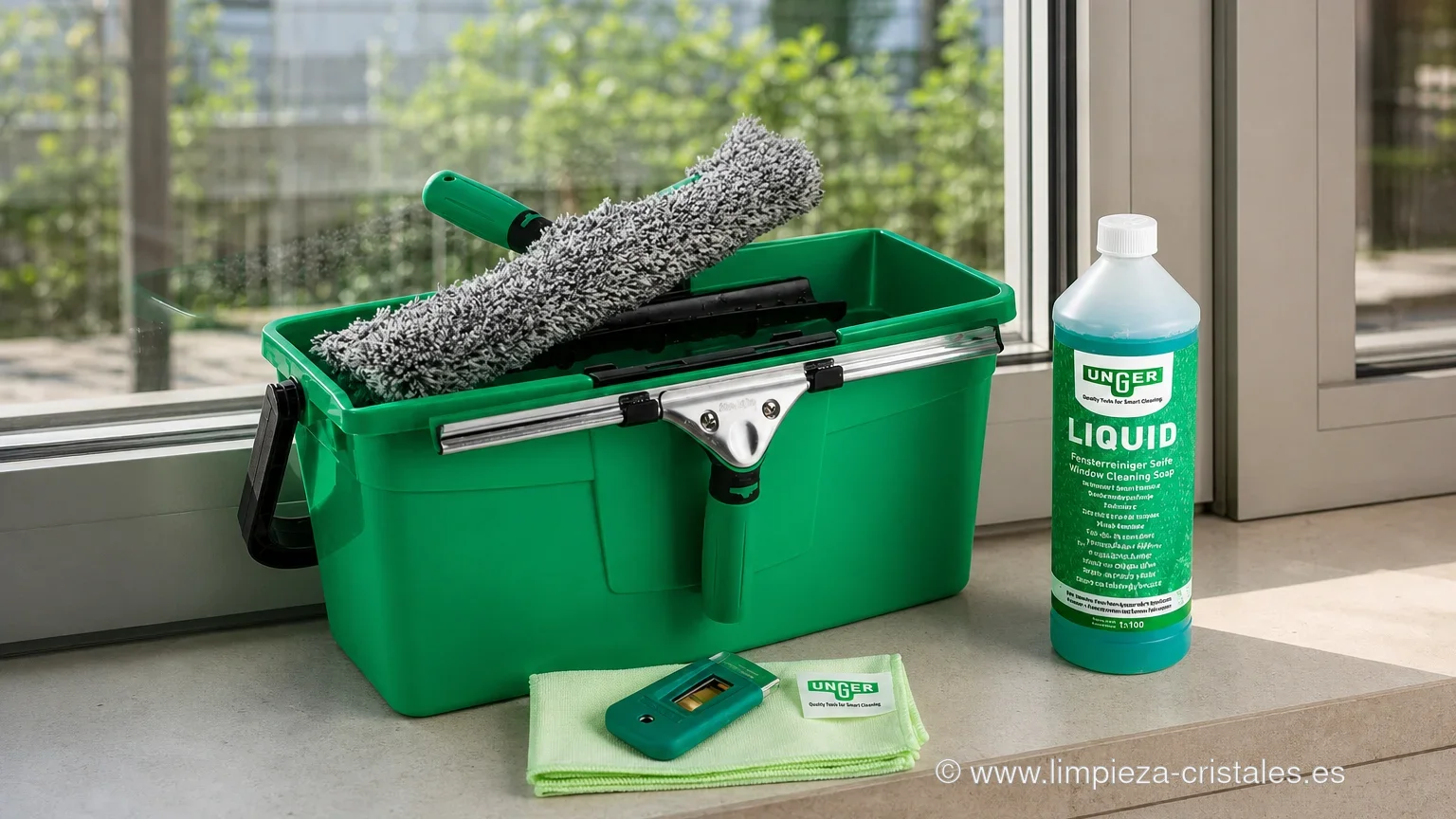
The basis for interior glass cleaning is a simple but professional combination: washer, window squeegee, bucket and microfibre cloths for finishing work. The washer applies the cleaning solution evenly. The window squeegee removes the liquid in a controlled pass, while the microfibre is reserved for frames, corners and small corrections.
It is not advisable to replace the window squeegee with paper or rely exclusively on cloth cleaning. This may work for small areas or touch-ups, but on doors, windows and screens the method slows the operation and makes it more likely that smears will remain. A correctly sized squeegee helps maintain even pressure and achieve consistent results.
The rubber blade determines the finish
The rubber blade is a consumable, not a component that should be kept in use until it fails completely. When it loses elasticity, develops cuts or leaves fine lines after a pass, it should be turned around if its profile allows this, or replaced. Keeping compatible replacements available prevents a service from being interrupted by a low-cost part.
The width of the window squeegee also makes a difference. A wide size speeds up work on large panes of glass, while a more compact one offers better control on partitions, doors with narrow frames or areas close to furniture. For offices with a variety of surfaces, having two sizes is usually more efficient than trying to handle everything with a single tool.
Essential office-cleaning equipment for high-level areas
Not all glazed surfaces can be cleaned from the floor with the same ease. Internal skylights, high-level glazing, façades accessible from inside and glass positioned above furniture require additional reach. In these cases, a telescopic pole compatible with cleaning accessories reduces movement and avoids unsafe solutions.
The pole should be selected according to the actual working height, not the maximum theoretical height that may initially seem convenient. The greater the extension, the heavier the set becomes and the more demanding it is to control the head. For regular high-level work, rigidity, section locks and ergonomics have a direct effect on operator fatigue.
Outside, where there are large surfaces or considerable height, pure-water systems for professional glass cleaning can be a suitable solution. Treated water is used to loosen dirt and allow the surface to dry without mineral deposits, provided that the system, brush and technique are configured correctly. It is not the answer for every office: interior glass, adhesive marks or built-up grease may require manual preparation first.
Use a scraper for bonded dirt, not for daily maintenance
Adhesive residue, building paint, dried splashes or bonded dirt require a different approach. This is where a professional scraper comes in. It should be used with a blade in good condition, a controlled angle and sufficient lubrication on the surface. It is not a tool that should be used automatically on every pane of glass.
Before scraping, the operator should identify the type of surface and confirm that there are no elements that could be damaged. Incorrect use can mark glass, especially if abrasive particles become trapped between the blade and the surface. For routine maintenance, the washer and window squeegee remain the fastest and safest system.
Buckets, cloths and organisation: time is lost here too
A professional bucket is not a secondary accessory. It should make it easy to load the washer, allow the equipment to be carried safely and, depending on the type of service, include compartments or holders to keep the window squeegee and cloths close at hand. During maintenance rounds, reducing trips back to the trolley or cleaning room improves productivity without compromising the finish.
Microfibre cloths should be separated according to their use. A cloth used to dry frames should not then be used on clean glass, as it may transfer dirt or moisture. Assigning colours or functions helps standardise the method, particularly when several operators cover the same building.
For a professional office-cleaning service, it is advisable to keep at least the following consumables available: replacement rubber blades, washer sleeves, microfibre cloths, scraper blades and connectors or adapters compatible with the pole. They are small parts, but they determine whether the equipment can continue working throughout a full shift.
Ergonomics and tool compatibility
An operator who cleans dozens of doors, screens and windows each day needs tools that work well with one hand and do not add unnecessary weight. Handle balance, the grip of the window squeegee and the ease of changing a rubber blade are just as important as the tool's materials.
Compatibility also deserves attention. Buying accessories individually can create problems when the pole does not accept the required head, the channel does not fit the rubber blade or the replacement does not match the tool size. Working within the same product system simplifies replenishment, operator training and stock management.
In a professional range such as Unger, the value lies not only in the main tool, but also in the ability to complete the set with compatible channels, rubber blades, sleeves, handles, adapters and poles. For companies carrying out recurring maintenance, this continuity is more useful than purchasing individual parts without planning for replacements.
How to configure equipment according to the type of office
A small office with glass doors, screens and internal windows can operate with a compact manual kit: bucket, washer, one or two window squeegees, cloths, scraper and basic replacements. This is an agile configuration for working between desks, meeting rooms and reception areas without taking up too much space.
At corporate headquarters, clinics, business centres or buildings with extensive glazing, it is preferable to expand the system with channels in several sizes, poles for high-level areas and an organised trolley. The aim is for each operator to be able to move between surfaces without wasting time looking for accessories or improvising methods.
For façades and external glazing, the decision depends on the height, access, volume of glass and service frequency. Poles with pure-water systems can provide speed on large surfaces, while traditional methods remain precise for finishing work, small panes or localised dirt. There is no single set-up for every situation: the right solution starts with the type of building and its maintenance routine.
Buying with technical support avoids configuration errors
Professional equipment must be capable of staying operational. Before buying, it is worth checking which replacement parts it requires, whether they are available and whether the system can be expanded with compatible accessories. This forward planning prevents a rubber blade, sleeve or adapter from turning a useful tool into equipment that is out of action.
Limpieza Cristales Unger provides technical advice and after-sales service (SAT) in Spain to configure equipment according to its actual use: interior maintenance, shopfronts, pole work or pure-water systems. For professionals, this guidance reduces duplicate purchases and makes it easier to choose a combination that maintains the pace of work.
The best cleaning equipment is not the set with the most accessories, but the one that allows you to finish every pane without marks, reach the necessary areas safely and replace its parts without interruptions. That is the foundation of a profitable and consistent office-cleaning service.