




Date de publication : 25/11/2026
A poorly prepared trolley turns every job into a succession of unnecessary trips, wet tools left in the wrong place and time losses that are difficult to measure. Organising a professional window-cleaning trolley is not about filling it with tools
A poorly prepared trolley turns every job into a succession of unnecessary trips, wet tools left in the wrong place and time losses that are difficult to measure. Organising a professional window-cleaning trolley is not about filling it with tools: it is about arranging each item according to how often it is used, the type of work and the actual sequence of operations. When the operator can find, transport and store every tool without interrupting their workflow, the service becomes more productive and safer.
The approach should be operational. A trolley for street-facing shop windows does not need the same configuration as one intended for communal areas, large interiors or work with a water-fed pole. The basic principles, however, are the same: protect tools, keep clean and used equipment separate, distribute the load securely and have replacement items available without turning the trolley into a mobile storeroom.
Organising a window-cleaning trolley by work zones
The most effective way to configure a trolley is to divide it into functional zones. This prevents tools being left on the floor, clean cloths being mixed with wet equipment and accessories that will not be used during the day being transported unnecessarily.
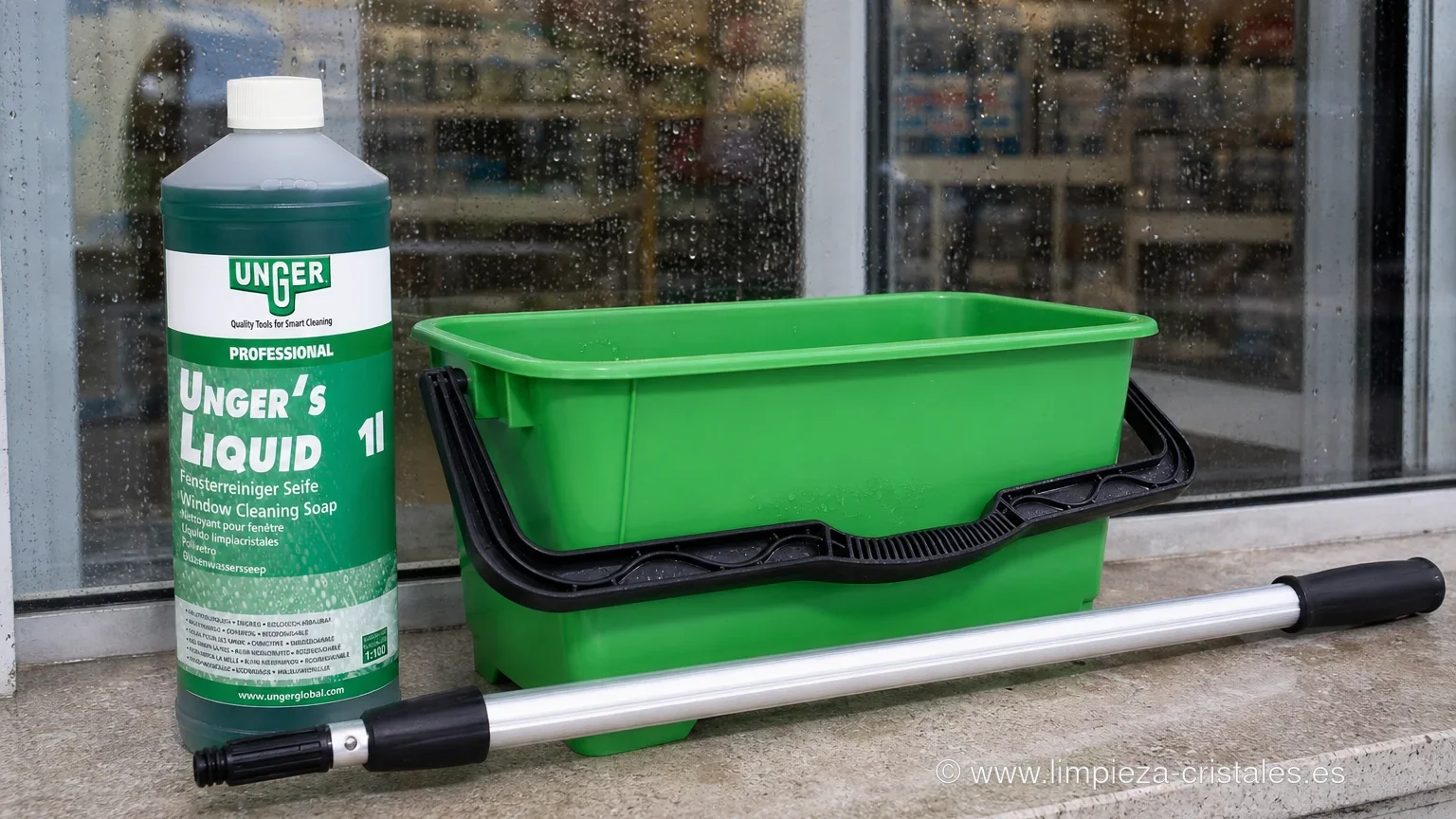
The top section should be reserved for tools used immediately. This is where it is sensible to place the bucket, washer, window-cleaning squeegee, detailing cloths and spray bottle when the working method requires one. These are the items that are constantly taken out and put back during cleaning, so they should be accessible without forcing the operator to bend down or search through the trolley.
Replacement items and supporting accessories should be kept in the intermediate trays or compartments: replacement squeegee rubbers, dry cloths, washer sleeves, scraper blades, adapters, frame protectors and small adjustment tools. Group them by function rather than by size. A compartment dedicated to replacement window-cleaning squeegee rubbers, for example, makes it easy to check what is missing before starting the route.
The lower section is suitable for heavier items or equipment used less frequently. A second bucket, bottles of cleaning solution, short extension poles, warning signs or a container for used textiles should be kept at the bottom to maintain a low centre of gravity. This arrangement reduces the risk of tipping when moving over kerbs, ramps or uneven paving.
The layout should follow the cleaning sequence
A well-organised trolley supports the working method. Before loading it, consider the usual sequence: preparing the area, removing stuck-on dirt, washing, squeegeeing, detailing the edges and carrying out a final inspection. The tools should appear in the same order within the trolley.
The scraper deserves a protected, separate location. It should not be left loose alongside cloths, rubbers or sleeves, as an exposed blade can damage equipment, cause cuts or mark a surface during transport. Keeping the blade retracted or protected is a basic safety measure, particularly when working in premises with customer traffic or in communal entrances.
It is also advisable to separate cloths according to their use. Those intended for finishing, frames or drying the squeegee rubber should not be mixed with cloths that have already collected dirt. A dedicated bag or compartment for used textiles prevents clean equipment from becoming contaminated and makes restocking easier at the end of the shift. It may seem like a minor detail, but it reduces marks on the glass and unnecessary repeat work.
Choose tools according to the service, not out of habit
The most common mistake is using the same trolley for every job, regardless of the work involved. An overloaded trolley makes moving around more difficult, while an overly basic configuration means returning to the vehicle or improvising. The solution is to create a fixed core load and add modules according to the planned service.
For shop windows and interior glass, agility is usually the priority. A stable bucket, one or two sizes of window-cleaning squeegee, washers suited to the working width, detailing cloths and a scraper will cover most of the day. If there are sensitive frames, narrow partitions or small panes, it is worth including a narrower channel and accessories that allow precise work.
For communal areas and building maintenance, the trolley may need more capacity for textiles, warning signs and replacement items. The distance between work areas makes it especially important not to rely on the vehicle for a rubber, sleeve or extra cloth. However, carrying too many units of every item does not improve the service: it is better to establish a minimum stock level and check it systematically.
For work with a water-fed pole, the trolley should act as a support point, not as a place to transport unsecured sections. Telescopic poles and their accessories should be transported safely and, whenever possible, in dedicated supports or in the vehicle. Within the trolley, reserve space for brushes, adapters, hoses or connection parts that will be used at the façade, ensuring they are not crushed by other tools.
Protect the tools that determine the finish
The rubber is the component that has the most direct influence on the result achieved by a window-cleaning squeegee. Transporting it compressed, bent or in contact with dirt can cause lines and drag marks, even when the operator uses the correct technique. Carrying clean, dry and protected replacement rubbers allows them to be changed at the right time and helps maintain a consistent finish.
Channels, handles and washers also need a location that protects them from knocks. If the trolley has side supports, use them to keep tools separate and securely positioned. If it does not, a sleeve or long compartment will prevent the channel from rubbing against other accessories during transport.
Cleaning products, meanwhile, should always be transported in properly sealed containers and kept upright. Placing them on top of cloths or replacement items is not good practice. A spill inside the trolley wastes product, damages textiles and may force you to stop the service to clean and reorganise the equipment.
Check the trolley before leaving and at the end of the day
Organisation does not maintain itself. A brief check before each working day prevents problems from arising once you are already at the customer’s premises. Check the condition of the rubbers, the cleanliness of the cloths, the operation of the wheels, the stability of the bucket and the presence of the replacement items required for the scheduled service. If the trolley is used by several operators, this routine is even more important.
At the end of the day, remove used textiles, empty and clean the bucket, dry the tools before storing them and discard any rubbers that have lost their working edge. Leaving the trolley ready for the next shift reduces unproductive time and makes it possible to identify damage or missing items before they affect a job.
Not every trolley requires the same level of equipment. A professional carrying out retail routes will prioritise manoeuvrability and quick access; a maintenance company may need greater capacity and clearly defined compartments; anyone working at height must prioritise system protection and compatibility. The choice should be based on the daily load, travel distances and the type of glass normally cleaned.
Having compatible tools and replacement items simplifies this process. As an Unger service and technical support provider in Spain, a specialist supplier can advise on trolley configurations, channel sizes, rubbers, washers and accessories that fit the actual working method. The best trolley is not the one that carries the most equipment, but the one that lets you reach every pane with the right tool, in good condition and without losing a minute looking for it.