




Date de publication : 21/11/2026
Glass that comes out marked after working with a water-fed pole is rarely fixed by changing the brush or repeating the rinse. When looking for a HydroPower filter review, the key question is whether the filter is still delivering water of the quality need
Glass that comes out marked after working with a water-fed pole is rarely fixed by changing the brush or repeating the rinse. When looking for a HydroPower filter review, the key question is different: whether the filter is still delivering water of the quality needed to dry without leaving residue. In professional window cleaning, system performance depends as much on technique as it does on the actual condition of the resin.
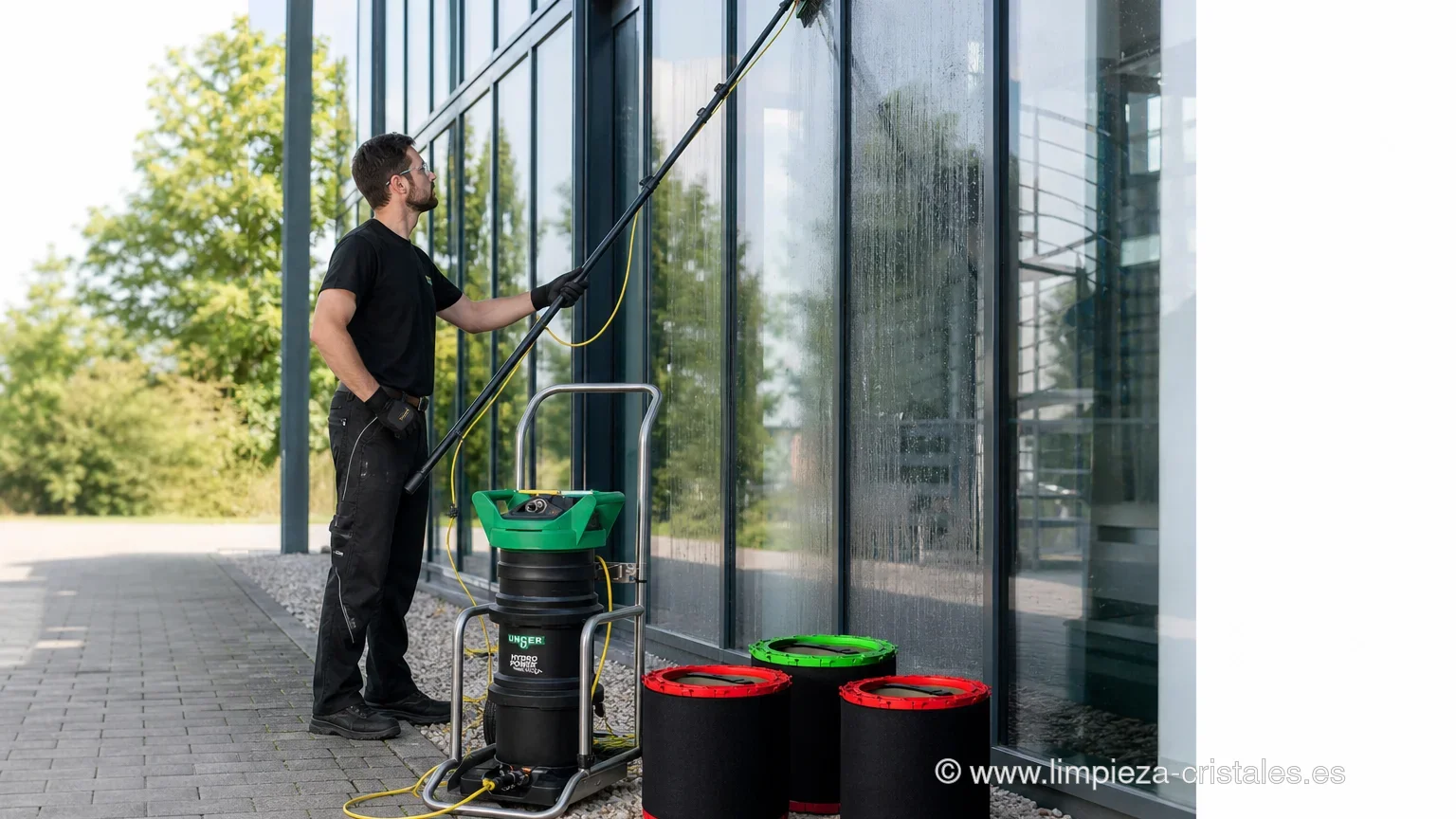
The HydroPower filters are designed for pure-water cleaning of windows, light façades, shop windows and exterior surfaces where manual drying is to be avoided. Their main benefit is not a generic promise of speed, but enabling more efficient work with water-fed poles, particularly when access by ladder or platform is impractical.
Our view of HydroPower filters in professional use
The assessment is favourable when they are used as part of a correct working method. A correctly sized HydroPower filter with resin in good condition enables consistent rinsing and reduces the time spent on touch-ups. For a cleaning company, this consistency is more valuable than a one-off increase in speed: it makes timings easier to calculate, standardises results between operatives and avoids additional visits caused by complaints about marks after drying.
The point that needs clarification is capacity. It is not a fixed figure and should not be treated as one. Filter life changes significantly depending on the quality of the incoming water, the volume used, the level of dirt and the required finish. In areas with a higher mineral content, the resin is exhausted sooner. Capacity is also used up more quickly if too much water is used to compensate for poor brushing technique, or if heavily ingrained dirt is tackled without adequate preparation.
For this reason, a pure-water system does not replace good technique. Brushing must loosen the dirt, rinsing must be thorough and even, and the surface must be free of debris that could be carried across the glass as it dries. The filter provides the water quality needed to prevent mineral deposits, but it cannot correct an uneven pass or remove bonded residues such as silicone, paint or building debris on its own.
Performance: where the difference is really noticeable
On shop windows, detached homes, communal buildings and for periodic façade maintenance, a HydroPower filter allows you to work from the ground with a compatible water-fed pole and a suitable brush. This reduces preparation time and avoids repeatedly climbing up and down to reposition a ladder. On recurring jobs, that operational difference adds up.
It is also useful when the aim is to maintain glass that is already in good condition. On maintenance rounds, pure water can provide a uniform finish without subsequently using a window-cleaning squeegee. However, on first cleans, post-construction cleans or surfaces with bonded contamination, it may be necessary to combine methods. Traditional cleaning with a washer, window-cleaning squeegee and professional scraper still has its place when stubborn dirt must be removed with direct control over the glass.
What determines the service life of a HydroPower filter
Deionisation resin retains minerals in the water that could leave marks as they evaporate. As it becomes saturated, it loses its ability to produce the required level of purity. Waiting until the results visibly deteriorate is not a good strategy: when marks appear after drying, the work may already require a touch-up.
Measuring the water leaving the system is the practical reference for knowing when the consumable needs replacing. On professional equipment, checking this figure before starting a long working day prevents interruptions and helps forecast the cost per service. It is not enough to rely on the number of days since the last change, because two customers in the same town may require very different water consumption.
There are four signs that justify checking the condition of the filter and the working method:
- The purity reading of the water leaving the system is no longer within the range required for a mark-free finish.
- Mineral spots or hazing begin to appear on glass that previously dried correctly.
- Normal service life drops noticeably without any change in the workload.
- The flow becomes irregular or the equipment no longer performs as usual, which may also indicate that connections, hoses or pre-filters need checking.
The fourth sign deserves particular attention. Not every problem attributed to the resin actually comes from the cartridge. A poorly connected inlet, a kinked hose, a contaminated brush or a tank containing residue can all affect the result. Diagnosing the issue before replacing parts avoids unnecessary expense and stoppages in the middle of a working round.
Resin replacement and preventive maintenance
Replacement should be carried out cleanly and in accordance with the procedure specified for the particular equipment. Opening the filter in a dirty area, reusing worn components or leaving the resin incorrectly seated can impair operation. Before closing the unit, check the seals, threads and that every component is correctly fitted. A small leak does more than waste water: it can alter the working pressure and make water-fed pole operation more difficult.
After replacing the resin, it is advisable to flush the system until the water leaving it reaches the expected reading. This initial check confirms that the unit has been assembled correctly and prevents starting a job with water that still contains residue from the replacement process. Keeping a simple record of changes, readings and service type helps estimate consumption far more accurately after several weeks.
Storage and handling also have an influence. The system should be transported protected from impacts that could damage the connections or housing, and prolonged periods without inspection should be avoided when it is used intensively. For companies with several operatives, establishing who checks the meter and who authorises resin replacement prevents each team from applying different criteria.
Who benefits from working with HydroPower?
It is particularly worthwhile for professionals carrying out regular exterior cleaning who need greater reach without multiplying their access equipment. A self-employed cleaner maintaining shop windows or communal buildings can improve productivity by reducing movement and manual drying time. A maintenance company can use it to standardise processes on routes with many surfaces accessible from the ground.
However, it is not the only solution for every situation. If the workload is very high, if jobs involve large, continuous water consumption or if the incoming water has a high mineral content, it is worth assessing the complete system configuration and the running cost of the resin. Choosing solely according to filter size, without considering the available water and the number of hours of use, often leads to unrealistic expectations.
For demanding end customers, the criterion is similar: a HydroPower filter makes sense when a professional finish is required on exterior glass and a regular maintenance routine is in place. If it will be used only occasionally on small surfaces, it is important to consider whether the investment and consumable maintenance are appropriate for the intended use.
The importance of replacement parts and technical support
With professional equipment, the purchase does not end when the filter arrives. The availability of resin, seals, connections and compatible components determines whether the system will remain cost-effective over time. Using the correct replacement parts avoids improvised adaptations that could compromise watertightness or the quality of the treated water.
At Limpieza Cristales Unger, as an Unger authorised service centre in Spain, advice is particularly valuable when there are questions about compatibility, consumable replacement or configuring the system for a specific type of work. Asking for advice before buying can prevent choosing a solution that is oversized for a small route or undersized for a more demanding operation.
The best opinion of HydroPower filters is not formed on the first day, but after several working rounds during which consumption, outlet readings and the actual finish on the glass are monitored. When the system is correctly sized and properly maintained, it stops being an accessory and becomes part of a more predictable cleaning operation.