



Date de publication : 12/11/2026
A shop window covered in marks, a façade that cannot be reached safely or a day lost changing incompatible accessories cannot be solved by simply working harder. They are solved with a better working system. Innovation in technical window cleaning
A shop window covered in marks, a façade that cannot be reached safely or a day lost changing incompatible accessories cannot be solved by simply working harder. They are solved with a better working system. Innovation in technical window cleaning is precisely about this: selecting tools and processes that make it possible to clean more surface area, achieve repeatable results, reduce fatigue and maintain control of the operation.
For a cleaning professional, innovation does not mean adding a new product simply because it is trending. It means reviewing where time is being lost, which tasks create the greatest risk and which component limits the final quality. Sometimes the improvement lies in choosing the right rubber blade; at other times, it comes from a well-configured telescopic pole or switching to a pure water system for exterior work.
Innovation in technical cleaning: productivity with purpose
Professional window cleaning has one particular characteristic: the result is immediately visible. An uneven pass, a worn rubber blade or a poorly balanced tool leaves visible marks. That is why useful innovation does not seek to replace the operator’s technique, but to make it more consistent and efficient.
A well-chosen setup should help keep three variables under control: the finish, the time per surface area and safety during the work. If a tool provides greater reach but requires repeated passes, it does not improve real productivity. Similarly, a system that is quick to assemble loses its value if replacement parts are unavailable or incompatible with the rest of the equipment.
The right decision depends on the environment. The same setup is not required for a shop with street-level windows, a residential development with high windows, an industrial unit with large glazed panels or an exterior façade that is difficult to access. Assessing the type of glass, height, service frequency and level of soiling makes it possible to buy wisely and avoid equipment that is either oversized or insufficient.
From individual tool to complete working system
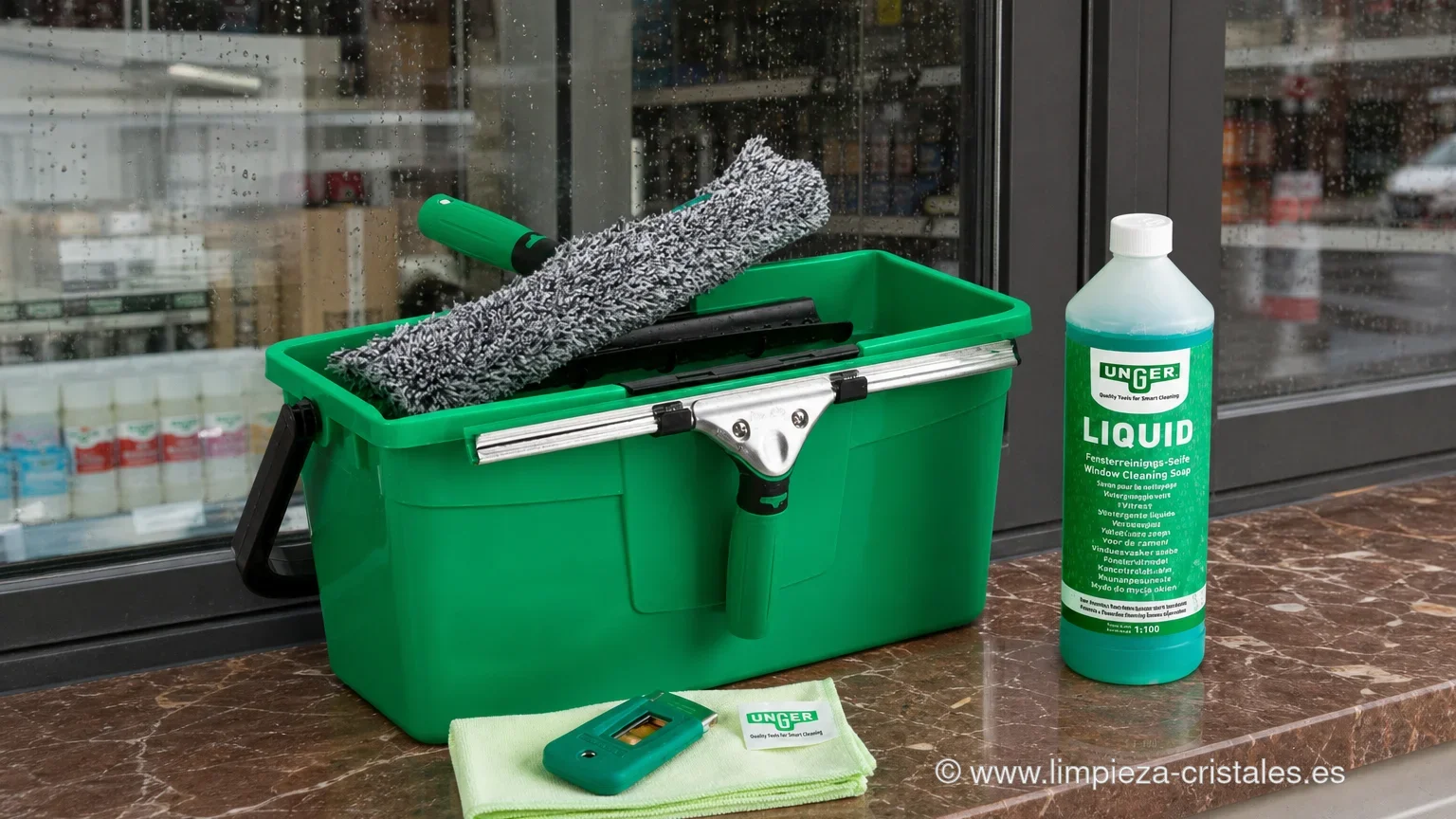
One of the most cost-effective improvements comes from no longer choosing each tool in isolation. The window squeegee, washer, bucket, handle and rubber blade should work together as a system. Compatibility reduces interruptions, prevents improvised adaptations and makes it easier for the operator to maintain a consistent technique.
For interior work or periodic maintenance, a window squeegee with a channel suited to the width of the glass and a rubber blade in good condition can make a considerable difference. The aim is not to use the widest channel possible, but the one that allows movement to be controlled without leaving lines or requiring the edges to be corrected. For divided windows, narrow frames or nearby furniture, a more manageable format is often faster than a large tool.
The washer also affects the pace of work. A sleeve with good water-retention capacity helps distribute the cleaning solution evenly and prevents you from having to return to the bucket constantly. However, carrying too much solution can cause drips indoors and increase the need to wipe frames or floors. Technical innovation means adjusting the system to the environment, rather than repeating the same setup for every job.
Replacement parts: a detail that affects profitability
Rubber blades, sleeves and other consumables are not secondary accessories. They are components that determine the quality of the finish and the operating cost of each working day. Continuing to use a tired rubber blade to get the most out of it often results in more touch-ups, more complaints and greater operator fatigue than the saving achieved.
It is advisable to schedule regular checks of wear components. If lines, skipping during the stroke or a loss of precision at the ends appear, it is time to turn or replace the rubber blade as appropriate. Keeping compatible replacement parts in the vehicle or warehouse prevents a job from being stopped by a small component.
Poles and reach: less risk, more control
Working at height requires a specific assessment. A telescopic pole makes it possible to tackle many surfaces without immediately resorting to more complex access equipment, but its effectiveness depends on its rigidity, weight, required length and the control the operator retains at the working end.
A pole that is too short forces awkward postures. One that is excessively long for the task can reduce precision and increase fatigue. The connection between the pole and the accessory is also important: any looseness is magnified when working at a distance and results in less clean passes or unnecessary movements.
The solution is not always to reach more metres. For interior maintenance, a lightweight and compact setup may be preferable. For high-level exterior work, the priorities become overall stability, material strength and the ability to work with specific accessories. Before buying, define the usual working height, not just the most demanding exceptional situation.
Pure water systems for exterior work
Cleaning with pure water systems has changed the way many exterior windows are cleaned, particularly where there is height, a large surface area or difficult access. The operating principle is clear: treated water removes the dirt and, when it dries, enables a residue-free finish if the process is carried out correctly.
It is not an automatic solution for every situation. The initial condition of the glass, frames, build-up of dirt, brushing technique and final rinse all have a direct effect on the result. During first-time maintenance of heavily soiled surfaces, more time may be needed because accumulated dirt in seals and frames can be deposited back onto the glass.
Its main advantage lies in combining reach and productivity with less need for direct intervention on the surface. With a suitable pole and brushes designed for this type of work, the professional can cover more surface area from the ground when service conditions allow. Even so, the system must be sized according to the workload and expected frequency of use. Equipment designed for occasional jobs will not necessarily perform equally well on a daily façade-cleaning route.
Ergonomics: an innovation you notice at the end of the shift
Productivity is not measured only in minutes. It is also measured by the ability to maintain good technique throughout the working day. Handles with an efficient grip, well-balanced poles and lightweight tools reduce strain on the wrists, shoulders and back.
This is particularly relevant for companies carrying out recurring work or employing several operatives. An uncomfortable tool may seem acceptable for ten minutes, but becomes a problem during repeated jobs. Ergonomics does not remove the need for training or replace safety procedures, although it does help maintain more controlled and consistent work.
When choosing a setup, assess the weight in real use, how easy it is to change accessories and how the complete system behaves when wearing gloves or working in damp conditions. These details are not always apparent in a product photograph, but they have a direct impact on daily performance.
How to decide which innovation to introduce first
The best investment usually addresses the main bottleneck. If the problem is constant touch-ups, first review the combination of rubber blade, channel and technique. If travelling and changing position are taking up time, assess the pole options. If exterior work regularly requires access to high windows, it may make sense to consider a correctly sized pure water system.
It is also advisable to prioritise systems with a reliable supply of replacement parts. The initial purchase price matters, but it should not be considered separately from future maintenance, parts availability and compatibility between components. Professional equipment has value when it remains operational and can be expanded over time.
Expert advice helps prevent incorrect configurations and duplicate purchases. As an Unger SAT service in Spain, a technical distributor can advise on compatibility, component replacement and the right setup for each application, from shop windows to exterior cleaning with a pole.
The next improvement does not have to be the most complex tool in the catalogue. Start by observing where errors, downtime or unnecessary effort are repeated. When a tool responds to a genuine service need, innovation stops being a promise and becomes measurable performance.