




Date de publication : 30/10/2026
Resin versus cartridges: the real differences in pure water systems for window cleaning, when to replace each filter and how to maintain consistent performance.
When a pure water system starts leaving marks, the flow rate drops or the TDS meter no longer reads zero, the question is often framed as a choice: resin versus cartridges. In reality, they are not always alternatives. Resin is the material that carries out the final deionisation stage; a cartridge is, depending on the equipment, a consumable that may contain that resin or a filter intended for another stage of the treatment process.
Understanding this difference helps prevent incorrect purchases, downtime and misdiagnosis. In professional window cleaning, particularly when using water-fed poles and washing brushes, each component affects water quality, operational autonomy and the cost per job.
Resin versus cartridges: the difference that determines the result
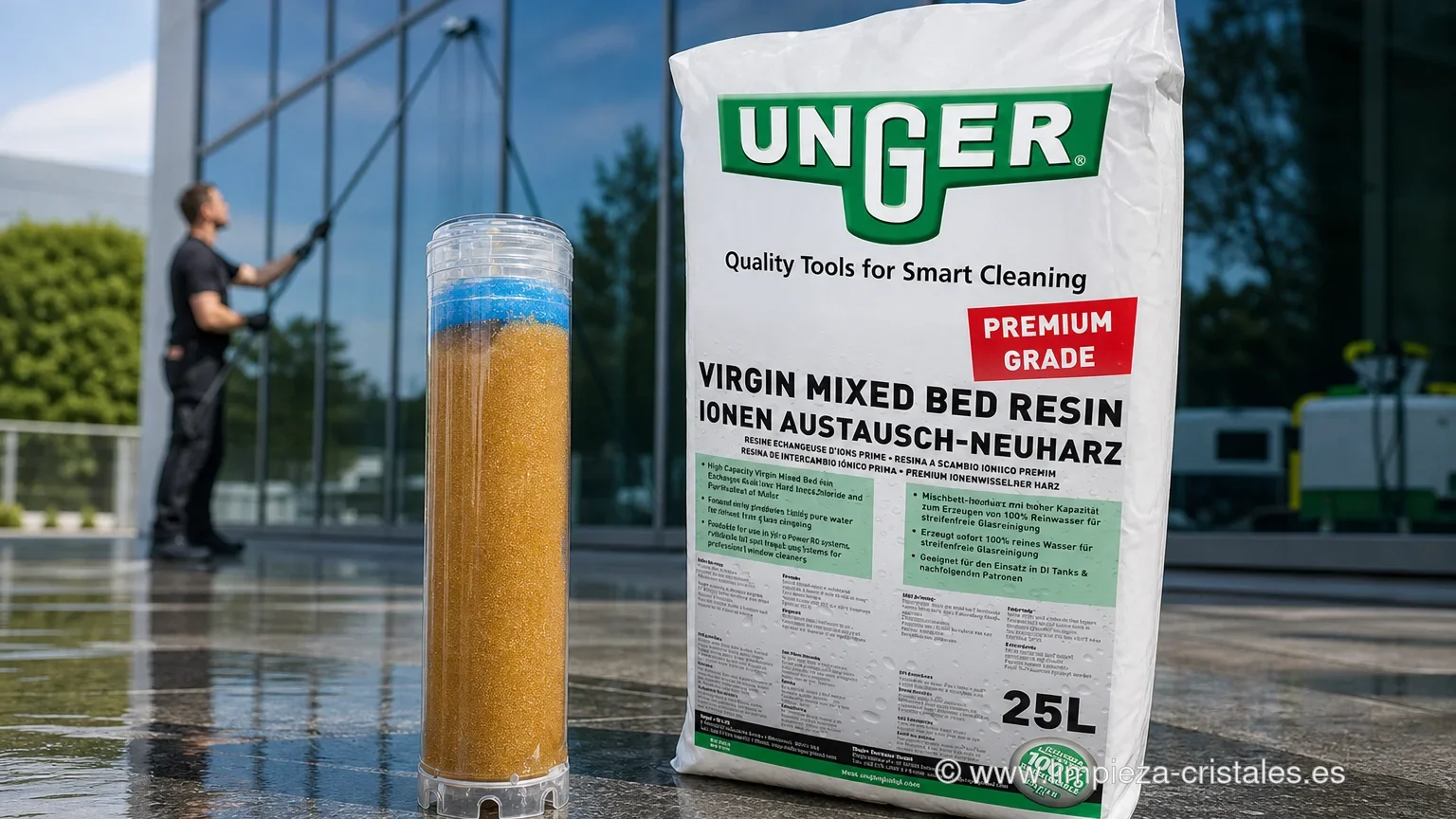
Ion exchange resin removes the dissolved minerals that remain in the water after the earlier filtration stages. Its function is to produce water with a TDS reading suitable for the final rinse of windows, frames and façades. When it is working correctly, the water dries without leaving visible mineral deposits.
A cartridge, on the other hand, is a filtration format. It may be a sediment, activated carbon or membrane cartridge, or a cartridge filled with deionising resin. Therefore, saying that you have to choose between resin and a cartridge can be misleading: a deionisation cartridge uses resin inside it.
The useful question is not which of the two is better, but which consumable has reached the end of its service life and what configuration the system requires. Replacing a pre-filter when the resin is exhausted will not restore a correct TDS reading. Replacing the resin when the problem is a damaged membrane or a saturated sediment cartridge will not resolve the underlying cause either.
What each stage does in a pure water system
Although configurations vary, a professional system will usually combine treatment stages with specific objectives. Pre-filters protect the system; reverse osmosis reduces the mineral load; and deionisation with resin polishes the result until the quality required for streak-free window cleaning is achieved.
Sediment cartridge
It retains particles, sand, rust and suspended dirt. It is a protective component, not an element that reduces dissolved minerals on its own. If it becomes saturated, the flow rate may drop and the subsequent components may be placed under greater strain.
A sediment cartridge in poor condition may seem like a minor issue, but it affects productivity. With less flow, the operator takes longer to rinse and may lose pressure at the water-fed pole. It can also allow dirt through or cause it to build up, which harms the remaining filters.
Activated carbon cartridge
Its usual purpose is to reduce compounds that could damage the reverse osmosis membrane, particularly when the incoming water contains chlorine or other treatment agents. It does not replace either the membrane or the resin. It is a preventative stage that extends the life of the system when replaced at the correct interval.
Reverse osmosis membrane
The membrane is the main barrier against the mineral load. It removes much of the dissolved solids before the water reaches the deionisation stage. The better its rejection rate and the more stable its operation, the less resin the system will consume.
For this reason, unusually high resin consumption warrants an inspection. It may be caused by high hardness in the source water, but also by a membrane that is no longer working efficiently, insufficient pressure or poor maintenance of the pre-filters.
Deionising resin
Resin is the final safeguard for a professional finish. It captures the residual ions that reverse osmosis has not removed and enables a TDS reading suitable for the final rinse. In direct deionisation systems without reverse osmosis, it carries out the entire mineral-reduction process, so consumption is considerably higher.
Its performance depends on the quality of the incoming water, the volume produced and how the equipment is used. There is no universal service life measured in weeks or jobs: two professionals using the same system may have very different consumption levels if they work in areas with different water hardness or carry out jobs of different sizes.
When to replace the resin and when to replace cartridges
The TDS meter should guide the decision about the resin. If the water leaving the final stage no longer records the value required by the system and the job, the resin has lost its ion exchange capacity and needs to be replaced or regenerated, depending on the format of the vessel. Continuing to work in this condition risks causing rings or marks to appear as the glass dries.
Sediment and carbon cartridges, by contrast, should be replaced preventively according to usage, the quality of the feed water and the system manufacturer's recommendations. It is not always advisable to wait for a visible fault. A pre-filter that looks clean on the outside may have lost capacity or be restricting the flow of water.
Practical signs can help distinguish between the two diagnoses. If the final TDS rises while the flow rate remains reasonable, the resin is an obvious candidate. If the flow rate drops, the vessel takes longer to fill or performance falls before the membrane, cartridges, connections, pressure and pre-filters should be checked. If the TDS rises before the resin stage, the membrane should also be inspected.
The mistake of using resin as a solution for everything
New resin can temporarily compensate for a poorly maintained system, but at the cost of increased consumable usage. It is common to replace the resin because the final water is no longer suitable, without checking what is happening in the earlier stages. The result is equipment that works again, but with much less autonomy than expected.
The professional way to control costs is to take readings at several points whenever the equipment allows it: incoming water, reverse osmosis outlet and final outlet. Comparing these readings shows whether the mineral load in the source water is particularly high, whether the membrane is retaining its rejection capacity or whether the resin has simply reached the end of its cycle.
It is also advisable to use replacement parts compatible with the installed system. A cartridge with incorrect dimensions, a faulty seal or resin that is unsuitable for the application can cause leaks, internal channelling or inconsistent performance. In high-level window cleaning, an incident of this kind does more than create additional consumption: it brings a working route to a standstill.
Which configuration is suitable for each type of service
For occasional work, interiors or windows with limited access, a compact deionisation system can be practical because of its simplicity. Its limitation is resin consumption when the incoming water has a high mineral load or when long working days are involved.
For recurring façade, communal building, large shopfront or water-fed pole maintenance work, combining reverse osmosis and resin usually provides more efficient management. The membrane handles most of the mineral reduction, while the resin is reserved for final polishing. This can reduce operating costs, although the equipment requires more disciplined monitoring of pre-filters, pressure, flow rates and maintenance.
The size of the vessel, hose length, brush type and working height also influence the choice. There is little point in sizing the filter alone without considering the daily water volume, loading and unloading logistics or the need to have replacement parts available quickly.
Maintenance that protects the finish and the budget
The best strategy is to keep a simple record of TDS readings, consumable replacements and hours or days of use. Maintenance does not need to become a complex task, but parts should not be replaced based on guesswork. Recording when each cartridge was installed and how the water changes over time makes it possible to anticipate purchases and reduce downtime.
Cleaning the connections, closing filter housings correctly and checking the seals are equally important. A small leak or air ingress can affect operation, waste water and make readings more difficult to interpret. Before blaming the resin, confirm that the circuit is working as it should.
As an Unger service centre in Spain, a specialist distributor can help identify whether consumption is caused by the available water, the equipment configuration or a component that requires inspection. This advice is particularly useful when combining water-fed poles, pure water systems and recurring work where an unsuitable choice of consumable is repeated every day.
The next time the water stops delivering the expected finish, do not replace parts at random. Check the reading, identify the stage that has lost performance and replace the specific consumable required. This approach protects the system, maintains productivity and prevents the glass from revealing a problem that could have been detected earlier.