




Date de publication : 27/10/2026
Discover the best window-cleaning kits for self-employed professionals and choose Unger tools based on the service, reach, replacement parts and real day-to-day performance.
A self-employed window cleaner does not need to accumulate tools: each component needs to work with the others, withstand an intensive working day and have replacement parts available when it needs replacing. That is why choosing the best kits for self-employed professionals is not about buying the largest case, but about configuring equipment suited to the type of service, access requirements and frequency of use.
A well-planned professional kit reduces unnecessary journeys, avoids improvising when faced with a difficult pane and improves working speed without compromising a clean finish. For shop windows, communal buildings, offices, periodic maintenance or pole-based exterior cleaning, the basic setup changes less than you might think. What really changes is the working system and the level of reach required.
What should a professional kit for self-employed window cleaners include?
The basis of any manual setup is straightforward, but each component has a specific function. The window squeegee removes water and dissolved dirt; the washer applies and works in the cleaning solution; the bucket supports an efficient workflow; and the scraper is reserved for stuck-on residues that cannot be removed through normal washing. Confusing a scraper with a window squeegee leads to buying the wrong tool for each stage.
With a professional Unger setup, it is advisable to look for compatibility between channels, rubbers, handles, washer supports and pole systems. This continuity means that only the worn component needs replacing, the tool can be adapted to the service and a familiar workflow can be maintained. In the medium term, this is usually more cost-effective than relying on generic tools that do not share replacement parts or measurements.
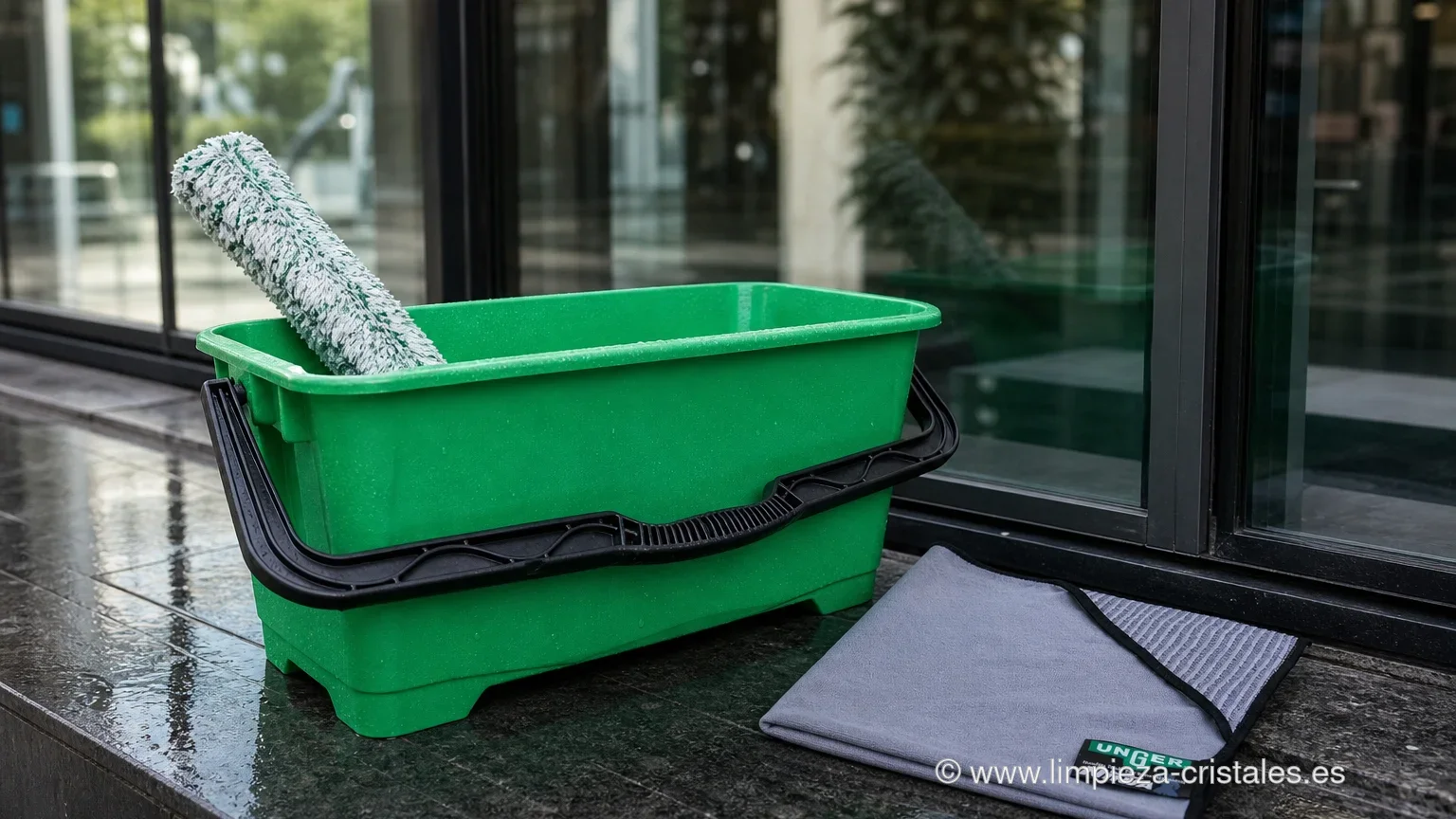
An initial kit for regular use should include a window squeegee with a quality channel and rubber, a washer with a washable sleeve, a practical bucket, a scraper with compatible blades, finishing cloths and a cover or bag for transporting the equipment. There is no need to start with every available channel size. It is more effective to choose a standard width for daily work and add a smaller size for narrow panes, interior frames or areas where manoeuvrability is limited.
Best kits for self-employed professionals according to the type of service
There is no single kit that is suitable for every professional. The right choice depends on where you work, how many square metres of glass you clean and whether access can be managed from the ground or requires reach systems.
Kit for shop windows, retail premises and interior glass
For routes covering shops, offices and small maintenance jobs, speed is the priority. Work is carried out at low height, you need to enter and leave discreetly and cloths, washer and window squeegee are normally used continuously in rotation. A compact, easy-to-transport setup with manual tools is ideal here, allowing good control over corners, edges and frames.
A professional bucket, a comfortable washer support, an absorbent sleeve and a well-balanced window squeegee usually provide more productivity than adding accessories that are rarely used. It is also useful to carry a replacement rubber already cut to size. When the rubber loses its sharp edge or develops cuts, the finish starts to show lines and touch-up time increases immediately.
The scraper should be included, but it should not be the main tool. It is used to remove stickers, paint and other stuck-on residues, always checking the type of glass beforehand and working with a blade in good condition. In routine maintenance work, excessive use of the scraper often indicates that the washing procedure or surface preparation is not appropriate.
Kit for communal buildings and periodic maintenance
Communal buildings, entrance halls and office blocks require continuity. There may be interior panes, partitions, glazed entrances and exterior panes at low or medium height. A self-employed professional needs a versatile set-up that does not require returning to the vehicle every time the situation changes.
In this case, it is worth combining manual equipment with a telescopic pole compatible with the necessary accessories. The pole can extend the working range from the ground at specific points, but it does not automatically replace manual technique. For a nearby interior pane, a window squeegee used by hand will still be faster and more precise.
Ergonomics matter greatly when carrying out many services in one day. Handles with a good grip, well-balanced components and an organised transport system reduce fatigue and wasted time. A well-organised kit also conveys professionalism to the customer: the operator can find each replacement part without spending several minutes searching among loose tools.
Kit for exterior work at height with a pole
When the volume and height of exterior glass increase, the main criterion is no longer compactness but safe reach. A telescopic pole should be selected according to the actual working height, not the maximum length advertised. The further it is extended, the more important rigidity, weight and control at the tip become.
For work with traditional tools, a combination of pole, compatible adapter, washer and window squeegee can handle certain panes from the ground. However, the professional must assess the surroundings, the angle of the glass, the available manoeuvring space, wind and safety conditions before deciding on the method. Greater reach does not always mean greater productivity if tool control is lost.
For repetitive exterior cleaning of façades, high-level panels or large surfaces, a pure water system for professional window cleaning may be suitable. This method requires a different setup: a water-fed pole, brush, hose and water-treatment equipment adapted to the intended use. It is not something to add impulsively to a basic kit. It makes sense when the volume of work and type of surface justify changing the system.
Kit for self-employed professionals just starting out
People starting out often make one of two opposite mistakes: buying a very basic kit that soon proves insufficient, or investing from day one in tools for services they have not yet secured. The most rational option is to start with professional manual equipment and expand it according to the jobs that become regular.
Before buying, it is worth answering four practical questions:
- Will most of the work involve shop windows, interior glass or exterior windows?
- What heights can normally be handled from the ground?
- How many hours of use will the tools have each week?
- Which consumables will need replacing most frequently: rubbers, sleeves, blades or cloths?
The answers provide better guidance than any pre-assembled kit. A self-employed professional focused on retail premises needs speed and replacement parts; someone working on communal buildings will probably benefit from the versatility of a pole; and anyone who regularly works outdoors should assess whether a pure water system would improve operational efficiency.
How to compare kits without paying for unnecessary accessories
The initial price matters, but it should not be the only factor. A professional kit delivers value when it maintains performance after many working days and can be maintained with replacement parts. A replaceable rubber, a washable washer sleeve or an easy-to-replace blade prevents the entire tool from being discarded through normal wear.
Compatibility should also be checked. A set of components from the same product family simplifies day-to-day work: assembly is familiar, the number of adapters is reduced and it is easier to expand the equipment. By contrast, mixing tools without checking measurements, fittings and replacement parts can cause looseness, duplicate purchases or downtime when a component needs replacing.
The choice between a pre-assembled kit and one configured from individual components depends on the situation. A pre-assembled kit can speed up the purchase if its components match the intended service. A bespoke configuration is preferable when there are specific requirements for height, glass widths, transport or workload. For a professional, paying for accessories that never leave the vehicle is not saving money: it is tying up the budget.
The value of replacement parts and technical advice
Window-cleaning tools undergo genuine wear. Rubbers become fatigued, sleeves lose their absorbency and blades need replacing to maintain safe, precise work. Planning ahead when buying means including the consumables needed from the outset to continue operating without interruptions.
At Limpieza Cristales Unger, knowledge of the product ranges and Unger authorised service centre status in Spain help to create coherent configurations, resolve compatibility queries and find replacement parts to keep every system operational. This support is particularly important when the kit includes poles, reach accessories or pure water solutions, where an incorrect decision affects the entire operation.
The best kit is not the one with the most components, but the one that enables you to complete the service with control, pace and a consistent finish. Start with the work you already carry out, choose compatible tools and leave room to expand the equipment when your contracts justify it. In this way, every purchase becomes real working capacity rather than stored equipment.