



Date de publication : 16/10/2026
Safety equipment for window cleaning: choose the right tools, water-fed poles and procedures to work with genuine professional control and efficiency
An exterior pane of glass several metres above the ground does not become a safe job simply because the operator is wearing gloves. Safety equipment for window cleaning works as a system: suitable access, compatible tools, personal protection, pre-use checks and a working method that prevents the professional from being exposed to unnecessary risk. When one of these elements fails, performance is no longer the priority.
In professional cleaning, safety also affects productivity. Poorly configured equipment forces operators to repeat movements, work from awkward positions or improvise when reaching. By contrast, a well-chosen technical solution allows more surface area to be cleaned from a stable position, reduces movement and maintains control of the tool.
The initial assessment determines which equipment is needed
Before preparing the bucket, washer or window squeegee, it is worth assessing the glazing. Cleaning a shopfront at street level is not the same as working on a glazed façade, a roof, an internal courtyard or a building with changes in level. Height matters, but it is not the only factor: access, the strength and gradient of the ground, the proximity of pedestrians, wind, the condition of the frames and the presence of power lines or other obstacles must also be assessed.
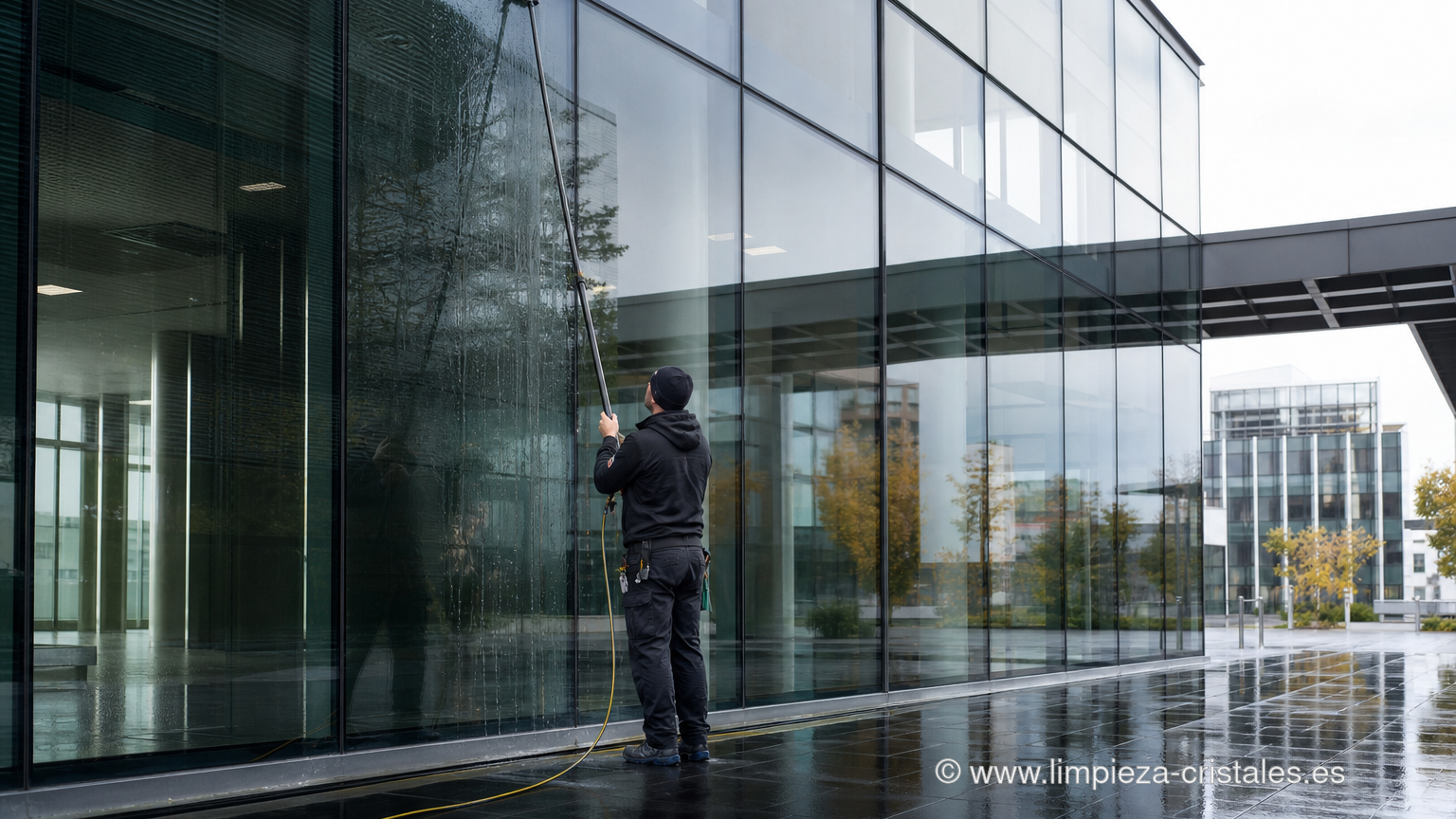
The first decision should be whether the work can be carried out from the ground. If the building’s geometry and the level of soiling allow it, a professional pole with a pure water system avoids having to climb ladders, platforms or exposed areas. This does not replace the operator’s judgement: an excessively long or poorly balanced pole, or one used near an electrical installation, creates other risks. However, when used within its limits, it clearly reduces the need to work at height.
When ground-level access is not viable, the appropriate access method must be defined. A ladder, mobile elevating work platform, scaffold or work-positioning system are not interchangeable options. The choice depends on the task, the exposure time, the stability of the surroundings and the preventive measures planned by the company. A ladder should never be chosen simply because it is quicker to transport.
Safety equipment for window cleaning
Personal protective equipment is the last line of defence, not the first. It must complement proper planning and be suitable for the actual risk. Using protective equipment without resolving unsafe access creates a false sense of control.
For routine glass-cleaning operations, safety footwear with slip-resistant soles is an essential starting point. It should provide grip on wet surfaces without restricting movement. Gloves, meanwhile, should protect against cuts caused by edges, profiles or accidental breakage, while retaining sufficient sensitivity to hold a window squeegee, washer or pole firmly.
Eye protection is necessary where there is a risk of splashing during the preparation or application of products, as well as during work where particles may become detached. The choice of chemical product must comply with its safety data sheet and the manufacturer’s instructions. Preparing more solution than necessary, mixing products without proper justification or decanting them into unlabelled containers introduces risks without offering any operational advantage.
For work at height, the harness, lanyard, connectors and fall-arrest device must form part of a complete system that is inspected and used by trained personnel. It is not enough simply to have a harness in the vehicle. The anchor point, the available clearance in the event of a fall, the pendulum effect and the rescue plan are all part of the same decision. If a safe configuration does not exist, the work must be reassessed.
It is also advisable to wear a helmet when the surroundings present a risk of impact or falling objects. On façades, in internal courtyards and in shared areas, protecting third parties is equally important. Cordon off the work area and avoid leaving tools resting on edges, railings or sills to reduce foreseeable incidents.
The right tool prevents unsafe postures and manoeuvres
Many incidents begin with a tool chosen solely because of its price or because its dimensions are inadequate. A pole must provide reach, rigidity and control. If it flexes excessively, the professional compensates by applying force, keeps their shoulders raised for too long and loses precision when making contact with the glass. If it is too heavy for the intended use, fatigue sets in sooner and the quality of the finish declines.
The length should be calculated with some allowance, but without oversizing the equipment. For low-level glass, a compact pole may complete the job more efficiently. For façades, a telescopic or modular pole designed for pure water systems allows the operator to remain away from the danger area. Compatibility between clamps, brushes, hoses, adaptors and the pole prevents unstable assemblies or improvised solutions.
The same principle applies to hand tools. A window squeegee with a rubber blade in good condition requires fewer passes and less pressure. A clean, correctly fitted washer distributes the solution evenly. A professional scraper should only be used when the glass and the contamination make it suitable, with a blade in good condition and a technique that will not damage the surface. Forcing a worn tool does not save money: it increases working time and may compromise the result.
Unger systems are designed to create compatible configurations combining hand tools, poles and accessories. For a cleaning company, this continuity simplifies replenishment and helps different operators follow a consistent method. Access to technical advice and spare parts in stock is particularly useful when the equipment forms part of a daily routine rather than being used occasionally.
Pure water reduces risks, but it requires a procedure
Cleaning with pure water systems makes it possible to work from the ground on exterior surfaces, using dedicated brushes and poles. Its main preventive advantage is reducing exposure associated with access at height. However, the ground may become wet, so run-off must be controlled, pedestrian routes signposted and hoses kept from crossing circulation areas without protection.
Hose management requires attention. Hoses should be uncoiled while avoiding loops, crossings and snags, and kept away from vehicles, doors, stairs and walkways. The operator needs to work from a position that allows them to move forward without walking backwards blindly. In areas with public traffic, a second professional may be needed to control the perimeter and assist with the operation.
Brief checks before every job
A few minutes of inspection prevents work from being carried out with defects that are often detected too late. This does not need to become a bureaucratic formality: it should be a genuine check, recorded in accordance with the company’s procedure. Before leaving for the job, check at least the following points:
- The condition of the pole, locks, clamps, brush and hose connections.
- Wear on rubber blades, washer sleeves, blades and handles of hand tools.
- The soles of the footwear, the integrity of the gloves and the cleanliness of the protective eyewear.
- The labelling, closure and condition of cleaning-product containers.
- Weather conditions, especially wind, rain, storms or temperatures that may affect the surface.
- The cordoned-off area and the absence of people beneath the work surface.
Checks should continue throughout the job. If the wind changes, a leak appears, a pole stops locking correctly or the ground loses grip, stopping is a professional decision. Pressure to finish a route or meet a schedule does not justify continuing in conditions that differ from those anticipated.
Training, organisation and technical support
Experience in window cleaning does not remove the need for training. In fact, experienced operators often recognise sooner when a task has stopped being routine. The company should establish procedures for work with poles, access at height, handling products, signage and equipment checks, and update these guidelines whenever methods or tools change.
The organisation of the trolley and vehicle also matters. Transporting an unprotected window squeegee, an exposed blade or an unsecured pole can cause damage before reaching the customer. Separating clean tools from used ones, securing long components and keeping spare parts clearly identified makes departure quicker and prevents assembly errors.
As an Unger service centre in Spain, Limpieza Cristales Unger can advise on the choice of tools, accessories and spare parts for specific professional configurations. This advice is particularly valuable when expanding a pole system, replacing components or adapting equipment to a new type of service.
Well-planned safety does not add complexity to the job: it eliminates improvisation. Before starting the next glazing job, it is worth asking a simple question: can I achieve the required finish from a stable position using equipment designed for the task? If the answer is no, the next step is not to begin, but to adjust the solution.