




Date de publication : 14/10/2026
Compare traditional window cleaning with purified water systems for performance, cost, reach and choosing the right professional streak-free glass cleaning method.
A shopfront at street level, a three-storey glazed façade and the internal windows of an office cannot all be cleaned using the same system. Traditional cleaning versus purified water is not a choice between an old method and a modern one: it is an operational decision that affects the time required per service, access, operator safety and the final finish.
For a cleaning company or self-employed professional, the aim is not to replace one technique with another without careful consideration. It is to know when a window squeegee provides maximum speed and when a pure water system makes it possible to work from the ground with a pole, without having to dry the glass afterwards. The most cost-effective solution is usually to combine both methods.
Traditional cleaning versus purified water: the real difference
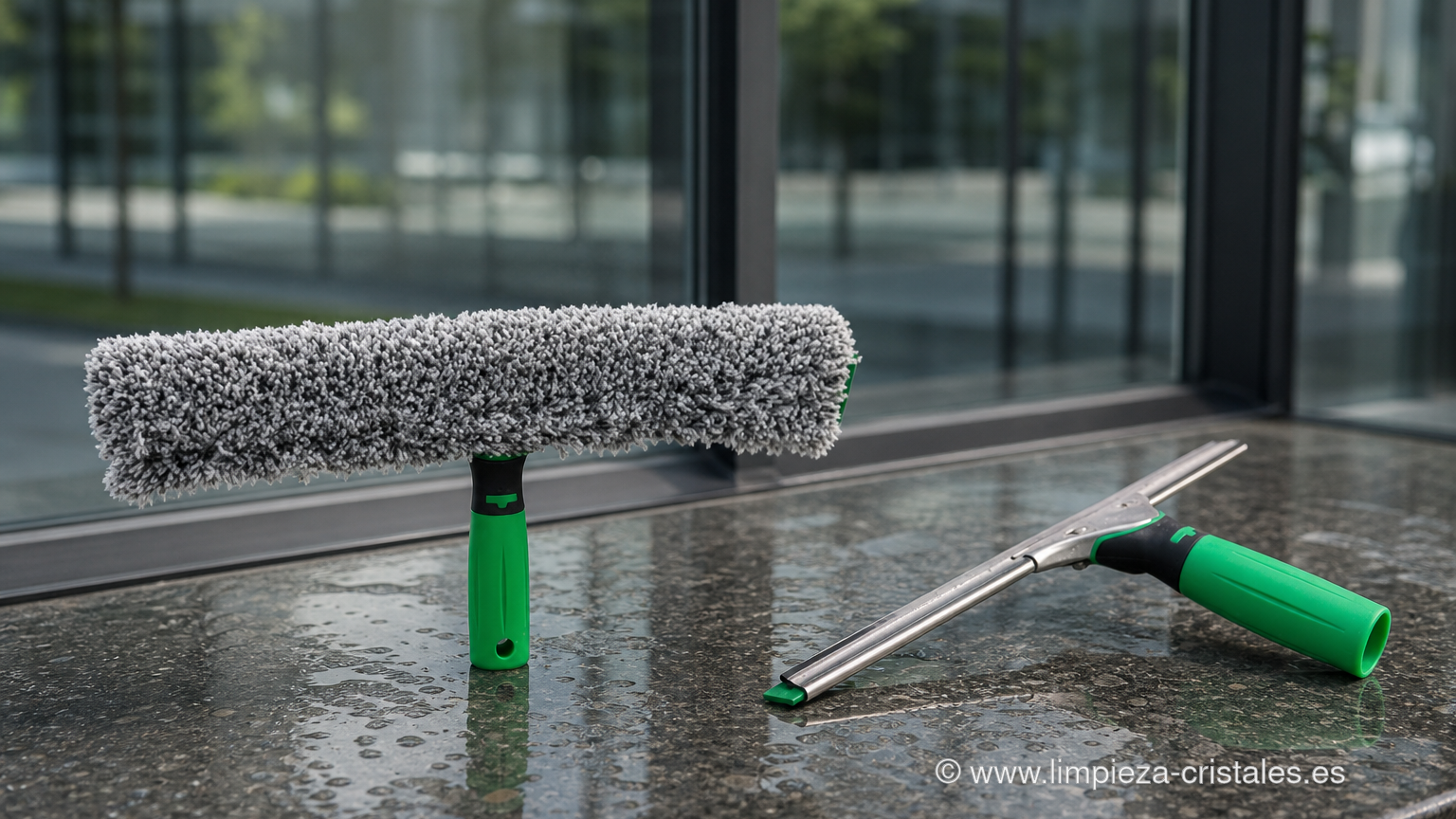
Traditional window cleaning involves applying a cleaning solution with a washer and removing the water with a window squeegee. The result depends on technique: even pressure, a squeegee rubber blade in good condition, the correct angle and careful work around the edges. It is a direct, controlled-contact process that is particularly effective for interiors, accessible windows and localised dirt.
Cleaning with purified water uses treated water to reduce dissolved minerals which, when the water evaporates, can leave deposits or marks. Applied through a pure water system, hose, brush and pole, it allows the glass to be scrubbed and rinsed without having to dry it with a squeegee. When the water maintains an appropriate purity level and the rinsing is sufficient, the glass dries evenly.
The main difference is not simply the type of water. It completely changes the way the job is approached. With the traditional method, the operator works close to the glass; with purified water, external surfaces can often be cleaned from a distance while keeping both feet on the ground.
When traditional cleaning is the right choice
The washer-and-squeegee technique remains essential for professional services. On internal windows, partitions, small shopfronts, office divisions and surfaces where an immediate finish is required, it offers a level of precision that is difficult to match.
It is also the most logical option when dealing with ingrained grease, repeated fingerprints, adhesive residue or highly localised dirt. The professional can select the appropriate tool, work on the specific area and check the result immediately. The quality of the rubber blade, the squeegee channel and the handle ergonomics have a direct impact on speed and fatigue during a long working day.
Traditional cleaning has another practical advantage: it requires little preparation for quick jobs. In a shop with accessible windows, preparing a bucket, washer, window squeegee, chamois or detailing cloth may be quicker than setting up a pole and pure water supply system.
However, it becomes less efficient as height, external surface area or access complexity increases. Working from a ladder takes more time, increases exposure to risk and requires the equipment to be repositioned continuously. In these situations, insisting on a manual method does not always mean maintaining a professional standard: it may mean reducing productivity.
The limitation of the manual method is not the finish
A professional with good technique can achieve an excellent finish using traditional cleaning. The limitation lies in the relationship between working time, accessibility and safety. A façade with many panes of glass may require numerous passes, movements and changes of position if it is cleaned exclusively with a squeegee.
For this reason, traditional cleaning should be understood as a precision tool. It is not an inferior system, but the right method when direct control adds genuine value.
What purified water offers for exterior cleaning
A purified water system is designed for regular exterior work, difficult-to-reach surfaces and pole cleaning. The brush agitates the dirt and the treated water carries it away during rinsing. As it contains far fewer minerals than ordinary water, it reduces the risk of residue being left behind as the glass dries.
This process is particularly useful for windows at moderate height, glazed façades, glazed enclosures, accessible rooflights and periodic maintenance work. The operator can reach a larger area without repeatedly moving access equipment up and down for each pane, improving the continuity of the job.
Productivity does not depend solely on reaching higher. It depends on avoiding interruptions to the process. A correctly configured pole, with the brush, hose and water flow suitably adapted, avoids unnecessary movement and makes it possible to maintain an orderly sequence: wet, brush, rinse and move on to the next pane.
However, purified water cannot compensate for poor technique. If the frames are heavily contaminated, if the brush does not reach the corners or if rinsing is insufficient, dirt can be moved across the glass. During first cleans or on glass exposed to persistent contamination, more intensive preliminary work may be necessary and, in certain areas, manual support may be required.
Water quality and equipment maintenance
A pure water system must be maintained as a complete setup, not treated as merely a pole with water. Performance depends on the condition of the filtration system, connections, hose and brush, as well as the purity reading that indicates when treatment components should be checked or replaced.
The professional must also consider workload, incoming water quality and frequency of use. An oversized system increases the investment without delivering a proportional improvement; an undersized one can limit autonomy and slow down the service. Taking technical advice when choosing the equipment helps prevent configuring a system that does not meet the demands of actual work routes.
Cost, time and safety: how to compare both systems
Comparing only the initial price leads to an incomplete decision. Traditional cleaning usually requires a lower investment in basic equipment, with straightforward replacement parts and a learning curve focused on hand technique. Purified water involves a treatment system, pole, brush and filtration consumables, so the initial outlay is higher.
In return, for repetitive external work, the investment can pay for itself through less time per square metre, fewer access manoeuvres and a greater ability to handle contracts involving extensive surfaces. There is no universal payback figure: it depends on the number of services, height, layout of the windows, travel and labour costs.
Safety should carry as much weight as speed. Whenever the work can be completed correctly from the ground using a pure water pole, the need to use access equipment for particular panes is reduced. This does not remove the need for a risk assessment or replace the required safety procedures, but it can simplify operations during routine maintenance.
For interiors or areas where water could affect flooring, furniture or people passing through, traditional cleaning retains a clear advantage. Control over moisture and run-off is much greater. Outdoors, by contrast, purified water systems gain ground through their reach and continuity.
The combination that works best on a professional route
The most efficient companies do not choose a single method out of habit. They prepare for the service using both. The window squeegee handles interiors, finishing work, shopfronts and areas requiring immediate control. The pure water system is used for exteriors, height and large surfaces where the pole reduces unproductive time.
This combination also requires a long-term approach to purchasing. Rubber blades, channels, washers, brushes, clamps, hoses and connectors are wear parts or items subject to intensive use. Working with compatible tools and keeping replacement parts available prevents a minor fault from interrupting a billable working day.
At Limpieza Cristales Unger, as Unger’s authorised service centre in Spain, the value lies not only in choosing a particular tool, but in defining a coherent setup for the type of service: pole length, interior or exterior use, cleaning frequency, replacement-part requirements and system maintenance.
Before replacing the equipment, it is worth reviewing which services consume the most hours and why. If the problem lies with edges and detailing, the improvement will probably come from traditional technique and a better-configured window squeegee. If the problem is reaching and safely maintaining exterior façades, purified water may transform the profitability of each service.