



Date de publication : 12/10/2026
Safety guide for high-level window cleaning: criteria for planning access, choosing equipment and reducing risks when cleaning windows, façades and hard-to-reach surfaces with a pole.
A poorly planned exterior window does not become a safe job simply by adding a pole or harness. The high-level window cleaning safety guide starts before the equipment is taken out of the vehicle: you must decide whether access is viable, which system minimises exposure to risk and which conditions mean the service should be postponed. In professional cleaning, productivity only matters if the operator can repeat the process under control.
Safety guide for high-level window cleaning: access defines the method
High-level window cleaning covers many different types of work: tall shopfronts, large internal glazed screens, glazed façades, courtyards, rooflights and exterior surfaces that are difficult to approach. A common mistake is to treat them all as if they required the same solution. They do not. The distance from the glass, changes in level, available anchorage points, presence of pedestrians and condition of the surface completely change the approach.
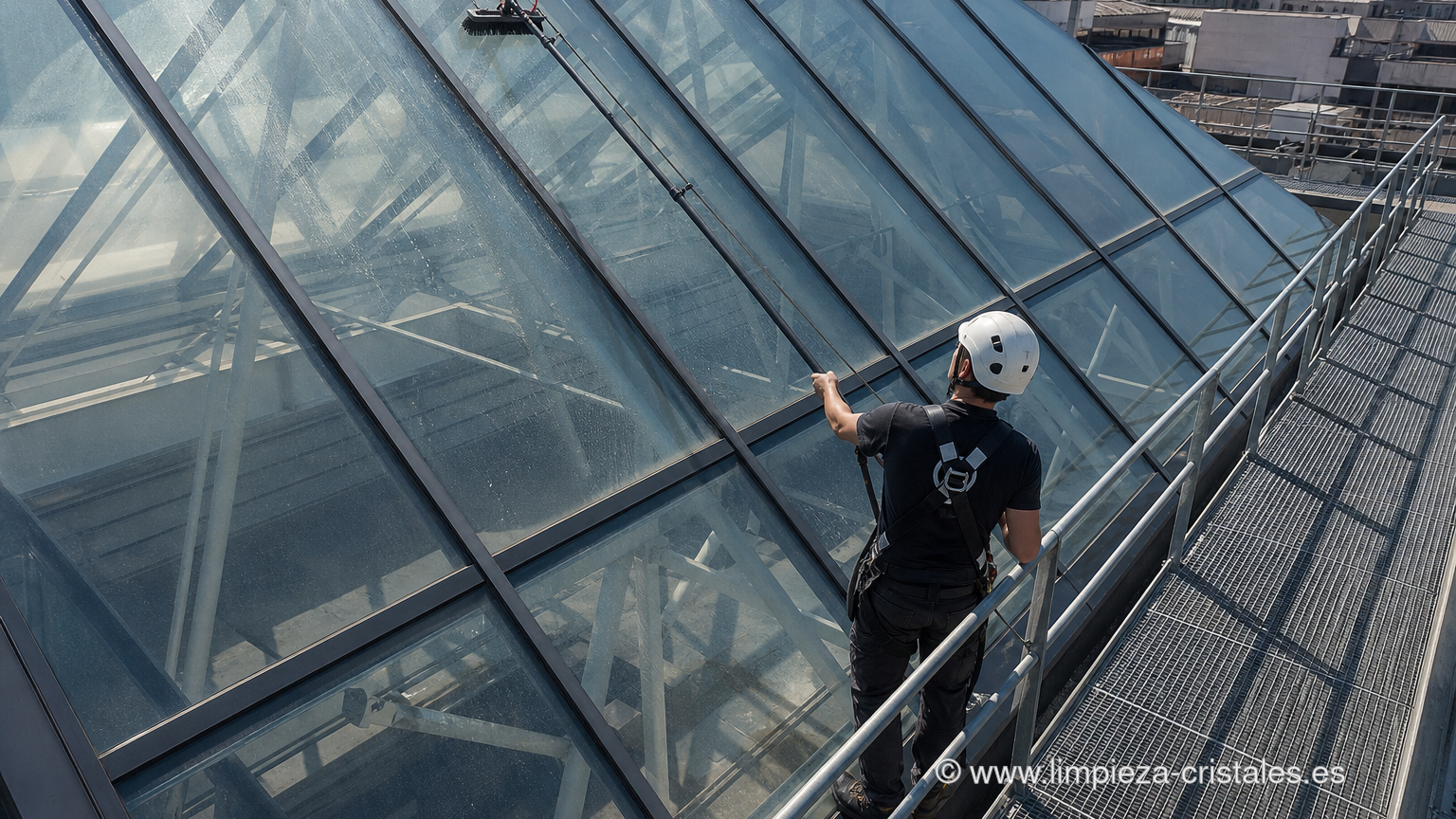
The first option should always be the one that reduces the operator’s exposure. In many cases, a correctly configured telescopic pole makes it possible to work from a safe level and avoids access to elevated areas. When height, geometry or reach make this impossible, it may be necessary to use a platform, an access lift or rope-access techniques. Each alternative requires specific training, equipment and procedures; they are not interchangeable.
Before accepting the job, it is advisable to carry out a visual inspection and record the basic details: approximate height, type of paving, proximity to walkways, obstacles, overhead power lines, condition of the frames and the possibility of falling objects. If the environment does not allow these risks to be controlled, the professional decision is not to improvise: change the method or reschedule the work.
Pre-work assessment: what must be resolved
An effective assessment does not need to become bureaucracy, but it must answer specific questions. Where will the work be carried out from? What could go wrong? Who, apart from the operator, could be exposed? How will the task be stopped if conditions change?
Access to the work area must be defined before starting. A ladder, for example, may have limited use for a brief, low-complexity operation, but it is not a substitute for a work-at-height system when it requires lateral force, prolonged work or the handling of long poles. Resting a ladder against glass, weak frames or unstable surfaces is a practice that must be ruled out.
The area below must also be assessed. A bucket, hand tool or accessory falling from height can injure third parties even when the operator remains protected. The work area must be signposted and, where appropriate, cordoned off. On façades with passing traffic, access control is not merely an operational detail: it is part of the preventive measure.
The weather requires clear criteria. Wind, rain, electrical storms, poor visibility or icy surfaces reduce control of the equipment and increase the risk of slipping or of the load moving unexpectedly. There is no universal figure that authorises every type of work: the limit depends on the system used, the façade’s exposure and the equipment instructions. If the operator cannot maintain a stable position and controlled handling, the task must be suspended.
Protective equipment: compatibility and proper inspection
For work involving a fall risk, personal protective equipment must form part of a complete system, not a collection of items selected separately. The harness, lanyard, connectors, fall-arrest device, helmet and anchorage must be compatible with the access method and used according to their instructions. A correctly adjusted harness does not compensate for inadequate anchorage or a poorly installed lifeline.
The pre-use inspection must be visual and functional. Check webbing, stitching, buckles, connectors, deformation, cuts, corrosion, labels and inspection dates established by the manufacturer or the company’s prevention plan. Any equipment that has been involved in a fall, shows signs of damage or raises concerns must be withdrawn from use until it has been inspected by a competent person.
A helmet protects against impacts and falling small objects, but it must be selected and adjusted for the type of activity. In rope access or on a platform, proper retention is essential. Gloves, non-slip footwear and clothing that will not snag complete the protection, although excessively thick gloves should be avoided because they reduce the feel needed to handle connectors, handles or tools.
The company must provide practical training, authorisation for the task and a rescue plan proportionate to the risk. Leaving a worker suspended after a fall while waiting for help is not an acceptable solution. Rescue must be capable of being initiated quickly and carried out by trained personnel. This is what distinguishes serious planning from merely apparent compliance.
Tools for working without losing control
The choice of tools directly affects posture, reach and fatigue. For ground-based cleaning, a professional telescopic pole must provide the necessary reach without becoming a lever that is difficult to control. The greater the length, the greater the physical demands and the lower the precision. That is why buying the longest pole is not always advisable: the correct length is the one that covers the usual work with sufficient margin and suitable rigidity.
For traditional cleaning, a squeegee, washer, bucket and the correct replacement parts must be secured and organised to avoid unnecessary movement. Hand tools must not be left on ledges, frames or cornices. When working with rope access, tool-tethering systems compatible with the procedure must be used, without interfering with the working lines.
Scrapers require particular care. Their purpose is to remove bonded dirt, not to replace an improvised blade or to be used on a surface whose behaviour is unknown. Before using one, check the type of glass, any films or coatings, treatments and the presence of particles that could cause scratches. A quick clean that damages the glazing creates a greater cost than the time apparently saved.
Pure water systems for professional window cleaning reduce the need to work with detergent in certain applications and make it possible to clean with a pole from the ground. However, they do not solve poor access on their own. Reach, hose weight, routing, obstacles and operator stability must all be assessed. A poorly managed hose can become a trip hazard or snag during the work.
A safe and efficient work sequence
Once the method has been defined, it is advisable to follow a consistent sequence. First, cordon off the area and check the conditions. Then inspect the protective equipment, tools and work positions. Only after that should cleaning begin, avoiding changes of position that require stretching, twisting the torso or working with the arms above shoulder height for too long.
Fatigue is a real operational risk, particularly when using long poles. Alternating tasks, adjusting the working height, taking short breaks and reviewing technique help prevent a forced posture from becoming a loss of control. If the surface cannot be completed from a stable position, reposition yourself or use another access method.
At the end, simply packing up is not enough. Signage should be removed once the risk no longer exists, tools should be inspected before being stored and any incident must be reported. An orderly close-down helps identify wear, replacement parts needed and problems that should not be repeated on the next service.
Buying equipment with professional judgement
Safety improves when tools are selected as a system: reach, weight, ergonomics, replacement-part compatibility and frequency of use all matter. An inexpensive kit without ongoing parts availability can bring a service to a halt because of a worn rubber, fitting or connector. For recurrent work, having spare parts and technical support offers clear operational value.
Limpieza Cristales Unger, as an Unger service centre in Spain, can advise on the selection of poles, hand tools and professional cleaning systems according to the height, type of glass and intended working method. This advice should complement, never replace, the preventive assessment and training required for each access method.
The best decision is not the one that allows you to reach higher at any cost, but the one that enables you to clean using a stable, repeatable method suited to the actual risk presented by each façade.