



Date de publication : 11/10/2026
Facade safety depends on sound planning, compatible equipment and the right decisions to reduce risks during high-level external window cleaning.
A glazed facade leaves no room for improvisation. A seemingly minor decision—working from an unstable support point, extending a pole without checking its condition or poorly cordoning off the area below—can turn routine cleaning into a serious incident. Facade safety starts before the equipment is assembled: it requires an assessment of access, the surroundings, the surface and the most suitable cleaning system for each building.
For a cleaning or maintenance company, the aim is not simply to complete the work without leaving marks. It is also to repeat the job productively, without exposing the operator, third parties or the equipment itself to unnecessary wear. This distinction separates a professional operation from a one-off solution.
Facade safety: plan the work from ground level
The first check should be carried out before cleaning begins. Consider the height, the geometry of the facade, any changes in level, balconies, canopies, cables, loading and unloading areas, customer entrances and pedestrian traffic. The type of glass and framing also matters: cleaning a shopfront at street level is not the same as cleaning a continuous facade with elevated panes, louvres, sensitive joints or hard-to-reach areas.
The choice of access method depends on this assessment. For some jobs, a professional pole allows work from ground level and removes the need to climb. In other cases, the height, lateral reach or obstacles make it necessary to use access platforms, scaffolding or other systems specified in the company’s safety plan. There is no single valid solution: trying to handle every job with the same equipment is often a source of risk and wasted time.
The condition of the ground affects everything else. Wet paving, slopes, loose gravel or unstable covers can compromise the operator’s position and any auxiliary equipment. If access does not provide a secure base, the procedure should be reassessed before work starts, not during cleaning.
Cordoning off the area protects people as well as equipment
In external cleaning, the risk is not only above. It is also below the work area. A window-cleaning squeegee, an adapter, a rubber blade, a bottle or a tool falling from height can cause damage even if the object is light. For this reason, the cordoned-off area must be appropriate to the height, the type of task and the actual flow of people.
It is not enough to place a sign wherever it is convenient. Identify alternative entrances, coordinate with reception, concierge staff or maintenance managers where applicable, and prevent pedestrians from entering the area from an uncontrolled side. In premises open to the public, this coordination has clear operational value: it reduces interruptions and allows work to proceed at a safer pace.
The movement of water and dirt must also be anticipated. When cleaning with a water-fed pole and pure water system, dripping can affect walkways, polished paving or entrances. The answer is not to speed up the work, but to control the area, dry it where necessary and organise the cleaning route so that the operator is not exposed to slips.
Poles: useful reach, rigidity and genuine control
Telescopic poles are among the most effective tools for improving facade safety when they allow work from ground level. However, the advertised reach should not be confused with the operational reach. As length increases, so do flex, physical effort and the difficulty of keeping the brush or tool correctly in contact with the glass.
A pole that is too heavy or insufficiently rigid forces the operator to compensate with awkward postures, sudden movements and longer exposure times. For regular work, the material, rigidity and ergonomics have a direct impact on safety and productivity. The professional must be able to control the head without losing precision, particularly around edges, glass junctions and areas close to public roads.
Before each use, check the locks, clamps, sections, hoses and connections. A leak or incorrectly adjusted lock not only reduces performance; it can also catch the operator by surprise during a manoeuvre. The pole should be extended progressively, staying within the reach that genuinely allows a stable posture without entering hazardous areas.
Pure water for technical window cleaning
Pure water systems allow external windows to be cleaned with a brush and pole, reducing the need to physically access certain heights. Their main preventive benefit is clear: when the work can be carried out from ground level, exposure associated with ladders and elevated positions is reduced.
However, the system must be configured correctly. The hose should run without creating trip hazards, connections must be in good condition and the flow rate should be adjusted to the task to prevent unnecessary pooling. The filtration equipment, pole, brush and adapters must work together as a compatible set. Mixing components without proper consideration can cause leaks, looseness or poor handling.
Technique also matters. Working methodically from the top, with sufficient rinsing and control of the edges, improves the finish and avoids going over the same pane several times. Fewer repetitions mean less fatigue and less time with the area cordoned off.
When a pole is not the right option
Not every facade should be cleaned with a pole. Some buildings have recesses, projecting elements, heavily sheltered panes, obstacles below or ingrained dirt that require a different access method and technique. Forcing the reach from ground level can cause the operator to lose control of the tool or adopt an unsuitable body position.
Manual tools may also be necessary indoors, on shopfronts or in detailed areas. In these cases, a window-cleaning squeegee with a blade in good condition, a suitable washer and an ergonomic handle provide better control of the movement and reduce the number of passes. A worn blade requires more effort, leaves marks and increases strain without improving quality.
Ladders require particularly careful assessment. They should not be used as an automatic response to any height. The support surface, stability, presence of doors, traffic and the need to work with both hands are factors that may make their use unsuitable. If the task requires lateral reach, sustained force or complex handling, a method offering greater control should be chosen.
Personal protective equipment does not replace the procedure
Personal protective equipment is part of the working system, but it cannot correct poor planning. Footwear with suitable grip, gloves compatible with tool handling and protection against environmental conditions all help reduce risks, provided they are selected for the task and kept in good condition.
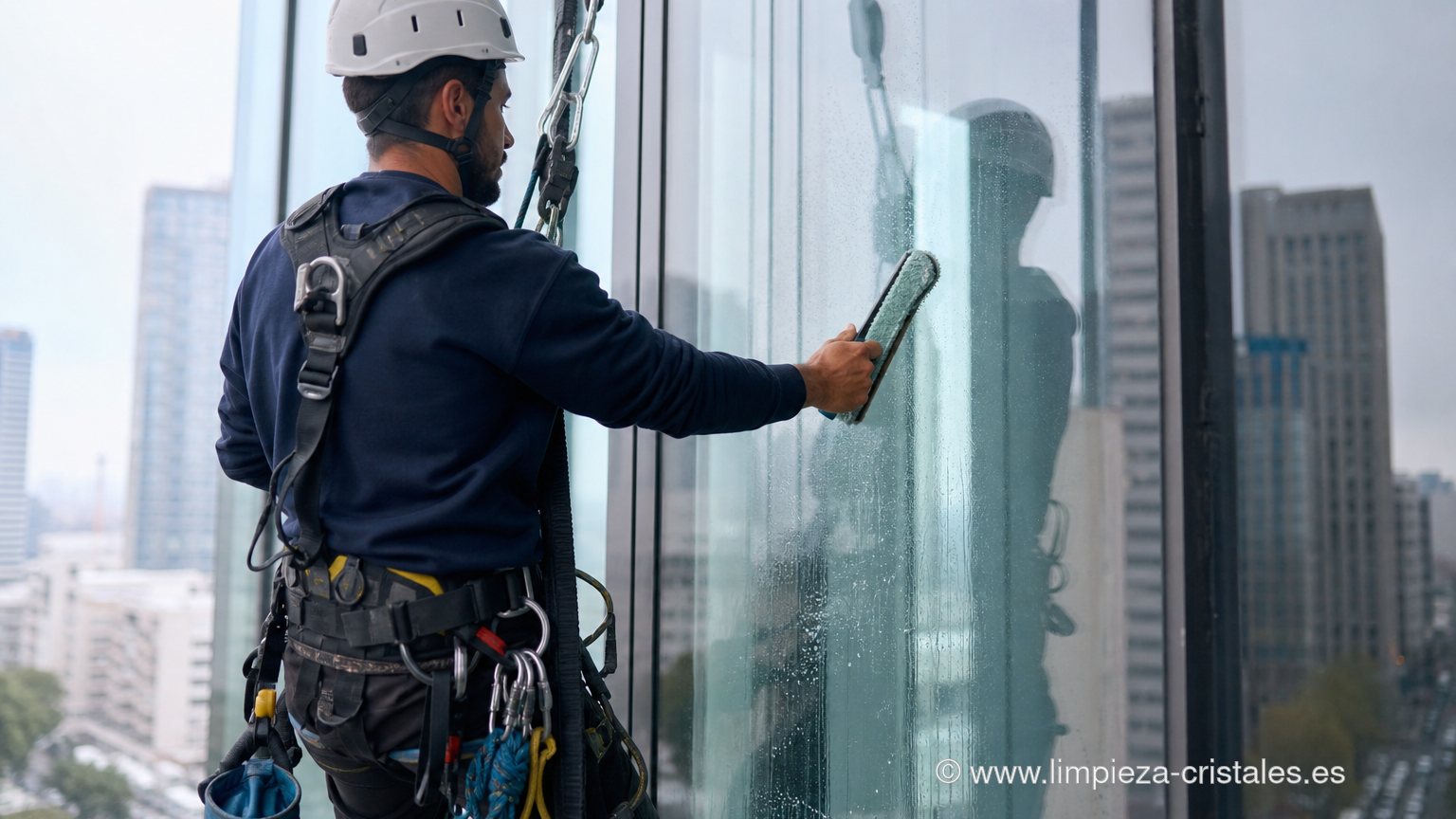
Where there is a risk of falling, the company must apply the relevant safety procedure and use the systems specified for that access method. It should not be assumed that a harness alone makes the work safe. The compatibility of the anchor point, connection system, rescue plan and operator training determine whether the system genuinely provides protection.
Weather conditions deserve the same level of attention. Wind, rain, storms, intense heat or wet surfaces change the conditions for maintaining control. Suspending or rescheduling an operation when the environment is no longer safe is not a loss of productivity: it prevents incidents, material damage and repeated work.
Tool maintenance: a cost-effective preventive measure
Safety is also maintained in the warehouse and vehicle. Poles should be transported with suitable protection, brushes should be cleaned to prevent abrasive residue and window-cleaning squeegee blades should be replaced when they lose their working edge. Compatible replacement parts prevent poor adaptations that may fail during an operation.
For equipment used intensively, keeping spare parts available and having access to technical advice reduces downtime and improvised decisions. Limpieza Cristales Unger, as Unger’s SAT service in Spain, can advise on compatibility between poles, replacement parts, pure water systems and accessories, helping to configure equipment suited to the type of facade and frequency of use.
The best decision is usually made before loading the equipment: inspect the building, choose the access method that reduces exposure and prepare tools that the operator can control precisely. When safety is integrated into the cleaning method, the result is more predictable, more professional and much easier to repeat.