




Date de publication : 27/11/2026
A hardened rubber edge, a channel clogged with dirt or a pole that does not lock securely can turn an acceptable job into marked passes, wasted time and greater physical effort. This guide explains how to maintain Unger tools for reliable performance and
A hardened rubber edge, a channel clogged with dirt or a pole that does not lock securely can turn an acceptable job into marked passes, wasted time and greater physical effort. This Unger tool maintenance guide is designed for equipment used regularly on interior glass, shop windows, communal buildings, façades and work at height. Maintaining each item involves more than simply cleaning it at the end of the day: it requires checking the parts involved in movement, locking, pressure and safety.
Proper maintenance extends the life of your tools, but it also protects productivity. A professional should not wait for a window squeegee to fail during a job before replacing a rubber blade or checking a lock. Preventive inspections make it possible to plan replacements, avoid incompatibilities and maintain a consistent finish on all types of glass.
Why maintenance affects the result
In window cleaning, tools work as a system. The rubber blade must sit evenly against the glass; the channel and guide must keep it straight; the handle must allow the angle to be controlled; and, when working with a pole, the fittings must transfer that control without play. Even minor wear at any of these points can be seen in the final result.
The working environment also has an impact. Daily use on shop windows is not as demanding as exterior cleaning in dusty conditions, changing temperatures or at several heights. For this reason, there is no single replacement interval that applies to all equipment. It depends on hours of use, the type of dirt, the operator’s technique and the care taken after each working day.
Unger tool maintenance guide by equipment type
Window squeegees: rubber blade, channel and handle
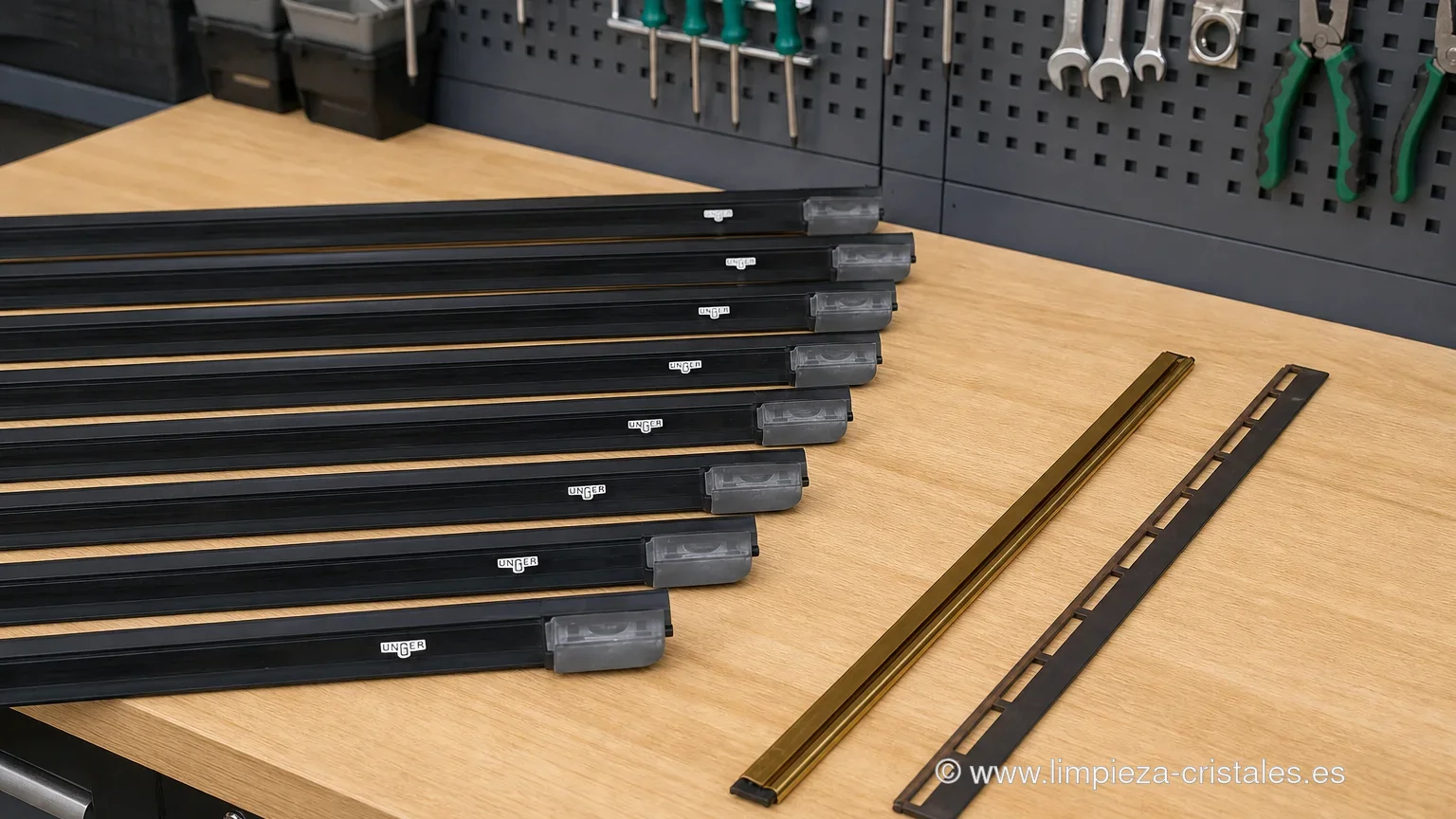
The rubber blade is the main wear component of a window squeegee. Clean it at the end of the job with a clean cloth to remove dirt and moisture. Before storing it, check the working edge: if it has nicks, flattened areas, waviness or reduced flexibility, it will no longer remove water evenly.
Do not wait for repeated marks to appear before turning or replacing the rubber blade. On many models, both edges can be used when one begins to lose precision. However, turning it over will not solve the problem of a contaminated, hardened or deformed blade. For demanding finishing work, the cost of a replacement is far lower than the time lost reworking glass.
The channel or guide must remain straight and free from accumulated residue at its ends. Even a slightly bent channel changes the pressure on the glass and causes water lines. Also check the retaining parts and the handle lock. If the rubber blade moves during the stroke or the channel is not held firmly, identify the affected part before continuing to work.
Avoid storing the window squeegee resting on its rubber blade for prolonged periods. The pressure can deform the edge and shorten its working life. Storing it dry, protected from excessive heat and with no weight on the rubber is a simple measure that has a direct effect on the finish.
Window washers, sleeves and supports
Washer sleeves retain fine dirt, product residue and particles that can be redistributed over the glass if they are not washed regularly. After a demanding day, rinse them and allow them to dry completely before storing them. If they remain damp inside a bucket or closed bag, they lose absorbency and may develop odours or deteriorate prematurely.
Check the attachment between the sleeve and the support. A sleeve that rotates, slips or is not tensioned correctly makes it harder to work around edges and frames. The support should also be checked for deformation or joints with excessive play. When the washer stops distributing liquid evenly, the problem is not always the sleeve: there may also be ingrained dirt or wear on the support itself.
Telescopic poles and work-at-height accessories
Telescopic poles require extra attention because they combine reach, locking levers and accessories subjected to load. Before use, visually inspect the sections, locking systems and connection to the tool. Any crack, deformation or lock that does not hold its position requires immediate checking. Working at height with an unstable pole reduces precision and creates an unnecessary risk.
After exterior use, remove dust, mud and moisture from the sections before collapsing them. Accumulated dirt can hinder movement or affect the adjustment of the locks. Do not force a section that offers resistance: clean the area first and check for residue or visible damage.
Tip accessories such as adapters, joints and fixing cones must fit without excessive play. A loose connection becomes more pronounced as the pole gets longer. Conversely, a connection that is too tight may indicate dirt or an unsuitable combination of parts. Compatibility between systems is essential, especially when configuring equipment for recurring work.
Buckets, supports and transport equipment
Professional buckets withstand working water, knocks and constant contact with tools. Clean the inside at the end of the day to prevent residue from sticking to the bottom or transferring to sleeves and rubber blades during the next job. Check the handles, wheels and tool holders if fitted, because a breakage during transport affects the operator’s organisation.
Transport is also part of maintenance. Storing window squeegees, washers and loose replacement parts inside the bucket encourages rubbing, contamination and deformation. Use an arrangement that allows each part to be located easily, keeps new rubber blades separate from used ones and prevents wet tools from being sealed away for many hours.
Pure water systems: cleaning and operational checks
In pure water systems for professional window cleaning, maintenance affects both the result and service continuity. Equipment may continue pumping water and still not be operating in suitable conditions for a residue-free finish. The condition of the filtration components and the value shown by the relevant meter must therefore be monitored, following the procedure for the system in use.
Hoses should be checked for cuts, persistent kinks or connections that leak water. After work, collect them without sharply bending or pinching them, and protect the connectors from knocks and dirt. Brushes also require attention: bristles loaded with particles can drag dirt across the glass or affect sensitive seals and frames.
Resin, filter and other consumables should be replaced according to the equipment’s actual performance and the instructions applicable to its configuration. Planning replacements in advance prevents unproductive call-outs and costly rework on façades. If the system’s behaviour changes, leaks appear, the flow rate drops or quality control becomes unstable, do not improvise: check the entire connection, pumping and filtration system.
Establish a routine that does not rely on memory
The best routine is brief and repeatable. At the end of each job, clean and dry rubber blades, channels, sleeves and pole sections. Once a week, check locks, joints, supports, handles and tip accessories. For intensively used equipment, carry out a more detailed check of available replacements and wear components before they run out on the road.
Keep a small stock of rubber blades, sleeves, connectors and parts that wear most frequently in your setup. The aim is not to accumulate materials without a plan, but to ensure operational continuity with compatible replacements. For a maintenance company, stopping a job because of a basic part costs far more than planning its replenishment.
If you are unsure about fitting a part, compatibility between accessories or diagnosing a system, specialist advice can prevent incorrect purchases. As an Unger service centre in Spain, Limpieza Cristales Unger can advise on the maintenance, replacement parts and configuration of tools to keep your equipment operational using sound technical criteria.
Well-maintained professional equipment is recognisable before it touches the glass: the rubber blades are ready, the locks respond, the poles work without play and the necessary replacements have already been planned. That preparation is what makes it possible to work efficiently and safely while achieving a finish the customer appreciates.