




Date de publication : 26/11/2026
Newly installed glass can look unusable at first glance because of splashes of mortar, grout or dried cement. Removing cement residue from glass is not a matter of scrubbing harder: it requires identifying the type of residue and protecting
Newly installed glass can look unusable at first glance because of splashes of mortar, grout or dried cement. Removing cement residue from glass is not a matter of scrubbing harder: it requires identifying the type of residue, protecting the glass finish and using tools that will not cause permanent scratches.
For a cleaning company, building contractor or maintenance professional, this type of work often arises during building handovers, shop refits, communal property maintenance and shopfront cleaning. Doing it properly protects the glass, prevents complaints and reduces final touch-up time. Done incorrectly, it can leave micro-scratches visible in backlighting, damage seals or compromise surface treatments.
Before removing cement residue from glass, inspect the surface
The term “cement” covers a wide range of residues. A recent mortar splash does not behave in the same way as a crust that has hardened over several weeks, and grout residue does not respond like a fine mineral stain. The method must reflect these differences.
You must also check what type of glass is being treated. Conventional glass can tolerate certain controlled mechanical processes, but coated glass, screen-printed glass, safety film, limescale protection, solar-control coatings and special finishes require greater care. The external and internal faces of a glazing unit may not have the same chemical or mechanical resistance either.
Before treating the entire surface, test the method in an inconspicuous corner. Check how the residue reacts, whether there are abrasive particles and whether the tool slides smoothly without catching. This takes very little time and can prevent an end-of-build clean from turning into a glass replacement.
The working order that prevents scratches
The professional rule is simple: first soften and remove loose dirt; then deal with the bonded residue. Never run a scraper directly over glass covered with building dust, sand, metal swarf or dried debris. These particles are what usually cause scratches.
Start by removing dust without dragging it across the surface. Next, wet the glass evenly and allow the chosen solution to work for the necessary time. Moisture reduces friction, helps loosen recent deposits and makes it easier to see exactly where the encrustation remains.
When the cement is only lightly bonded, a controlled application of professional cleaner andworking with a washermay be enough to soften it. The final removal should be carried out with a window squeegee fitted with a rubber blade in good condition, using orderly strokes and drying the edges to prevent hazing.
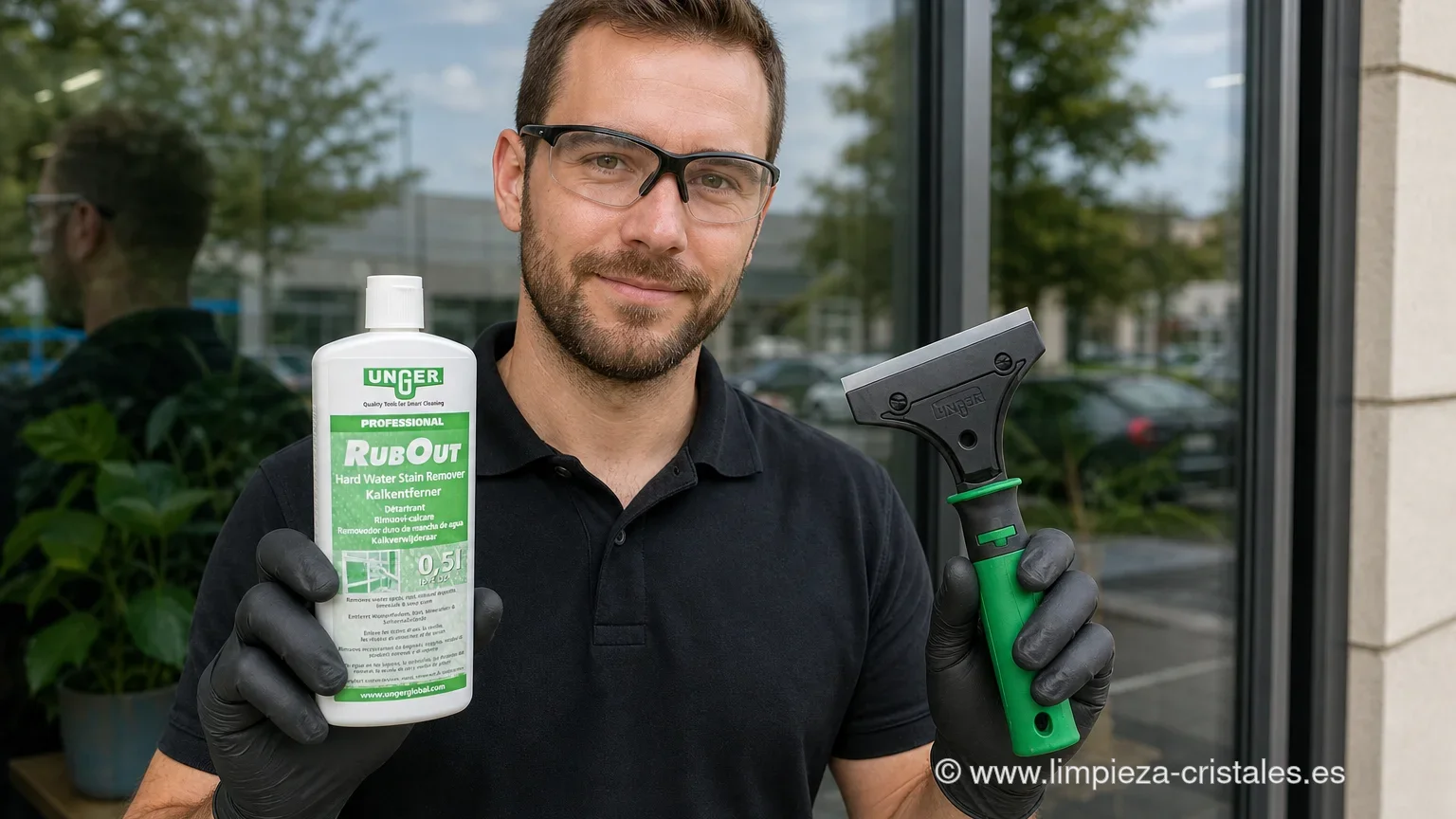
If there are hardened spots, use a scraper rather than a window squeegee. It should have a new, clean blade that is seated perfectly. A damaged edge, a blade with residue stuck to it or an incorrect angle greatly increases the risk of marking the glass.
How to use a scraper on dried cement
Use the scraper with the glass thoroughly lubricated and make short, steady movements without knocks. The aim is not to chip away at the cement or attack the crust from every angle. Rest the blade on the glass and move forward evenly, removing the residue progressively.
Always keep the area wet. If the product dries during the process, apply it again before continuing. An adequate film of moisture helps the blade slide and makes any particle that could become trapped beneath it visible.
Use moderate pressure. If the residue does not come away after several controlled passes, do not automatically apply more force. It is better to soften it again or consider a descaling product that is compatible with the surface. Excessive pressure does not necessarily improve the result and does increase the risk of damage.
Take particular care around aluminium frames, powder-coated profiles, seals, silicone and stone elements close to the glass. A product that is effective on the encrustation may affect adjacent materials if it is left to work without control. Localised application and the immediate removal of splashes are part of the procedure.
When to use a building-residue remover
Specialist cleaners for cement residue may be necessary when the encrustation is extensive, very dry or resistant to mechanical removal. However, they are not a universal solution. The choice depends on the type of residue, the glass, the profiles and the surrounding materials.
Before applying a building-residue remover, check the manufacturer’s compatibility instructions and carry out a test. Some products are acidic and require tightly controlled handling; they are not suitable for every surface. Do not improvise mixtures or use unidentified substances either: during an end-of-build clean, an incorrect reaction can leave stains, discolouration or damage that is difficult to rectify.
Apply the product only to the affected area, respect the recommended dwell time and do not allow it to dry on the glass. Then remove the dissolved residue with plenty of washer and squeegee work, repeating the process if necessary. The final finish must remove every haze, chemical residue and run-off mark.
On façades, large glazed areas or work at height, logistics matter just as much as the product. An application system using a pole can improve reach and productivity, but dosage must be controlled and the liquid must be prevented from reaching sensitive surfaces. When access is difficult, the method must be even more conservative.
Common mistakes when removing cement from glass
The most common mistake is scraping dry. Even if the crust appears isolated, a single mineral particle beneath the blade can leave a visible mark when the light changes. The second mistake is using abrasive scouring pads, aggressive discs or tools intended for other surfaces. A glass surface that looks clean is not worth the cost of scratching it.
It is also common to confuse speed with efficiency. Treating the entire pane with a strong chemical, without a prior test or protection for the frames, can mean spending even longer correcting damage afterwards. True productivity comes from applying the right system from the outset: preparation, safe mechanical removal, localised treatment and a professional finish.
Another critical point is the condition of consumables. A hardened rubber blade leaves water and marks; a used blade can drag contamination across the surface; awasher saturatedwith dirt redistributes residue. For recurring building-cleaning and maintenance work, having compatible replacement parts available is a working requirement, not a minor detail.
Professional tools for a controlled finish
For this type of work, the basic kit should include a quality washer, a window squeegee with a rubber blade suited to the width of the pane, a professional scraper with replacement blades and clean finishing cloths. On large surfaces, choose sizes that reduce the number of passes without sacrificing control; on frames, divided shopfronts or areas with obstructions, a more compact tool is usually more precise.
Ergonomics also matter. A stable handle reduces fatigue and helps maintain a consistent angle while scraping. On external glass or in high-level areas, a telescopic pole compatible withworking accessorieshelps maintain productivity without forcing awkward postures. However, scraping with a pole should only be carried out when visibility, support and control of the tool are sufficient.
Unger tools are designed to integrate into professional window-cleaning setups, with replacement options and compatibility across systems. Advice from an Unger service centre in Spain can help determine which scraper, rubber blade, holder or pole is the best fit for the workload and type of installation.
The final inspection makes the difference
Once the cement has been removed, inspect the glass from different angles and, if possible, in side lighting. This reveals building residue, blade marks, deposits around the seals and dried drops along the edges. Glass may look fine from straight on but show obvious defects when exposed to external light.
Finally, clean the frames, sills and seals so that dirt does not contaminate the glass again during the next rainfall or while it is being handled. If you find scratches that were already present, document them before handing over the work to avoid later confusion.
The best way to remove cement from glass is to act promptly, use moisture and tools in good condition, and follow a technical approach that prioritises the integrity of the glass. When there is any doubt about the type of surface or the hardness of the encrustation, pausing to validate the method is always more cost-effective than taking an unnecessary risk.