




Date de publication : 24/11/2026
A retail shopfront cleaning case study often reveals a problem less visible than dirt: a lack of method. The glass may look clean after a quick pass, but if it has streaks, smears, drips on the frame or marks that become visible as the li
A retail shopfront cleaning case study often reveals a problem less visible than dirt: a lack of method. The glass may look clean after a quick pass, but if it has streaks, smears, drips on the frame or marks that become visible as the light changes, the business loses image and the operator loses time going over the same areas. For a cleaning or maintenance company, the aim is not simply to leave the shopfront transparent, but to do so with a frequency, equipment and technique that protect the service margin.
In street-level premises, shopping centres, franchises and small shops, shopfronts accumulate fingerprints, urban dust, rain residue, traffic emissions and splashes. The type of dirt varies by location, but customers always perceive the same result: clean glass or neglected glass. It is therefore worth treating the work as a repeatable professional operation, rather than as a generic cleaning task.
Retail shopfront case study: what affects the work
Before choosing a tool, the entire shopfront should be assessed. Cleaning an easily accessible interior pane is not the same as working on an exterior glazed frontage with irregular framing, vinyls, awnings, pedestrian traffic or panes beyond manual reach. The contracted frequency also changes the solution: weekly maintenance usually requires speed and consistency, while bringing a shopfront back into condition after months without a service requires more stages and, in some cases, controlled descaling work.
The surface is the first criterion. Smooth glass with light dirt and regular maintenance allows for an efficient process using a washer, window squeegee and finishing cloth. When there are adhesives, dried splashes or bonded residue, a professional scraper with suitable blades must be added. The scraper does not replace the window squeegee: its role is to remove localised, adhered dirt before the final clean.
Height also matters. Straining to reach the top of a shopfront not only slows the work, but also reduces precision when completing the stroke. A correctly configured telescopic pole allows the operator to maintain distance, control the tool angle and work more safely. The choice between traditional pole cleaning and pure water depends on the height, available space, level of dirt and the need to avoid drips over pedestrian areas.
The method that reduces reworking and idle time
With recurring maintenance, productivity is gained before touching the glass. The operator should prepare the tools in order of use and carry replacement squeegee rubbers, clean cloths and spare blades. Stopping a route because the squeegee rubber is damaged or because the washer is no longer distributing the cleaning solution properly costs more than the replacement itself.
The sequence begins with a visual inspection. It is worth identifying edges with build-up, tape residue, limescale spots, fingerprints at mid-height and areas affected by rain. The immediate surroundings should then be protected if there are goods, signage or sensitive items next to the glass. Outdoors, this step is particularly important when working during trading hours.
The washer should carry enough solution to loosen the dirt without saturating the frame. Too little application means more effort and encourages dragging; too much liquid leaves runs and requires a larger area of the frame to be dried. After wetting, the window squeegee removes the water evenly. The technique may use straight strokes or a fan pattern, but it must be adapted to the size of the pane and the operator's actual level of control. On narrow shopfronts, vertical strokes often make it easier to control the edges precisely. On broad panes, a fan pattern can reduce working time provided constant pressure is maintained.
Finishing does not mean drying the entire pane with a cloth. The microfibre cloth is reserved for detailing edges, removing drips from the frame and correcting specific spots. Drying large areas by hand after using a window squeegee usually indicates that the rubber, technique or solution dosage needs reviewing.
The rubber determines the quality of the stroke
A clean, flexible squeegee rubber with a straight edge makes the difference between even water removal and a surface covered in fine lines. On a shopfront route, wear is rapid because of dust, abrasive particles and repeated pressure against the glass. Turning the rubber around when one side begins to lose performance can extend its working life, but it should not be used until it starts leaving marks consistently.
Compatibility matters too. The handle, channel and rubber must work together as a stable unit. A channel that is too long for a narrow pane reduces control; one that is too short increases the number of strokes and joins. For commercial shopfronts, having several sizes available makes it possible to handle everything from glazed doors to wide frontages without improvising.
When to use a pole and when to use pure water
A telescopic pole is an effective solution for reaching elevated glass from the ground with traditional tools. It works particularly well on shopfronts of moderate height, with accessible frames and a need to finish the work with a window squeegee. The critical factor is rigidity: an unstable pole transmits movement less effectively, requires more correction and tires the operator sooner.
Pure water systems for professional window cleaning make sense when manual access is difficult, the exterior surface is extensive or the aim is to reduce the use of ladders on jobs suited to this method. The brush and pole allow the operator to agitate the dirt and rinse the glass for residue-free drying, provided the system is properly maintained and the treated water retains the required quality.
However, pure water does not solve every shopfront problem on its own. Indoors, near carpets, displays or areas that cannot be wetted, traditional cleaning offers more control. Nor is it the immediate option for bonded residue or accumulated grease: the type of dirt must first be assessed and the appropriate preparation stage carried out. Professional judgement lies in combining systems, not imposing one method on every service.
Mistakes that increase shopfront maintenance costs
The first is using generic consumer tools on professional routes. An awkward tool, a rubber with poor adaptability or a handle without a reliable lock ultimately creates more pauses, more effort and an uneven finish. The second is working without spares. Rubbers, blades, washer sleeves and cloths are wear items, not secondary accessories.
Another common mistake is confusing speed with haste. Cleaning a shopfront becomes slow when the same area has to be corrected three times. Preparing the glass, using the correct channel size and finishing the perimeter on every stroke is usually faster than trying to compensate with cloths at the end.
Using a scraper without checking the condition of the blade or the type of surface should also be avoided. A damaged blade can scratch the glass or leave marks. When there are doubts about coatings, films or vinyls, the correct approach is to carry out a discreet test and adjust the procedure.
Equipment set-up for a recurring service
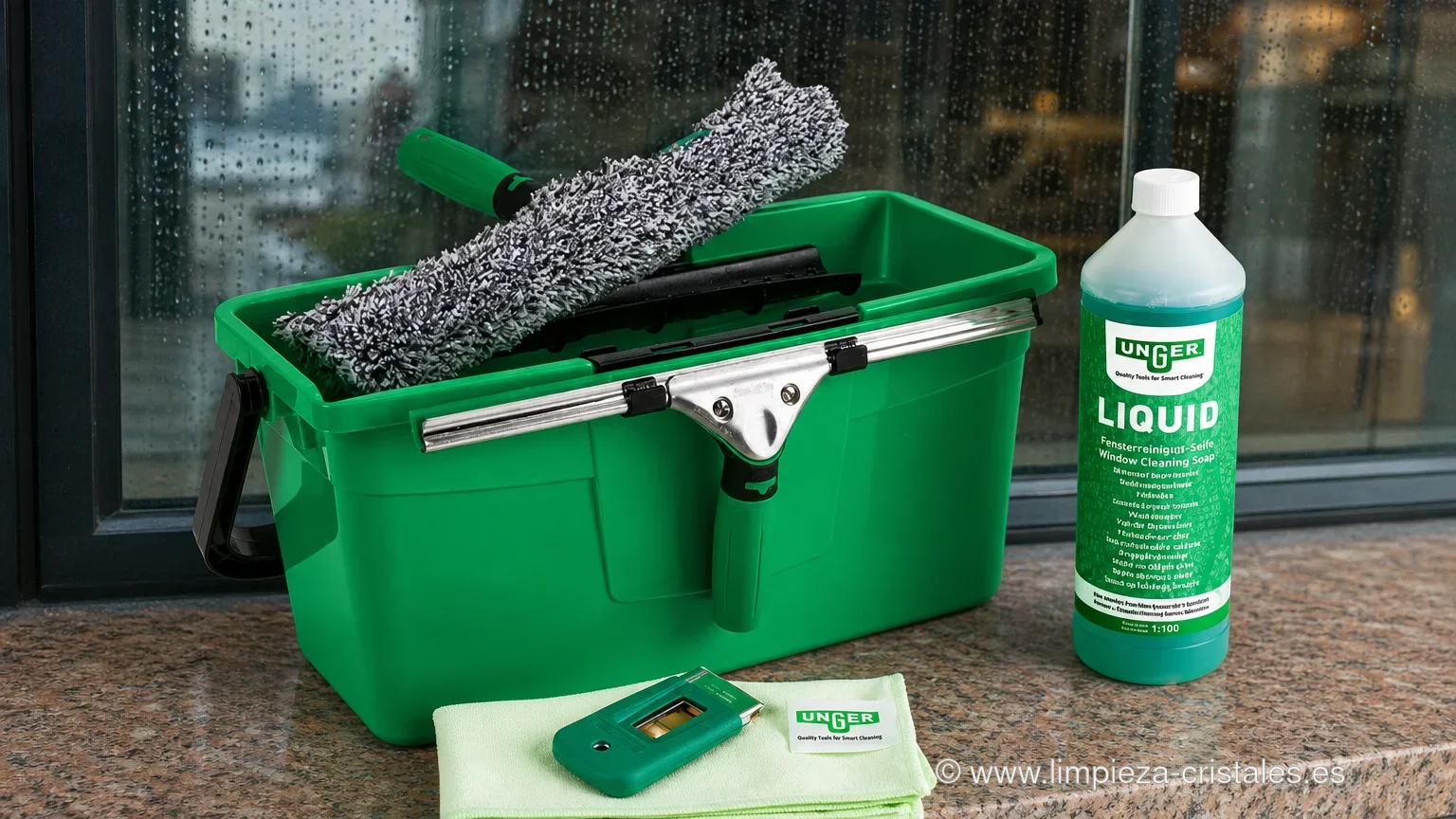
A professional shopfront set-up should be compact and scalable. For manual cleaning, the essentials are a washer, a window squeegee with channels in different sizes, a bucket, microfibre cloths, a scraper and replacement parts. If there are high-level areas, add a telescopic pole compatible with the working heads. For exterior frontages requiring greater reach, a pure water system with the appropriate pole and brush can be considered.
Ergonomics deserves attention. On routes involving dozens of panes, a few extra grams in a tool or a handle that requires excessive gripping force become fatigue by the end of the day. Similarly, choosing products that are compatible with one another simplifies replenishment and avoids carrying duplicate equipment.
At Limpieza Cristales Unger, advice is not limited to choosing a single tool. As an Unger service centre in Spain, the value lies in helping to configure coherent systems, with replacement parts available and a solution suited to the type of shopfront, service frequency and working method.
A shopfront does not need one spectacular clean a year. It needs a clean, even and repeatable result every time the business opens its doors. When the equipment is well chosen and the procedure is defined, that consistency stops being a difficult-to-control cost and becomes an operational advantage for the professional.