




Date de publication : 22/11/2026
A corporate façade cannot be cleaned on an improvised basis. When exterior glass builds up environmental dust, mineral deposits, pollution or run-off marks, the building’s appearance changes immediately. This corporate façade case study
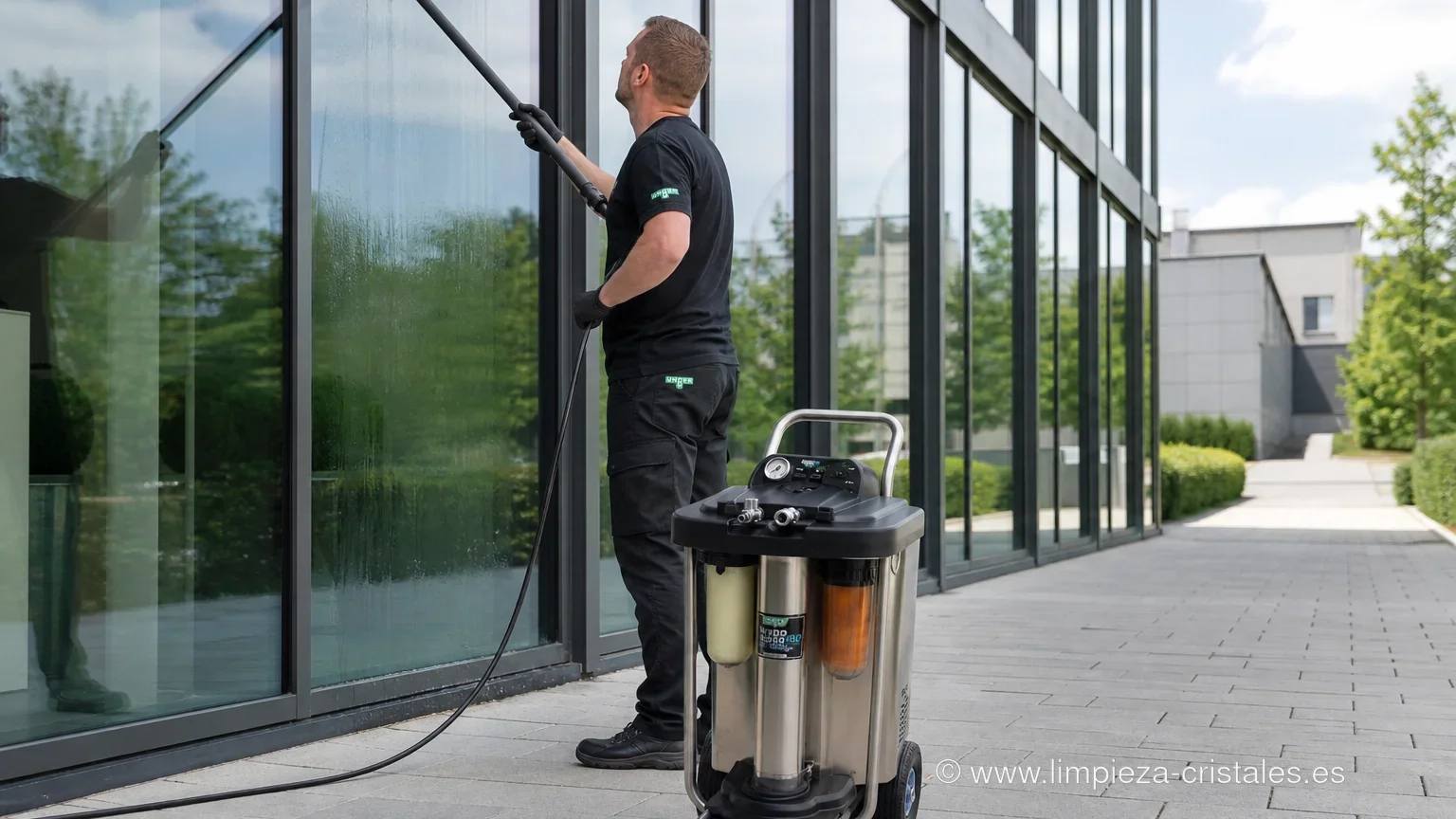
A corporate façade cannot be cleaned on an improvised basis. When exterior glass builds up environmental dust, mineral deposits, pollution or run-off marks, the building’s appearance changes immediately. This corporate façade case study presents a common situation for cleaning and maintenance companies: an office building with large glazed sections, heavily used entrances and difficult-to-reach areas that require consistent results without interrupting normal operations.
The aim is not simply to make the glass look clean when the service is complete. It is necessary to reduce reworking, work safely, maintain a consistent appearance across the entire building envelope and choose a system that is cost-effective for regular maintenance. The right equipment depends on the height, level of dirt, type of glass, available access and contracted service frequency.
Corporate façade case study: the operational challenge
Consider a company headquarters with a glazed façade at ground-floor level and several upper levels accessible from the perimeter. The main entrance has fingerprints, rain marks and dirt deposited by daily traffic. On the upper floors, environmental pollution combines with dust accumulated on frames, seals and difficult-to-reach areas.
Approaching the entire building with the same method is usually a mistake. Traditional cleaning with a washer and window-cleaning squeegee offers excellent control at entrances, shopfronts, reception screens and low-level glazing. However, productivity falls when ladders or platforms have to be repositioned for each section of façade. Conversely, a pole with a brush and pure water can be highly efficient outdoors, but it does not automatically replace manual finishing on glass with localised dirt or in interior areas.
The professional solution starts by dividing the façade into work areas and assigning the most suitable system to each one. This decision affects operatives’ time, safety, replacement-part consumption and the final quality.
Assessing the site before preparing the equipment
Before loading the equipment, it is advisable to review four aspects: actual reach, type of dirt, façade drainage and working conditions. It is not enough to calculate the height in metres. You must check whether uneven ground, vegetation, street furniture, canopies or pedestrian areas restrict the operative’s position and the angle of the pole.
The type of dirt must also be identified. Light dust and normal rain marks respond well to washing with a pure-water system. By contrast, adhesive residue, construction splashes or bonded mineral deposits may require targeted pre-treatment and a specific tool. Applying force or using a scraper without assessing the type of glass and the contamination present can cause avoidable problems.
The condition of frames and seals matters more than it may seem. If dirt trapped in these areas runs down during rinsing, it can mark the glass again. For this reason, during initial maintenance visits it is often effective to carry out detailed cleaning of frames, sills and accumulation points first. On subsequent visits, the time required is significantly reduced.
Choosing pure water for exterior cleaning
In this situation, a professional pure-water system makes it possible to clean and rinse the glass using a pole fitted with a brush. Treated water helps prevent mineral residue being left behind as it dries, provided that the system is properly maintained and the work process is correct. It is not simply a matter of wetting the glass: the dirt must be agitated with the brush, the glass must be rinsed sufficiently and care must be taken not to carry contamination from untreated areas.
The choice between a compact unit, a system with greater autonomy or a configuration designed for long working days depends on the surface area, service frequency and each company’s logistics. For routes covering different sites, mobility and quick set-up are more important. For an extensive façade with recurring maintenance, greater autonomy and operational stability may justify a higher-specification configuration.
Control of treated water and maintenance of consumables are part of the final result. If the operative notices that drying leaves repeated marks, they should not assume that the problem lies with the glass. The brush may be contaminated, the rinsing technique may be insufficient or the condition of the system may need checking. Working with compatible, readily available replacement parts prevents unproductive stoppages.
Poles and brushes: reaching higher areas without losing control
A pole is not chosen solely for its maximum length. An excessively heavy or flexible tool causes operative fatigue and reduces precision, particularly at the end of the working day. For corporate façades, it is worth assessing rigidity, weight, section diameter, ease of locking and compatibility with the hose, brush and angle accessories.
A suitable brush should make it easy to agitate dirt on glass and frames without compromising control. The configuration changes according to the façade finish, level of dirt and access conditions. In areas with projecting elements or recessed panes, angle adaptors help maintain an effective position without forcing the operative’s posture.
Pole work reduces reliance on ladders in many applications, but it does not remove the need for a risk assessment. Wind, pedestrian traffic, proximity to electrical installations, uneven surfaces and obstacles must all form part of the planning. Productivity can never justify a poorly planned operation.
The working method that prevents reworking
Once the system has been defined, the order of work makes a difference. It is usual to start with the upper areas to avoid contaminating panes that have already been completed. Before applying water, loose debris is removed from frames and accumulation points. The glass is then cleaned in overlapping sections, with even agitation and complete rinsing of each pane.
At ground-floor level and around the main entrance, the manual method remains particularly useful. A quality washer, a window-cleaning squeegee with a rubber blade in good condition and a professional cloth for finishing touches allow fingerprints and contact marks to be corrected quickly. The key is not to extend this manual process across the entire façade when a pure-water system offers better performance on the exterior levels.
The visual inspection should be carried out from different angles, not only straight on. Side lighting reveals dried drops, lines and residue that may go unnoticed during cleaning. This final check is essential in corporate buildings because the façade forms part of the image of the company occupying the premises.
What equipment should be planned for recurring service work
On a maintenance route, continuity depends less on a single tool than on a well-configured equipment setup. In addition to the main system, it is advisable to have replacement rubber blades for the window-cleaning squeegee, washer sleeves, brushes in good condition, connectors, hoses, adaptors and finishing cloths. Waiting for a consumable to fail during the service damages both margins and planning.
It is also useful to standardise configurations when several operatives work on the same contract. If everyone uses compatible poles, brushes and accessories, training is simpler and replacements can be arranged quickly. This approach reduces errors and helps maintain the same finish across shifts or teams.
For professionals looking to configure or expand their equipment, Limpieza Cristales Unger provides technical knowledge of the range and support as an Unger SAT service in Spain. This is valuable when checking compatibility, choosing replacement parts or planning a working-at-height solution that reflects actual use rather than a one-off purchase.
Profitability: looking beyond the time per pane
The profitability of a corporate façade should not be measured solely by the minutes spent on each pane. Travel, preparation, repositioning the operative, treated-water consumption, replacement of consumables, reworking and operational risk must all be taken into account. Equipment that appears cheaper may prove expensive if it forces the team to work slowly, causes fatigue or fails to deliver consistent results.
Service frequency also affects the choice. An intensive first intervention may require more detailed manual work and additional preparation time. When maintenance is scheduled at a frequency suited to the building’s environment, the level of dirt stabilises and the pure-water system becomes more efficient. If visits are spaced too far apart, bonded dirt once again increases the cost per service.
There is no single configuration for every façade. A low-rise building with wide access areas requires a different approach from a headquarters with internal courtyards, canopies or recessed glazing. The right decision is the one that combines safety, reach, ergonomics and available replacement parts, enabling the operative to repeat the same result week after week.
A well-maintained façade is not achieved through greater effort, but through a repeatable method and tools that are compatible with the work involved. Before the next service, review the access, the dirt and the reach required: this brief assessment will usually make it clear whether to work with a window-cleaning squeegee, a pole and pure water, or both systems in coordination.