




Date de publication : 19/11/2026
When cleaning dozens of windows, shopfronts or façade sections in a single working day, the handle is no longer a minor accessory. The benefits of a professional ergonomic handle are felt in squeegee control, ma
When cleaning dozens of windows, shopfronts or façade sections in a single working day, the handle is no longer a minor accessory. The benefits of a professional ergonomic handle are felt in squeegee control, reduced unproductive movements and lower accumulated fatigue at the end of the shift. It is a small component, but it directly affects technique, speed and the final finish.
A professional handle should allow you to hold the channel securely, position the rubber precisely and maintain a natural wrist posture. It is not simply a matter of feeling comfortable when holding it for a few minutes. The real test is how it performs after many strokes on interior windows, shopfronts, partitions, high-level surfaces or repetitive jobs involving constant changes of angle.
Benefits of a professional ergonomic handle in real-world work
Well-designed ergonomics reduce unnecessary tension in the hand, fingers and wrist. When cleaning windows, excessive pressure is often a sign that the equipment is not supporting the movement properly or that the technique needs adjusting. A handle with a secure grip and suitable geometry helps guide the squeegee without having to clench the hand too tightly.
This is especially important when working with fanning movements. The wrist must be able to rotate smoothly while the rubber maintains the correct contact with the glass. If the handle forces the user into an awkward position, the forearm and shoulder compensate. The result can be a slower pace, greater fatigue and a higher risk of leaving water lines around the edges.
The improvement is not limited to comfort. A good grip helps maintain more even pressure on the channel. This consistency allows the rubber to remove water reliably and helps achieve a clean finish with fewer touch-ups. For a maintenance company, eliminating one touch-up per window can have a significant effect on end-of-day working times.
It also improves operational safety. A tool that does not slip and is easy to control reduces the risk of sudden movements, particularly on ladders, platforms or in areas where there is less room for correction. Ergonomics do not replace safety procedures, but they do help the operator work more steadily and predictably.
The handle affects squeegee performance
A squeegee works as a complete system: the handle, channel and rubber must be compatible and suited to the surface. Choosing high-quality rubber will not compensate for a handle with play, an unreliable locking mechanism or an angle that makes control difficult. Likewise, an excellent handle cannot compensate for worn, damaged or incorrectly fitted rubber.
In periodic maintenance work, speed depends on repeating a technically correct movement many times. An ergonomic handle supports this repetition by making it easier to change direction. The hand guides the tool rather than fighting against it. On interior windows in offices, shops or communal buildings, where frames, corners and obstacles are common, this difference is noticeable from the very first service.
There is another practical advantage: a secure grip makes it easier to remove and replace the channel or rubber when necessary. The availability of spare parts is part of professional performance. Replacing the rubber at the right time prevents wasted minutes trying to correct marks with a tool that no longer delivers the required result.
Grip, weight and balance: three factors that work together
The grip should provide security without requiring excessive pressure. Textured surfaces or materials that remain easy to grip when wet can improve control, although the right design will depend on the type of use and the operator’s preferences. A professional who mainly cleans shopfronts may prioritise agility, while someone working across large surfaces for long periods will particularly value reduced hand strain.
Weight also matters, but choosing the lightest handle is not always best. A handle that is too light may give some users less sense of control, while a more substantial model may feel more stable during certain manoeuvres. What matters is the balance of the complete assembly with its channel. The tool should feel precise and should not tend to pull the wrist to one side.
Finally, it is worth checking the quality of the locking mechanism. In intensive use, the lock must keep the channel stable, allow quick changes and withstand repeated fitting and removal cycles. A channel that moves even slightly during a stroke affects the working angle and can leave an uneven edge.
Fixed or swivel handle: choose according to the application
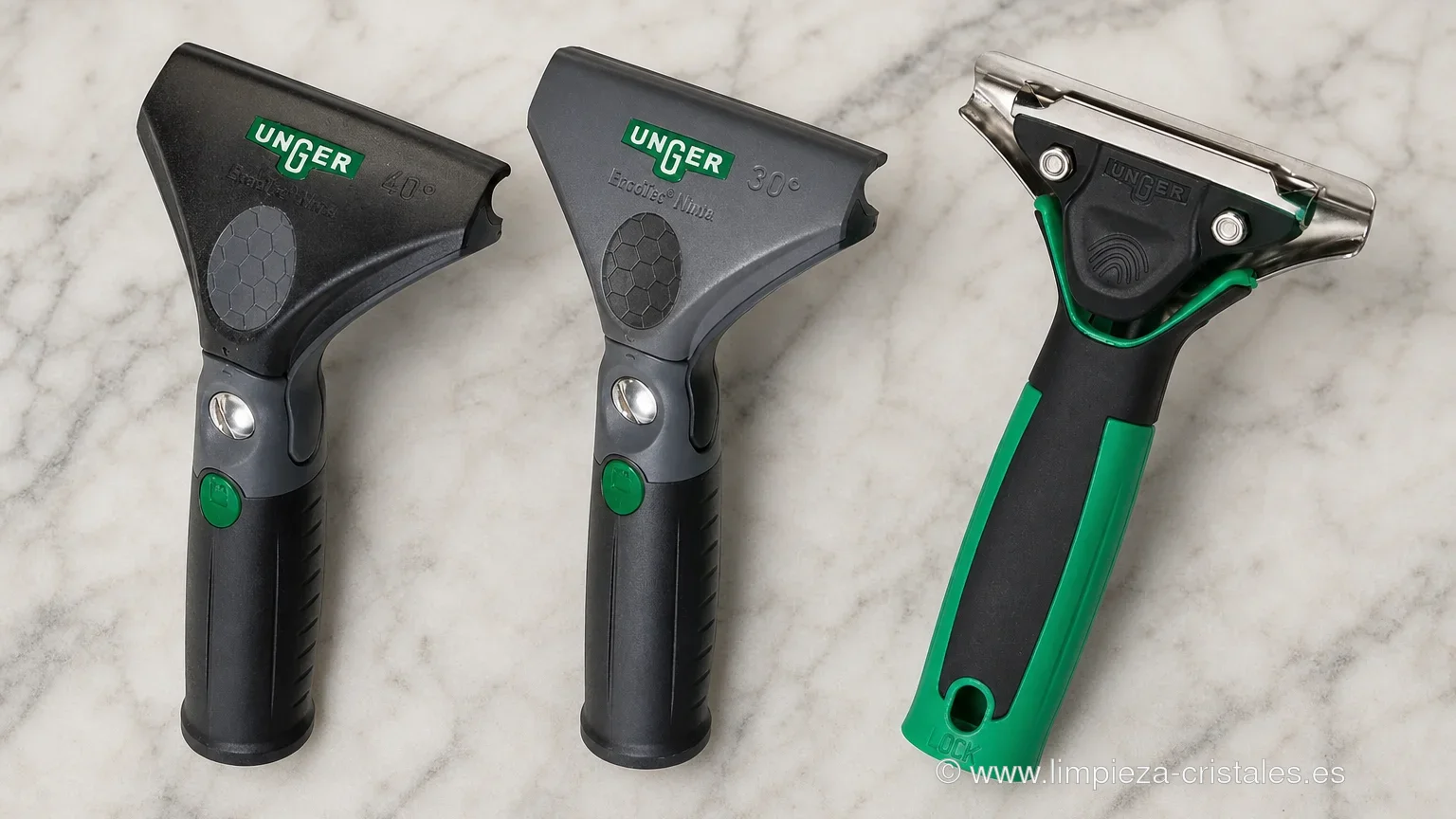
There is no single correct handle for every window-cleaning task. A fixed handle is often an effective choice for hand work, routine maintenance and users who want a direct response. Its simplicity makes it easier to control the rubber angle clearly and perform quick movements on accessible surfaces.
A swivel handle offers another option: adjusting the channel position in areas where the hand cannot be placed directly in front of the glass. It can be useful on high panels, glass behind furniture, complex interiors or certain tasks carried out with a pole. However, this articulation requires an understanding of how the tool behaves. If it is too loose or cannot be locked in the right position, it may reduce precision for users who have not yet mastered the technique.
For this reason, the decision should be based on the application. For a professional cleaning shopfronts and windows at hand height, a quality fixed handle may be the most efficient option. For teams working on sites with varying access conditions, having a swivel handle as an additional option increases their ability to tackle different situations. It is not about having more features, but about having the right feature when access conditions require it.
Compatibility with poles and work at height
When a squeegee is connected to a pole, the demands placed on the handle change. Distance increases the sensation of weight and reduces direct feedback from the rubber’s contact with the glass. In this situation, the rigidity of the connection and the ability to adjust the angle are crucial for avoiding inaccurate strokes.
A handle designed for pole work must integrate correctly with the system being used. Forcing compatibility or mixing components without checking the fit can cause play, premature wear and a loss of control. In high-level operations, every connection in the system deserves attention: pole, cone or adapter, handle, channel and rubber must work together as a safe system.
Technique remains decisive. A swivel handle can make access easier, but it cannot replace a suitable pole or proper work planning. On façades or exterior windows with difficult access, it may also be more appropriate to consider pure-water systems for professional cleaning, depending on the height, type of dirt and required finish.
Signs that it is time to replace the handle
Wear is not always obvious at first glance. A handle should be inspected if there is play in the lock, reduced grip in the handle area, difficulty securing the channel or unusual movement during cleaning. Waiting until it fails completely usually means more touch-ups, a poorer finish and an unnecessary interruption to the service.
It is also worth reassessing the equipment when an operator experiences recurring hand fatigue or when the range of work has expanded. A tool that performed well on low-level surfaces may no longer be the most suitable option after adding pole work, large windows or more intensive routes.
The advantage of working with professional systems is that components can be replaced without discarding the entire set-up. Choosing tools with spare parts available protects your investment and helps maintain a consistent working standard. At Limpieza Cristales Unger, technical advice and SAT Unger status in Spain help customers select compatible configurations and resolve maintenance or replacement queries.
Before buying, it is worth defining which channel is used, the most common width, whether the work is mainly carried out by hand or with a pole, and what type of access the jobs involve. With this information, the handle becomes more than a generic purchase: it becomes a technical decision that improves every stroke across the glass.