




Date de publication : 13/11/2026
When a squeegee leaves water on the glass, the problem is rarely solved by applying more pressure. In fact, increasing pressure without identifying the cause can make marks worse, tire the operator and accelerate rubber wear. In professional cleaning, a l
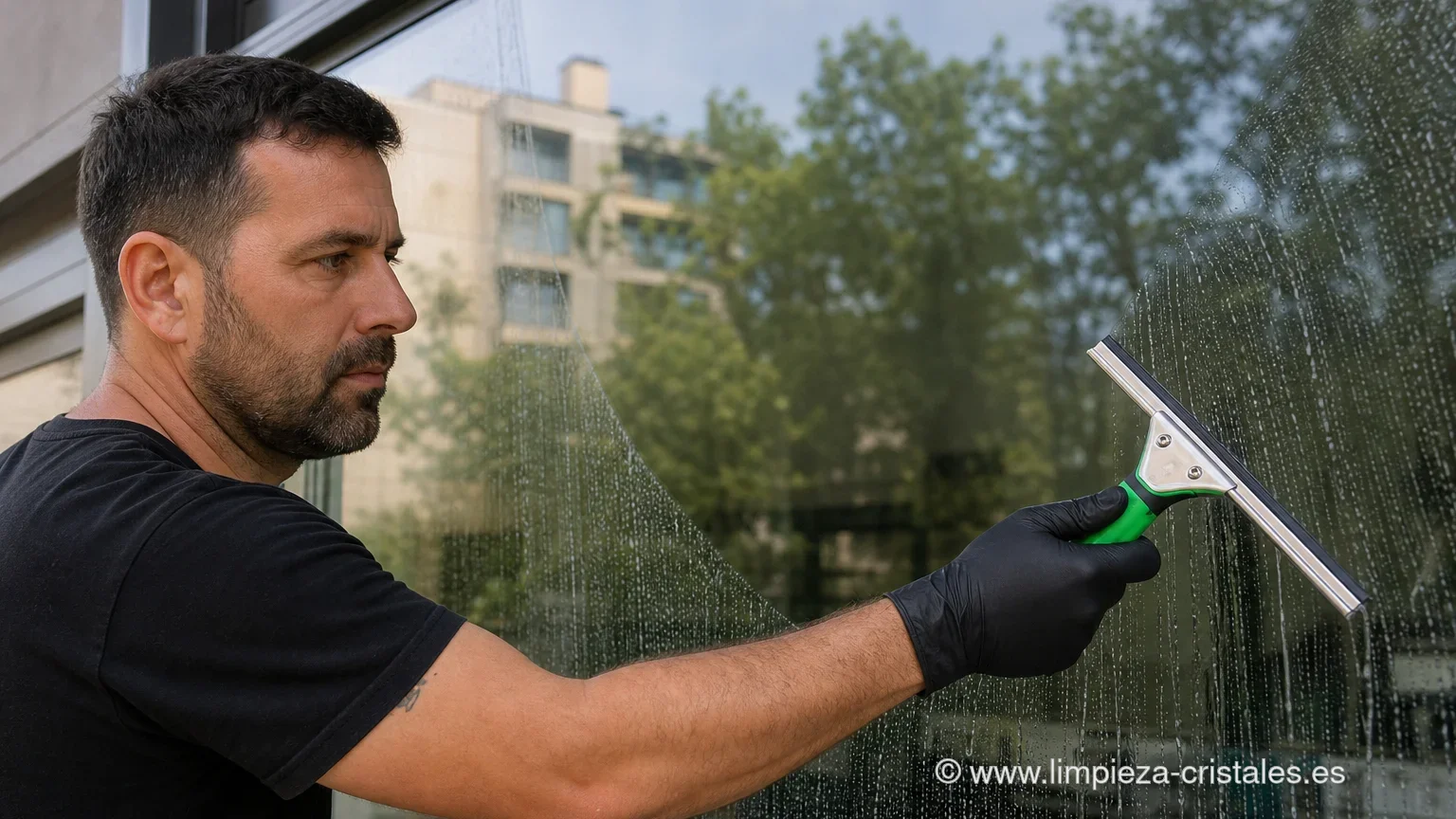
When a squeegee leaves water on the glass, the problem is rarely solved by applying more pressure. In fact, increasing pressure without identifying the cause can make marks worse, tire the operator and accelerate rubber wear. In professional cleaning, a line of water left behind after a pass indicates that one of the components in the system — the rubber blade, channel, handle, technique or condition of the glass — is not working correctly.
The key is to diagnose the type of residue left behind: a continuous line along the edge is not the same as scattered drops, a wet area in the centre or water that reappears after finishing. Each pattern points to a different cause and helps determine whether it is enough to turn the rubber, clean the channel or replace a spare part.
When the squeegee leaves water: identify the mark
A thin, continuous strip usually appears at one of the ends of the window-cleaning squeegee. This is normally caused by damaged rubber, an incorrectly cut blade, movement inside the channel or uneven protrusion. It can also happen if the end of the channel has bent after an impact, which is common when cleaning shop windows, communal areas or low-level glass with obstacles.
If isolated drops remain across the surface, check the dirt first. Fine dust, building residue, airborne grease or particles stuck to the rubber edge interrupt continuous contact with the glass. In this case, replacing a rubber blade that is still in good condition will not always solve the problem: first clean the edge, channel and glass.
Wet areas in the centre of the pass are usually related to uneven pressure, deformed rubber or a channel that is too flexible for the working width. If the rubber has developed a permanent curve, the edge will not rest evenly and will leave an area wet. This is a common problem when the tool is stored resting on the rubber or remains fitted for too long in a strained position.
When water reappears after an apparently correct pass, the source may be the frames, seals or glazing gaskets. Liquid retained in these areas runs down onto the glass after a few seconds. The solution is not to repeat the pass indefinitely, but to wipe around the perimeter with a professional microfibre cloth before the final finish.
The rubber blade is the first point to check
The rubber blade is the component that dries the glass. A clean, straight and flexible edge removes the cleaning solution with less effort and maintains an even contact line. When it loses flexibility or develops cuts, nicks or rounded edges, the likelihood of the squeegee leaving water and drag marks increases.
Before replacing it, turn the rubber if the model has two usable edges. This makes use of the second edge and reduces the cost per service, provided the alternative side is clean and free from deformation. If both edges show wear, replacement is the most productive option: persevering with a worn-out blade takes longer than fitting a new replacement.
The material also makes a difference. Softer rubber blades tend to adapt better to cold glass, slight irregularities and interior work where smooth gliding is preferred. Firmer rubber offers greater stability in high temperatures, on large panes or in conditions where rubber that is too flexible may fold. There is no single hardness suitable for every job: the climate, working pressure and type of glass determine the most appropriate response.
The length must match the channel. A blade that is too short leaves the ends poorly supported; one that is too long may fold, come out of the channel or create burrs. After fitting it, check that it protrudes evenly on both sides and that the final cut is clean. A small defect at the end can easily translate into a visible line of water.
Quick cleaning between panes
During cleaning, the edge accumulates dust and residue from the glass. Wiping it with a clean cloth every few passes prevents these particles from being dragged across the glass. This is a simple routine that is particularly important outdoors, on building sites, in street-level premises and on surfaces affected by airborne pollution.
Channel, handle and working angle
A rubber blade in perfect condition cannot compensate for a deformed channel. Check that the channel is straight and that its ends have not been damaged. Even a slight deviation changes the pressure on the glass and causes one side not to dry correctly. If the channel has bent, replacing it is usually more reliable than trying to straighten it, as the repaired shape rarely remains stable.
The handle must hold the channel securely, without play. An inadequate closure or worn component allows small movements during the pass, which may be difficult for the user to notice but are enough to leave water behind. Check the fit before starting a long day, especially when switching between channels of different sizes.
The angle is another decisive factor. The rubber needs to work at an angle that allows the flexible edge to remove water without folding. With an angle that is too open, the rubber tends to bounce or vibrate; with one that is too closed, friction increases and lines may be left behind. The correct sensation is controlled, constant resistance — not excessive pressure on the wrist.
When using S-shaped movements, keep the leading edge slightly raised in relation to the side closing the pass. On straight passes, dry the edge of the glass with the cloth before starting and slightly overlap each stroke. Overlapping prevents a vertical line from being left between two passes, but it should not be so wide that it slows the work unnecessarily.
The glass and cleaning solution matter too
Not all glass responds in the same way. Glass with a greasy film, silicone residue, limescale, paint or adhered contamination can prevent the rubber from gliding and making proper contact. In these situations, the window-cleaning squeegee should not be used as a descaling tool: first prepare the surface with the appropriate implement and remove particles that could damage the rubber or scratch the glass.
The amount of solution applied should be enough to lubricate the surface and loosen dirt, but not excessive. An over-saturated washer soaks frames and seals, increasing the risk of further runs afterwards. Conversely, glass that is too dry creates friction, vibration and rubber bounce. The aim is an even film, not an excess of liquid.
It is also worth monitoring the condition of the working water in the bucket. When it contains suspended dirt, that dirt returns to the washer and eventually ends up on the glass or the rubber edge. For recurring work, replacing the solution when it becomes dirty maintains a more consistent finish and extends the life of consumables.
Adapt the tool to the type of job
For narrow panes, a compact squeegee provides better control around the edges and reduces finishing work with a cloth. On medium-sized shop windows, a wider channel improves speed provided the operator can maintain even pressure. On large surfaces or when working with a pole, the balance between channel rigidity, articulation and technique is even more important: a set-up that is too wide or flexible may leave water even when the rubber is new.
There is no need to choose the maximum size as a rule. A narrower tool may be more efficient if it reduces rework, prevents mistakes around frames and allows greater precision. True productivity is measured by panes completed correctly the first time, not only by the number of centimetres covered in each pass.
In pure water systems for exterior cleaning, the window-cleaning squeegee is normally reserved for specific finishing work or surfaces where the manual method offers better control. If both systems are combined, keep the tools and cloths intended for each process separate to prevent dirt or residue from being transferred to a technical finish.
When to replace the spare part and when to seek advice
Replace the rubber when it has cuts, has lost its flexibility, has rounded edges or visible deformation, or when it requires too many repeat passes despite correct technique. Replace the channel if it is bent, does not hold the rubber securely or its ends have been damaged. If the problem occurs with different rubber blades and types of glass, check the handle and working method before continuing to buy replacement parts without a clear diagnosis.
Compatibility between the channel, rubber blade, handle and working system prevents common fitting errors. At Limpieza Cristales Unger, as an Unger authorised service centre in Spain, technical advice makes it possible to configure tools and replacement parts according to size, application and frequency of use. This is especially useful for companies that need to standardise equipment across several operators.
A squeegee that dries well does not require force or constant corrections. Start with the rubber edge, then check the channel, and adjust the technique and glass preparation afterwards: this systematic review restores precision to the work and prevents every pane from becoming an unnecessary repeat job.