




Date de publication : 10/11/2026
A street-level shopfront, an office with internal glass partitions and a multi-storey glazed façade require different cleaning approaches. Choosing between manual or mechanised cleaning is not about deciding which method is “best” in the abstract
A street-level shopfront, an office with internal glass partitions and a multi-storey glazed façade require different cleaning approaches. Choosing between manual or mechanised cleaning is not about deciding which method is “best” in the abstract, but about calculating which system delivers the required finish with the least time, risk and operating cost.
In professional window cleaning, the most cost-effective solution is often a well-planned combination of both methods. Manual cleaning remains central for detailed work and internal surfaces. Mechanised or pure-water systems are increasingly useful where there is height, repetition, large expanses of glass or a need to reduce complex access requirements. The key is assigning each piece of equipment the work for which it delivers the greatest efficiency.
Manual or mechanised cleaning: making the right choice
Before preparing a trolley, pole or pure-water system, it is worth reviewing four variables: the type of dirt, accessibility, service frequency and the expected standard of finish. An operative can achieve an excellent result with a washer and window squeegee on internal glass, but the same procedure becomes less efficient when it has to be repeated across dozens of external panes several metres above ground.
Manual cleaning provides direct control. It allows the operative to focus on localised marks, adhered residue, frames, seals and corners where a pole brush cannot reach with the same precision. It is also the preferred method when furniture, signage or pedestrian traffic is very close to the glass and the work area needs to be fully controlled.
Mechanised cleaning, understood in this context as the use of professional pure-water cleaning systems, poles, brushes and treated-water production equipment, addresses a different need: covering more surface area from the ground, reducing repositioning and maintaining consistent productivity. It does not eliminate the operative’s skill. Instead, that skill is applied to the choice of brush, flow rate, working angle, rinsing and final drying.
When manual cleaning remains the best option
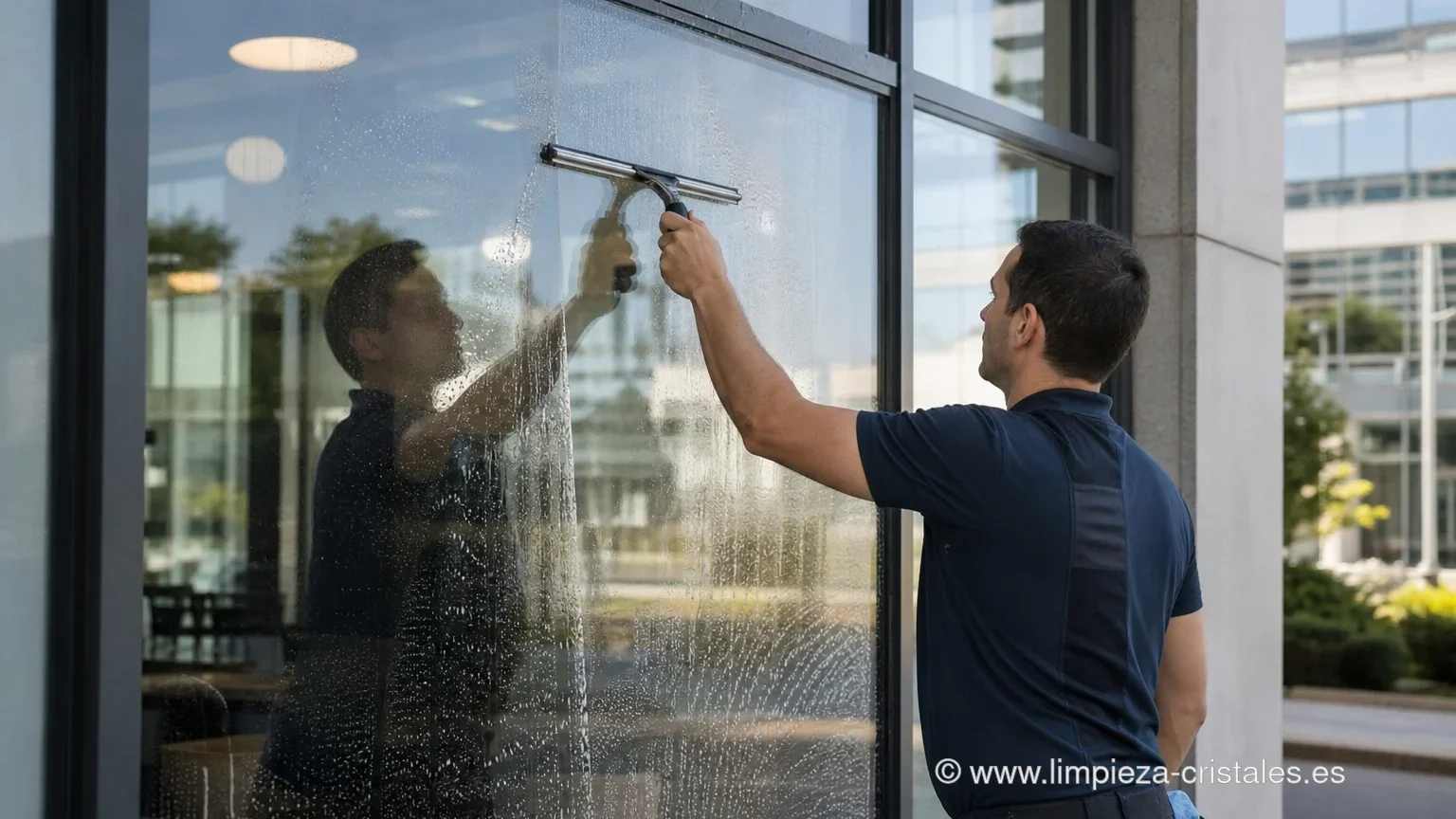
Manual cleaning is particularly effective indoors, on shopfronts, glass partitions, non-food display cases and glass with nearby obstacles. A professional set consisting of a washer, window squeegee, bucket and finishing cloth allows work to be completed quickly, provided the rubber blades are in good condition and the tool width is suited to the pane.
With this system, quality depends heavily on technique. Worn rubber can leave lines and require additional passes. A channel that is too wide for a narrow window reduces manoeuvrability. An uncomfortable handle can tire the operative during long working routes. For this reason, the apparent simplicity of the method should not lead to the purchase of generic tools without checking compatibility and replacement parts.
Manual work is also advantageous when a one-off intervention is required. If the glass has adhesive, paint, silicone or other adhered residue, the process will usually begin with the appropriate tool and a professional scraper, used carefully to avoid damaging the surface. Cleaning is then completed with a washer and window squeegee. A pure-water system does not replace this removal stage when the dirt is firmly bonded.
On low-level façades or regularly serviced shopfronts, the manual method can be highly competitive because it reduces initial preparation. There is no need to set up hoses or manage treated-water equipment to clean a small number of square metres. However, as the number of windows increases or access becomes more difficult, the relationship between time and surface area changes quickly.
Tools that determine the manual result
Manual productivity does not depend on a single item, but on a coherent system. The window squeegee should have a clean, straight rubber blade that is compatible with its channel. The washer needs a sleeve with the right dirt-removal capacity for the level of soiling. Replacement sleeves, rubber blades, channels and handles should be easy to change, preventing a worn tool from reducing the quality of the entire route.
Telescopic poles also play an important role in manual cleaning from the ground. They extend the reach of a window squeegee or washer on elevated glass, although they require greater technique and may lose precision as their length increases. They are a good solution for moderate heights and specific points, but not necessarily the most productive answer for an extensive façade.
Where mechanised cleaning delivers the greatest benefits
Cleaning with pure-water systems is intended for external surfaces, particularly when the aim is to clean frames and glass from the ground using a pole. Water treated for professional cleaning is applied through a brush, lifts the dirt and is rinsed over the surface. When it dries correctly, it prevents the deposits that can leave marks on the glass.
Its main advantage is operational. The operative can clean high-level panes without immediately resorting to ladders, platforms or other access equipment, provided the work assessment confirms that it can be carried out safely from the ground. This improves route continuity and makes it possible to cover repetitive surfaces using a more consistent procedure.
However, mechanising the process does not mean working without preparation. It is necessary to assess the quality of the available water, equipment capacity, the required pole length, brush type, condition of the hoses and the surrounding environment. A heavily soiled façade may require more brushing and rinsing. On heavily exposed glass, an initial deep manual or combined clean may be necessary before introducing a regular pure-water maintenance programme.
Mechanised cleaning is particularly worthwhile for residential developments, office buildings, commercial premises and façades with large glazed areas. It is also useful when the client requires a consistent service frequency and the professional needs to standardise working times. In these cases, the saving is measured not only in minutes per pane, but also in less access equipment set-up, fewer interruptions and greater predictability when planning work.
Limitations to consider
A pure-water system is not an automatic answer for every pane of glass. Indoors, it may not be practical because of moisture management and the working environment. It does not replace a scraper or manual intervention when glass has adhered residue. Nor is it advisable to force the use of an excessively long pole if brush control and the operative’s posture are compromised.
The initial cost is also higher than that of a basic manual kit. In return, the system can pay for itself when there is a substantial workload, repetitive high-level cleaning and a suitable maintenance portfolio. For a professional who mainly cleans small, street-level shopfronts, investing first in quality manual tools and replacement parts may make more sense. For someone who regularly manages external cleaning, investing in pure water can transform productivity.
A combined system is usually the most professional approach
In practice, many profitable services combine both methods. Internal areas are handled with a washer, window squeegee and finishing cloths. High-level external glass is cleaned with a pole and pure water. Edges, isolated marks and areas with residue are corrected manually. This is not a contradiction: it is technical planning that avoids using a tool outside its intended application.
This approach also helps you configure your vehicle and storage area sensibly. Window squeegee rubber blades, washer sleeves, channels, handles, brushes, connectors and hoses are not secondary accessories. They are replacement parts that protect service continuity. Equipment left idle because of a worn or incompatible part creates a much higher cost than maintaining an organised stock of replacements.
When choosing Unger equipment, compatibility between components should form part of the decision. A pole should not be selected solely for its reach, but also for its weight, rigidity, fixing system and intended application. A brush must be suited to the type of surface and washing technique. As an Unger service centre in Spain, Limpieza Cristales Unger can advise on the selection and maintenance of these systems, with product knowledge and replacement-part availability.
How to decide what to buy for each service
Start by reviewing your actual route, rather than focusing on the most eye-catching tool. If internal cleaning and shopfronts make up most of your work, prioritise a robust manual set-up with several channel sizes, spare rubber blades, washers and a professional bucket. If you regularly clean elevated glass, add a telescopic pole suited to your usual working reach and assess when the job justifies moving to pure water.
If the volume of external work is high, the mechanised system should be sized according to the expected working days and operating conditions. An undersized system forces you to work with pauses, increases repositioning and reduces the expected profit. An oversized system can tie up investment without delivering a proportional improvement. The right technical choice is the one that matches the amount of glass you clean, your working frequency and the access challenges you need to resolve.
The best tool is not the one that replaces everything else, but the one that prevents repetition, fatigue and inconsistent results. When the method is adapted to the glass, access and service frequency, every job becomes more profitable and the client notices a consistent finish.