




Date de publication : 09/11/2026
Limescale on glass cannot be removed simply by applying more product or scrubbing harder. When mineral residue has dried on the surface, cleaning requires identifying the type of mark, controlling dwell time and using the
Glass with limescale cannot be restored simply by applying more product or scrubbing harder. When mineral residue has dried on the surface, cleaning requires identifying the type of mark, controlling dwell time and using tools that remove the dirt without spreading it. For a professional, an opaque shower screen, a shop window covered in splashes or a façade with run-off marks are not merely an aesthetic problem: they mean more operative time, a poorer perception of the service and a risk of damaging the glass or its finishes.
Limescale appears when water evaporates and leaves the minerals it contained on the glass. At first, it looks like a whitish film or isolated spots. If it remains for weeks or months, it can bond firmly and, in some cases, attack or permanently mark the surface. It is therefore important to distinguish between a recoverable surface deposit and an alteration of the glass itself.
Why limescale appears on glass and how severe the soiling is
The usual causes are splashes, irrigation, rain carrying mineral dust, condensation, poorly dried cleaning or run-off from façades. On exterior glass, frames, seals and sills also play a part: if they accumulate dirt, every contact with moisture contaminates the glass again.
The first level is a recent film that reduces transparency and leaves visible rings when viewed against the light. It normally responds well to a suitable limescale remover and controlled mechanical removal. The second level consists of hardened mineral drops, common on shower screens, shop windows near irrigated areas and repeatedly exposed exterior panes. This requires longer contact time, several passes and precise technique.
The third scenario is the most delicate. If the deposit has remained bonded for a long time, there may be surface alteration that will not disappear completely even after the limescale has been removed. Do not promise full restoration without first carrying out a test in an inconspicuous area. This check is particularly necessary on treated, screen-printed or laminated glass, glass with solar-control films or glass with special coatings.
How to clean limescale from glass using a professional method
Efficiency depends less on improvisation and more on following a consistent sequence. Before starting, remove dust, sand and loose particles. Applying a product to dry glass with abrasive particles on the surface can cause drag marks, scratches or a paste that is difficult to remove.
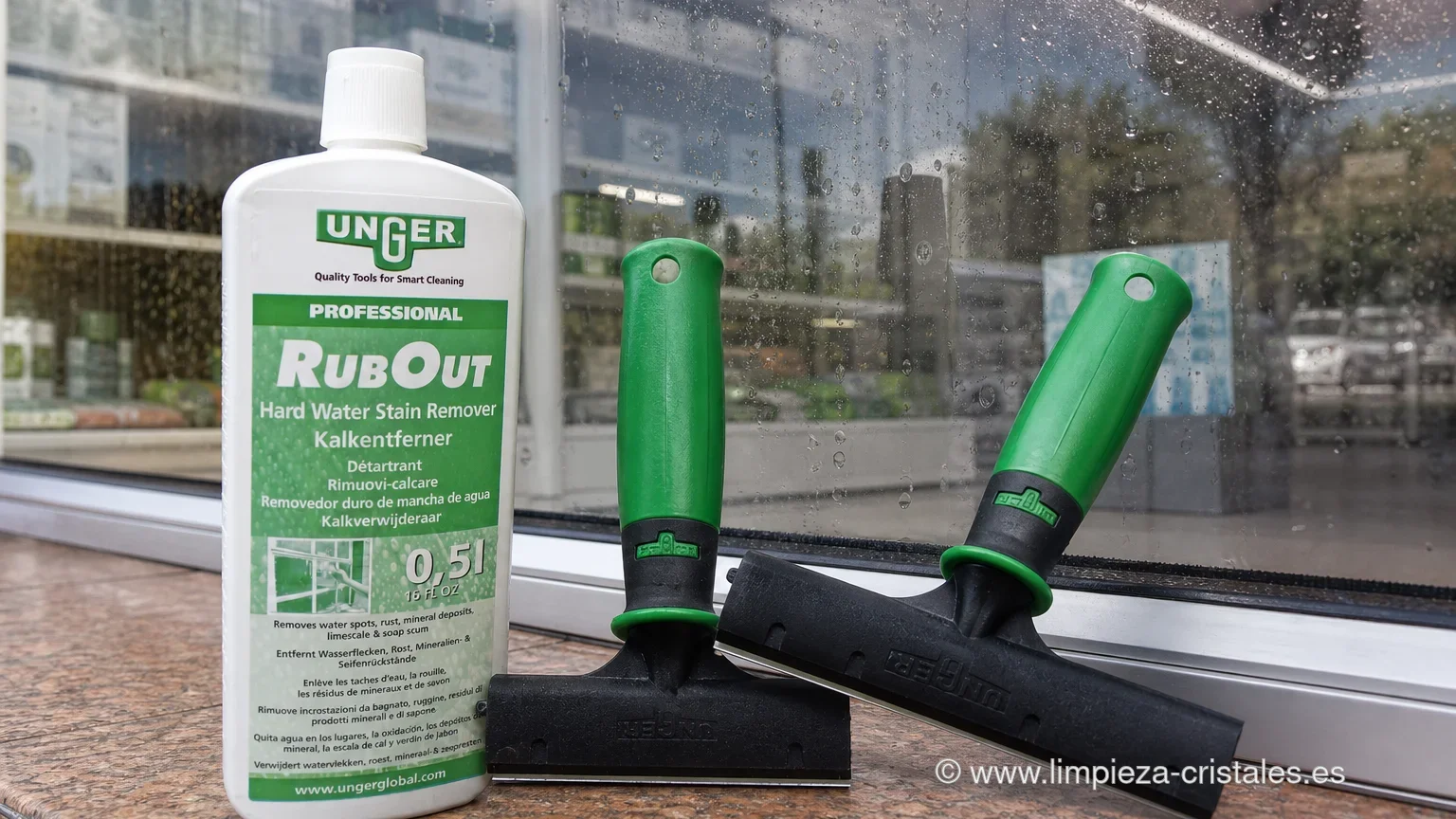
The limescale remover must be selected for glass cleaning and used according to the manufacturer’s safety and dilution instructions. Its purpose is to soften the mineral residue, not to replace the removal process. Apply a controlled amount with a clean window washer or compatible tool, keep the surface wet for the necessary time and prevent the product from drying on the glass or on sensitive profiles.
Then work the pane with moderate pressure. On localised deposits, a window scraper with a blade in perfect condition can be useful, but only when the type of glass and the soiling allow it. The blade must be clean, properly seated and moved with sufficient lubrication. A scraper is not a universal solution: using it on a surface contaminated with mineral particles or on certain treatments can cause irreversible damage.
Final removal is carried out with a professional window squeegee with the rubber in good condition. Hardened, nicked or contaminated rubber leaves lines and means the work has to be repeated, undoing the benefit of having prepared the glass properly. Finish the edges with a clean microfibre cloth, without excess product, and inspect from different angles before considering the pane complete.
On large surfaces, squeegee technique must be consistent. You can work with straight passes or in a fan pattern depending on the space, but always maintain a wet edge and clean the rubber between passes when the residue load is high. The aim is not only to remove the liquid: it is to prevent dissolved minerals from depositing again as marks.
A preliminary test prevents complaints
Before working on a shower screen, façade or large surface with severe deposits, carry out a test in an inconspicuous area. Check the product’s reaction, how the dirt behaves and the finish after drying. This stage takes very little time and makes it possible to calculate labour, material consumption and the realistic result.
It is also important to identify whether the mark is on the exterior or interior face, or inside the cavity of a double-glazed unit. If the milky appearance is inside the cavity, it is not limescale that can be accessed through conventional cleaning. Persisting from the outside only increases the time spent without solving the problem.
Tools that make a difference when removing limescale
For this type of work, the equipment must allow you to apply, agitate and remove the product without losing control. A professional window washer with an absorbent sleeve distributes the product more effectively than a generic sponge and maintains a more even level of moisture. The window squeegee should have a stable channel and rubber compatible with the working width, as areas with mineral residue require clean evacuation of the liquid.
For narrow windows, shower screens and interior partitions, a compact set provides precision. For shop windows or large exterior panes, it is worth matching the squeegee width to the size of the glass to reduce overlaps and working time. A wider tool is not always more productive: if the operative loses control or constantly has to correct the edges, performance drops.
Telescopic poles are useful when the height allows safe work from ground level. However, when treating bonded limescale, accessibility must be assessed. Applying a limescale remover, allowing it to work and applying pressure are more difficult to control from a distance. In some cases, direct access provides a more predictable result and reduces the risk of leaving areas poorly rinsed.
When exterior maintenance work is carried out regularly, a pure water system can be a highly effective solution for rinsing and maintaining glass, frames and structures. Its advantage is that it reduces the minerals that would cause marks during drying. However, it does not automatically replace the initial limescale removal: if the glass already has fixed limescale, the surface must first be restored using the appropriate method.
Common mistakes that worsen the finish
The most common is rubbing a hard mineral deposit with a dry cloth. Friction drags particles across the surface and can leave micro-scratches, especially when the glass has been exposed to outdoor dust. It is also a mistake to use worn household tools, abrasive scourers or unchecked blades.
Another mistake is applying product and allowing it to dry, particularly in high temperatures or direct sunlight. The liquid evaporates before the operative can remove it correctly, leaving hazy films, drops or chemical residue. Plan the work in manageable sections and adapt the pace to the environmental conditions.
A maintenance clean should not be confused with the restoration of heavily limescaled glass. If the quotation, estimated time and chosen tool are based on a standard clean, the result will be uneven. Informing the customer in advance about the condition of the surface and the limits of restoration is part of a professional service.
How to prevent limescale from bonding again
Prevention is based on reducing repeated contact with mineral water and acting before the deposit hardens. Check nearby sprinklers, water outlets, gutters and run-off points around the glazing. In residential developments, shops and buildings with large glazed surfaces, this inspection can prevent hours of later restoration work.
Set a maintenance frequency that reflects the glass’s actual exposure. A protected shop window does not require the same procedure as a façade next to an irrigated area or a shower screen subject to continuous splashing. For periodic work, keeping window washer sleeves, rubbers and replacement parts in good condition helps maintain consistent quality without increasing touch-up time.
The choice of system should reflect the type of deposit, height, access and service frequency. At Limpieza Cristales Unger, as an Unger SAT in Spain, technical advice can help configure compatible tools and suitable replacement parts for each operation. The difference between glass that is simply clean and a professional finish usually lies in this combination of diagnosis, technique and well-maintained equipment.