




Date de publication : 06/11/2026
Professional bucket review: capacity, stability, accessories and compatibility to help you choose an efficient, durable window-cleaning bucket.
A bucket may seem like a secondary item until it affects the pace of an entire route covering shop windows, offices or communal buildings. If it makes you bend too far, tips over when moved, does not accommodate the washer properly or makes changing the water difficult, every pass takes longer. That is why a professional bucket review should assess how it performs as part of a window-cleaning system, not just its capacity.
For an operator working every day, the right bucket reduces interruptions, keeps tools organised and makes cleaning more controlled. For a demanding end customer, it means moving beyond unstable domestic solutions and choosing equipment designed for continuous use.
What a professional bucket review should assess
The first mistake is choosing based solely on litres. A high capacity can be useful for larger jobs, but it also increases the weight when full and makes it less convenient to move between floors, vehicles or walkways. In window cleaning, the volume should match the type of work and the method being used.
A bucket for premises with interior glass has different requirements from one used regularly for exterior cleaning. In the first case, ease of transport and keeping tools organised often matter most. In the second, it is worth prioritising stability, durability and a wide opening that allows the washer to be used comfortably.
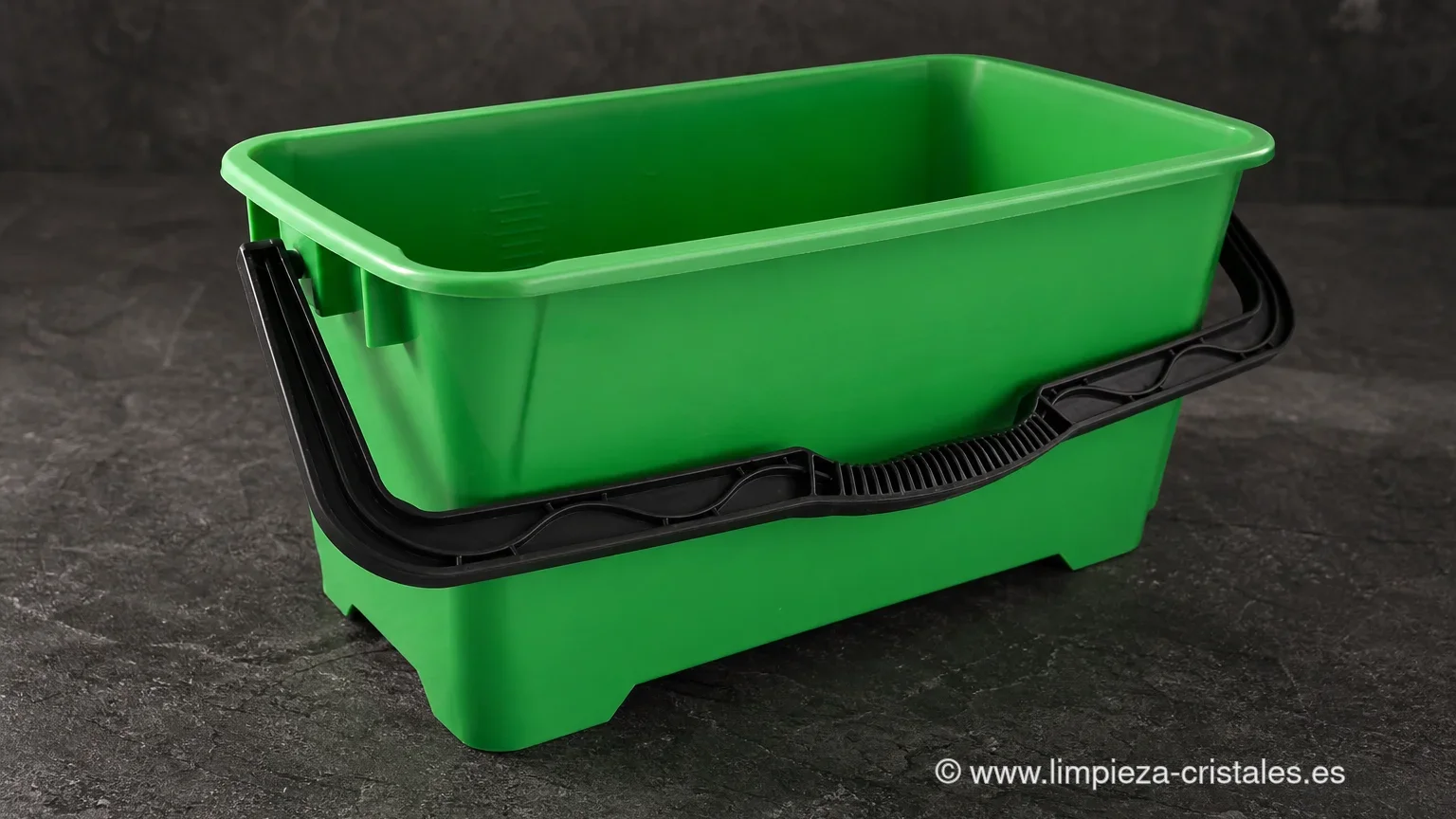
The shape matters too. A long, rectangular bucket makes it easier to immerse longer washers, while a conventional format may limit the amount of water it can hold and force the sleeve to be folded or compressed. This inconvenience affects how evenly the washer is wetted and ultimately slows the work down.
Usable capacity, not theoretical capacity
Usable capacity is the amount of cleaning solution that can be carried and used without splashing, compromising stability or adding unnecessary effort. Filling a bucket to the brim is rarely the best choice during a real working day. The load should allow safe movement, particularly on stairs, through narrow entrances or across areas with passing foot traffic.
It is also worth considering how often the water needs replacing. On very dirty glass, with pollution residue, airborne grease or accumulated dirt, changing the water regularly helps protect the finish. A large bucket is no advantage if the same solution is kept for too long and dirt is redistributed across the glass.
Stability and base support
A professional bucket should remain stable when the washer is inserted, a window squeegee is placed on it or a compatible wringer is used. A wide base reduces the risk of tipping, but the design must be balanced against a footprint that does not get in the way in confined working areas.
The material and wall thickness directly affect resistance to knocks, repeated loads and dragging. A bucket intended for professional use is not chosen for a single job: it must withstand the pace of routes, loading and unloading in a vehicle, and constant contact with wet tools. If the handle flexes too much or the rim deforms, the problem appears before the bucket breaks: control is lost when carrying it.
Accessories that turn the bucket into a workstation
The difference between a basic bucket and a productive solution lies in the accessories it can accommodate. Not all of them are needed for every job, but they should be compatible with the operator’s way of working and with the rest of the equipment.
A wringer can regularly remove some of the excess solution from the washer. This is useful when controlling drips indoors, around sensitive frames or in public-facing areas. However, it should not be assumed that aggressive wringing always improves the result: on very dirty exterior glass, it may be preferable to retain enough solution to loosen the dirt before using the window squeegee.
Tool holders help keep the washer, window squeegee and other frequently used tools close at hand. The benefit is not just tidiness. They prevent tools being left on the floor, placed on furniture or searched for with wet hands. On repetitive jobs, these small movements make a real difference to productivity.
You should also check compatibility between the bucket, its holders and the sizes of the washers. Buying accessories separately without checking the system can result in looseness, interference or insecure positioning. Modularity is worthwhile when it is genuinely used, not as an add-on that makes the whole setup bulkier.
A professional bucket for different types of service
The choice changes with the environment. For shop windows and retail premises, a manageable bucket with good stability allows you to work quickly without taking up too much space. In offices, educational centres or communal buildings, drip control and ease of transport are often priorities, especially when moving between interior areas.
For façades and larger exterior windows, the wide opening and durability become more important. Here, the bucket supports a more intensive process, with long washers, window squeegees in different sizes and frequent changes of position. If you work with a pole, the bucket remains useful for hand work, touch-ups, frames and low-level areas, although it does not replace a pure-water system where that is the appropriate method.
For maintenance teams, there is another decisive criterion: logistics. A bucket should be easy to store and transport neatly alongside sleeves, rubbers, handles, scrapers and replacement parts. A very large model may be efficient at a fixed location, but impractical if the operator gets in and out of the vehicle many times a day. There is no universally superior format: it depends on the workload, access and cleaning method.
Signs that the bucket is already limiting performance
There is no need to wait for the plastic to break before replacing a bucket. If the handle is uncomfortable, the rim makes it difficult to move the washer or the accessories shift position, the equipment is reducing efficiency. The same applies when the bucket no longer sits evenly, has become deformed or is no longer compatible with the tools normally used.
It is worth distinguishing between cosmetic and functional wear. Surface marks are normal in professional work. A crack, unstable base or damaged handle, on the other hand, affects safety and justifies replacement. Keeping the equipment in good condition prevents problems when moving around and helps project a more professional image to the customer.
How to buy based on technical criteria
Before deciding, it is worth identifying three details: the washer length used most frequently, whether the work is mainly indoors or outdoors, and how many journeys are made during the day. With this information, it is easier to choose between a compact bucket, a long format or a configuration with accessories.
Next, consider the complete system. A quality window squeegee, a suitable washer sleeve and a rubber in good condition will not perform as well if the bucket makes the work uncomfortable or prevents the tool from being prepared properly. Compatibility and the availability of replacement parts matter more than an isolated purchase based solely on price.
At Limpieza Cristales Unger, product advice and support as an Unger SAT in Spain make it possible to assess these compatibilities before configuring the equipment. This is particularly useful for professionals who need to replace several tools or standardise equipment across operators.
A good professional bucket does not attract attention on its own, but its benefits are noticeable every working day: fewer unproductive movements, better-organised tools and a more consistent window-cleaning process. Choosing one carefully may seem like a small improvement, but its impact on daily work is highly visible.