




Date de publication : 05/11/2026
Compare ergonomic and standard handles for window-cleaning squeegees and choose the right option based on usage time, precision, pole work and compatible replacement parts.
A handle may seem like a secondary component of a window-cleaning squeegee until you make dozens of passes across shop windows, interior glass or façades. The comparison between an ergonomic handle and a standard handle directly affects rubber blade control, working speed and the fatigue an operator accumulates by the end of the day. It is not about choosing the most eye-catching model, but the one that best suits the type of service, frequency of use and tool configuration.
In professional window cleaning, the tool must transmit the movement of the hand to the channel and rubber blade with as little loss as possible. A good handle provides grip, stability and compatibility; an unsuitable one may force you to squeeze harder than necessary, make turning more difficult or turn a repetitive task into a source of fatigue. That is why it is worth assessing the complete system, not just the initial price.
Ergonomic vs standard handles in professional use
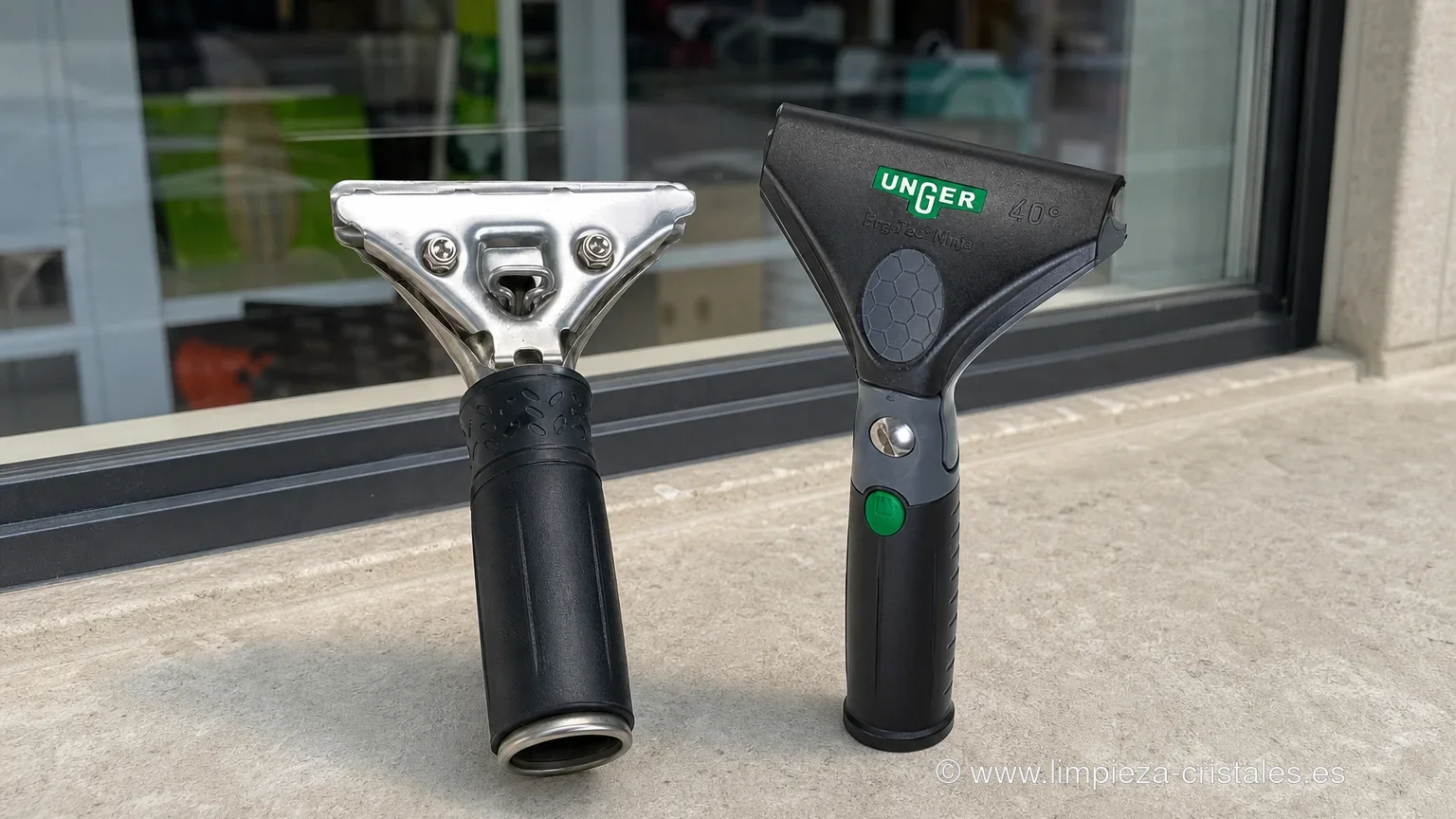
A standard handle has a simple, straightforward design. It usually provides a conventional grip, a functional fastening mechanism and the familiar feel of a tool for anyone carrying out occasional cleaning or preferring a configuration without additional features. It is a valid option when the work is brief, the technique is well established and there is no need to change hand position constantly.
An ergonomic handle is designed to adapt the tool to the actual working posture. It may include a more anatomical shape, support areas, non-slip surfaces or an angle that makes certain strokes easier. Its purpose is not to do the work by itself, but to reduce unnecessary tension in the fingers, wrist and forearm while maintaining precise guidance of the window-cleaning squeegee.
The difference is particularly noticeable during repetitive services. Cleaning a single pane does not always reveal the advantage of an ergonomic handle. However, on a route covering several shops, in a building with large glazed areas or during daily maintenance, small repeated efforts become significant in terms of time, comfort and consistency of finish.
Ergonomics does not replace technique
A well-designed handle helps, but it cannot compensate for a worn rubber blade, a deformed channel or poorly distributed pressure. Nor does it remove the need to choose the correct channel width for each pane. Performance depends on the handle, channel, rubber blade and technique working together as a system.
Ergonomics is most valuable when it allows you to relax your grip without losing control. If the operator has to close their hand excessively to stop the tool from turning, the apparent comfort is no longer useful. Look for a firm, natural grip without play or forced positions.
When to choose a standard handle
A standard handle may be the most sensible choice for low-frequency work, interior cleaning of accessible surfaces or teams that need a versatile tool that is easy to share. Its simple design allows for quick adaptation, especially for operators who already master the classic fanning or straight-pull technique.
It is also suitable when a lightweight configuration is the priority. For certain tasks, a less bulky handle makes it easier to work in narrow frames, interior partitions or areas where being close to the glass restricts turning. It should not be assumed that more support points or a more complex shape automatically mean greater productivity.
Another advantage is ease of maintenance. Fewer moving parts or specialist components can make cleaning the tool and checking its locking system more straightforward. For a company rotating several window-cleaning squeegees, this simplicity can be useful, provided the compatibility of channels and replacement parts is clear before purchase.
When an ergonomic handle is worthwhile
An ergonomic handle usually offers greater value when the window-cleaning squeegee is used for many hours, with constant changes of direction or on medium and large surfaces. The aim is for the hand to follow the technical movement without having to compensate for an uncomfortable design with extra force.
It is particularly worthwhile for professionals carrying out intensive shop-window cleaning, office maintenance, interior glass cleaning around nearby furniture or work involving changes in posture. A grip that supports the palm can help maintain a steadier working pace, which is important when seeking a streak-free finish across a large number of panes.
The choice makes even more sense if the operator notices localised fatigue at the end of the day or needs to make frequent wrist turns. Not every discomfort should be diagnosed as a handle problem, but it is worth checking whether the shape, thickness and grip angle suit the operator’s usual way of working.
Working with a pole: control before apparent comfort
When a window-cleaning squeegee is used with a pole, the handle behaves differently. Distance amplifies any play, imbalance or lack of control. In this context, more important than a hand-comfortable grip is a system that provides a secure connection and a useful working angle.
An articulated handle or one prepared for specific configurations can make it easier to reach high or deep panes, or glass positioned behind obstacles. However, it must be chosen carefully: an articulation adds possibilities, but it also requires control of the angle and checks that the complete assembly does not become excessively heavy or unstable.
For regular work with telescopic poles, it is best to define the actual working height, type of glass and technique used first. The compatible handle for the relevant channel and connection can then be selected. Buying components separately without checking how they fit together can create play, restrict movement or make replacement parts difficult to manage.
Factors that should determine your purchase
The decision between an ergonomic and a standard handle should be based on the service, not an isolated preference. In a cleaning company, two operators may achieve better results with different configurations because their hands, techniques and tasks differ. Testing the tool for its intended use is always more reliable than judging it by appearance alone.
There are four points worth reviewing before adding a handle to your equipment:
- Frequency and duration of use: the more repetitive the work, the greater the importance of ergonomics and reducing grip tension.
- Type of surface and access: large shop windows, narrow frames, interior partitions and pole work all create different requirements.
- System compatibility: the handle must hold the chosen channel securely and allow the rubber blade and replacement parts to be changed quickly.
- Actual operator control: the tool must support even pressure, precise turning and a natural posture without adding unnecessary weight or bulk.
Compatibility deserves particular attention. A professional window-cleaning squeegee should not become a collection of improvised parts. The availability of compatible rubber blades, channels, locking components and accessories affects operating costs and prevents a service from being halted because the correct replacement part is unavailable.
Common mistakes when comparing handles
The first is deciding solely on price. An inexpensive handle may be adequate for occasional work, but if it creates an uncomfortable grip or wears out prematurely, the saving disappears through lost productivity and replacements. The right approach is to calculate how the tool will be used and how much performance it must deliver throughout its service life.
It is also common to choose an ergonomic handle expecting it to work equally well with every technique. Some designs feel excellent during straight pulls and less natural during fast fanning movements. The tool should support the working method, not force the operator to change it unnecessarily.
Finally, a window-cleaning squeegee should not be confused with a scraper. Both tools may be used during the same service, but they perform different functions. A squeegee handle should optimise the removal of cleaning solution and uniform contact with the rubber blade; a scraper is designed to remove adhered residue with its blade and requires a different type of control.
How to configure a cost-effective tool
For a professional, the best choice is not usually a single handle for the entire equipment set. It may be more efficient to keep a standard, lightweight and durable configuration for quick services, while reserving an ergonomic or articulated option for long shifts, demanding areas or pole work. This arrangement makes it possible to assign the right tool without compromising the operator’s pace.
If you have doubts about compatibility between the handle, channel, rubber blade or pole, specialist advice can prevent duplicate purchases. Limpieza Cristales Unger, as the Unger service centre in Spain, can help with component selection and the continued availability of replacement parts within a coherent professional configuration.
The right choice is recognised in daily work: the window-cleaning squeegee responds precisely, the rubber blade makes uniform contact and the operator finishes the route with the same level of control as on the first pane. That is the criterion that should ultimately determine the handle.