




Date de publication : 01/11/2026
Discover the best shop window cleaning accessories and build a professional Unger setup for fast, streak-free results with less daily effort.
A shop window covered in fingerprints, run-off marks or adhesive residue can look neglected within seconds. Choosing the best accessories for shop windows is not about buying lots of tools, but putting together a compatible setup that allows you to work quickly, achieve a consistent finish and avoid unnecessary repeat passes.
For a cleaning company, maintenance business or shop that requires frequent cleaning, productivity is the decisive factor. The tool must suit the size of the glass, the type of dirt, accessibility and frequency of use. A properly equipped professional window squeegee, together with a washer, suitable rubber blade and detailing accessories, handles most indoor and street-level outdoor work.
What shop window cleaning really requires
Shop windows often have greater visual demands than other glass surfaces. They are exposed to fingerprints, urban dust, splashes, rain residue and, in many cases, marks from vinyls or tape. They are also cleaned close to customers, shop staff or passers-by, so the process must be orderly and leave as little dripping as possible.
A general-purpose tool may be suitable for occasional work, but it becomes a disadvantage when the job is recurring. Materials deform sooner, rubber blades lose their drying performance and handles offer less control. A professional system, by contrast, allows you to replace worn components without having to replace the entire setup.
It is also important to distinguish between two situations. For interior glass or shop windows accessible from the pavement, manual cleaning with a washer and window squeegee remains the most direct solution. For high panes, glazed façades or areas where access is unsafe, extension poles and pure-water systems for technical window cleaning come into play.
Best accessories for shop windows: essential equipment
An effective setup starts with just a few items, but each one has a specific function. Before choosing products, it is worth checking widths, compatibility and the availability of replacement parts. This avoids ending up with duplicate tools or components that do not fit together.
Window squeegee and quality rubber blade
The window squeegee is the component that determines the final finish. It must maintain even pressure against the glass, provide a secure grip and allow quick blade changes. For standard shop windows, it is practical to combine a channel of medium width with a more compact one for edges, divisions and narrow areas.
The rubber blade deserves as much attention as the handle. A damaged, hardened or uneven blade leaves lines even when the glass has been properly wetted. For daily work, keeping replacement blades available prevents time being wasted trying to correct marks caused by an exhausted consumable. The choice between a softer or firmer blade depends on the temperature, surface and operator’s technique, so there is no single option that is right for every service.
Washer with washable sleeve
The washer distributes the cleaning solution and lifts dirt before the drying stage. For shop windows with typical day-to-day dirt, a professional microfibre sleeve with good water-retention capacity allows more surface area to be covered without having to return to the bucket constantly.
It is best to use a width close to that of the main window squeegee. This reduces the number of passes and maintains a more consistent working pace. For narrow frames, small panes or shop windows with framing, a compact washer provides greater precision and reduces the risk of wetting nearby walls, signs or displays.
Bucket, sieve and transport accessories
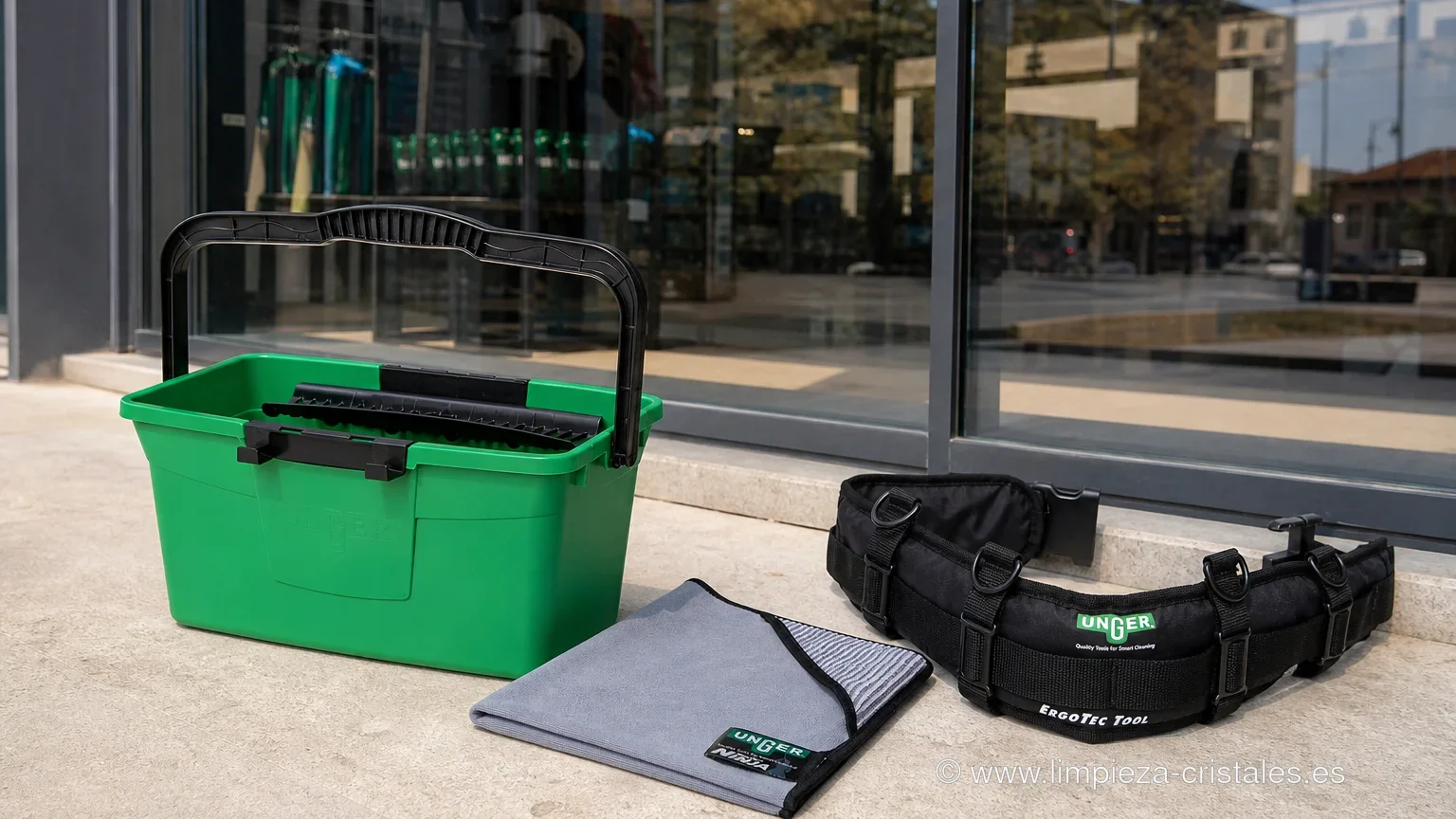
The bucket is not a secondary item when cleaning several shops or large glazed areas. A professional format with enough room for the washer makes the process easier, while a sieve allows you to wring out the sleeve and control the amount of liquid applied more effectively.
Organisation also affects the result. A belt holder, window squeegee holster or transport bag prevents tools from being left on the floor, reduces unnecessary movement and protects channels and rubber blades. In commercial environments, this way of working improves both speed and the operator’s appearance during the service.
Detailing accessories that prevent repeat work
Repeat work takes time and usually occurs when corners, edges or adhered residue are overlooked. For these situations, the setup should include specific tools rather than improvised solutions.
A safety scraper, used with a blade in good condition and with the correct technique, is suitable for removing solid residue adhered to the glass, such as adhesive or dried splashes. It should not be confused with a window squeegee: the scraper removes localised dirt, while the window squeegee removes liquid and leaves the glass dry. Before using it, it is advisable to check that the glass and its treatments are suitable for this procedure.
Professional microfibre cloths have a specific purpose: drying frames, absorbing small drips and finishing corners. They do not replace a good pass with a window squeegee, but they are essential for delivering a clean finish around the perimeter. Carrying several cloths separated by use prevents dirt from being transferred from the frames back onto the glass.
On shop windows with deep framing or visible joints, a narrow detailing tool can save a great deal of corrective work. It is particularly useful in shops with modular glass, glazed entrance doors and display cases where every edge is visible.
When to add an extension pole or pure water
Not all shop windows can be cleaned from the ground with the same equipment. If there is an upper section that is difficult to reach, an extension pole compatible with manual tools allows you to work more safely without relying on unstable supports. The length should be selected according to the actual working height: an excessively long pole on a low pane adds weight and reduces control.
For large exterior surfaces, elevated glass or periodic maintenance of commercial façades, a pure-water system may be more efficient. Water treated for professional cleaning collects dirt and, when applied with the correct brush and flow rate, allows the surface to dry without mineral residue. It is a productivity solution that is especially valuable when manual access is limited.
That said, the surroundings must still be assessed. Very dirty edges, ingrained contamination or interior work will continue to require manual tools and finishing work. The best setup usually combines both methods according to the area of the building, rather than automatically replacing one with the other.
How to choose according to workload
A shop that cleans its window once or twice a week can work with a compact manual kit: washer, window squeegee, replacement rubber blades, bucket, cloths and safety scraper. The priority is a comfortable tool that is easy to store and capable of delivering a good result from the first pass.
For a professional servicing a route of premises, it is worth expanding the setup with several channel widths, replacement sleeves, a tool belt and an organised transport solution. This investment pays for itself through fewer interruptions and a faster response to different glass dimensions.
For maintenance companies carrying out recurring exterior work, compatibility between poles, brushes, adaptors and pure-water systems becomes more important. Buying from product families makes it easier to expand the setup later and keep the necessary spare parts available. This is where technical advice prevents costly configuration mistakes.
Limpieza Cristales Unger also brings the experience of being an Unger SAT in Spain, providing useful support when selecting tools, replacement parts and systems for professional use. Before completing the purchase, it is worth defining the type of shop window, working height, weekly workload and the accessories already in use.
The right choice is not the one with the most components, but the one that enables the operator to wet, dry, finish and move on to the next pane without wasting time. A properly sized Unger setup turns a repetitive task into a controlled, cleaner and more profitable process.