




Date de publication : 23/10/2026
Interior cleaning or pure water: choose the right system based on access, height, glass type and the finish required for each professional job.
An indoor shop window covered with fingerprints, airborne grease and passing dust cannot be tackled in the same way as a glazed façade eight metres above the ground. That is why framing the decision as interior cleaning or pure water only makes sense when the job is assessed as a whole: access, dirt, glass geometry, the risk of dripping, the productivity required and the finish expected.
The right technique is not necessarily the one that seems fastest at first. It is the one that allows you to work safely, achieve consistent results on every pane and reduce touch-ups. For many professionals, the most cost-effective solution is to combine both methods depending on the area of the building.
Interior cleaning or pure water: the real difference
Traditional interior cleaning is based on direct control of the glass. The operator applies solution with a washer, removes the water with a window-cleaning squeegee and finishes the edges, corners and any remaining marks. It is a precise method, particularly useful when there are frames, furniture, delicate floors or people moving nearby.
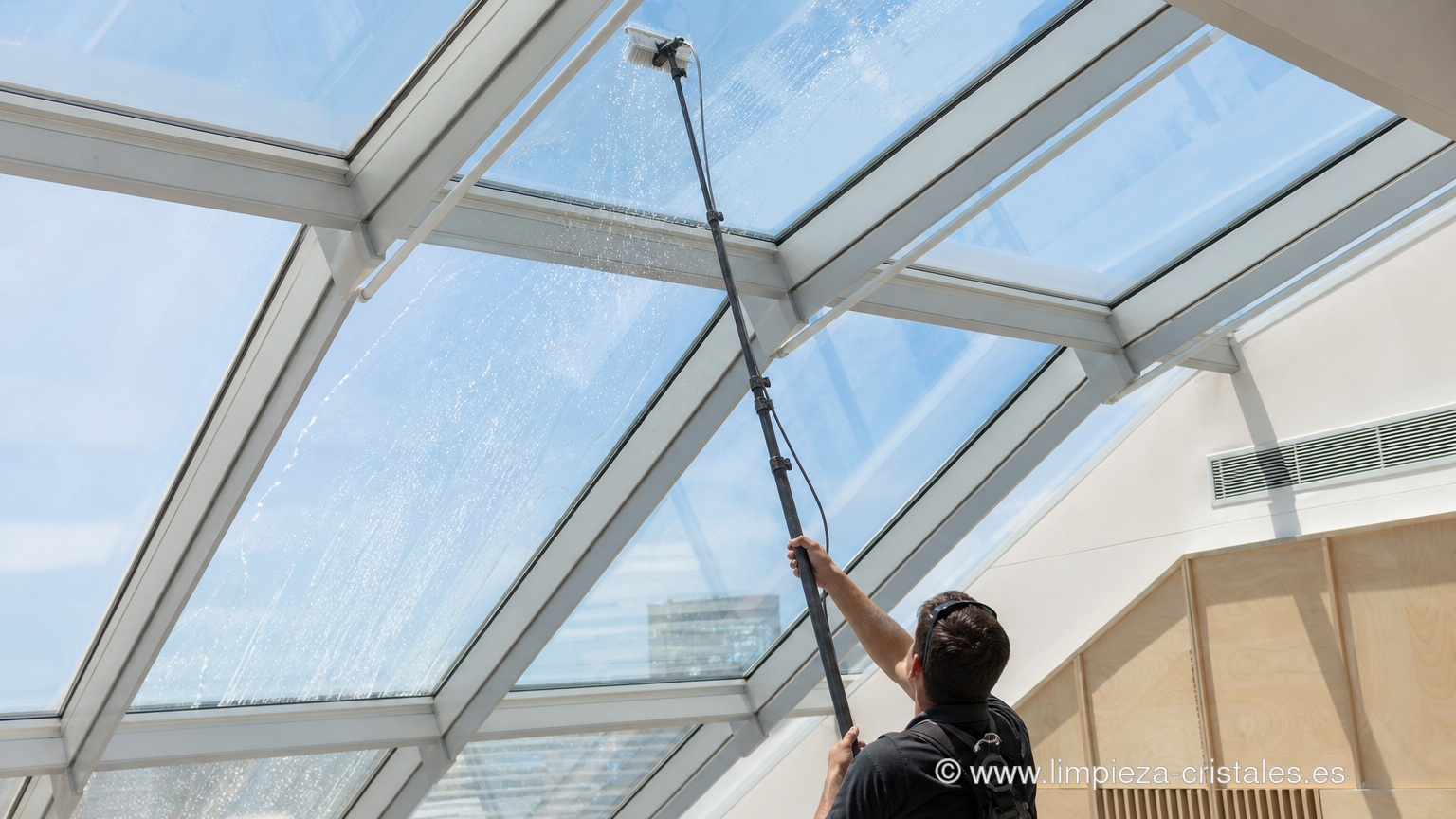
The pure-water system uses treated water to remove minerals and dissolved solids. Applied to the glass with a brush fed through a water-fed pole, it loosens and carries away dirt, then dries without the need to use a window-cleaning squeegee. The result depends on the water having the right level of purity, correct brushing technique and a sufficiently thorough final rinse.
The difference is not just in the tool. With manual cleaning, drying is controlled during each pass. With pure water, the finish is achieved as the glass dries naturally, without mineral residue. For this reason, the method requires the water quality, filters and resins to be checked, as well as an organised washing sequence.
When to prioritise interior cleaning
Indoors, manual cleaning remains the benchmark when precision and control are required. Offices, shops, partitions, display cases, glazed doors and windows with nearby access usually need a clean, contained and fast intervention. A good washer, a window-cleaning squeegee with a rubber blade in good condition and consistent technique reduce the time per pane without compromising the finish.
This system should also be prioritised when there is a risk of water reaching sensitive areas. Carpets, wood, electrical equipment, exposed goods or deteriorated seals require very controlled water application. Pure water can be used in some interior areas, but it should not be treated as an automatic replacement for manual cleaning: dripping, splashing and available ventilation have a major impact on the practical result.
Manual interior cleaning also offers another advantage: it allows adhered dirt to be identified and treated. Adhesive residue, paint, silicone or building dust will not disappear simply by increasing the water flow. In these cases, the professional must first assess the type of surface and use a suitable scraper only when the glass and its treatment allow it. Working without this check can scratch the glass or damage technical coatings.
The equipment that makes the difference indoors
Productivity does not depend solely on skill. A worn rubber blade leaves lines, requires repeated passes and increases fatigue. A well-balanced window-cleaning squeegee, a channel of the right size and a washer that distributes the solution evenly make it possible to maintain a steady pace throughout the day.
The tool size should match the pane. On small panes or those with complex framing, a channel that is too wide reduces manoeuvrability. On large shop windows, a short channel means making too many passes. Having several configurations and spare parts avoids adapting the job to an unsuitable tool.
When pure water delivers greater productivity
Pure water excels outdoors, particularly on hard-to-reach glass, façades, skylights, communal building windows and surfaces at height. Combining a water-fed pole, brush and treated water makes it possible to work from the ground in many situations, reducing set-up times and the need for auxiliary access equipment when working conditions allow.
This does not mean that pure water is always faster by definition. On low-level, very small and accessible glass, setting up the system may not be worthwhile compared with well-executed manual cleaning. However, when there are dozens of repetitive external panes, considerable reach is required or the geometry makes direct access difficult, the time saving can be significant.
The key is to assess the installation as a whole. A façade with deep frames, louvres, ageing seals or heavy dirt build-up requires more brushing and rinsing than smooth glass cleaned regularly. If you work too quickly, residue can remain in corners, along the top of frames or in joints, then run down onto the glass as it dries.
System maintenance determines the finish
A pure-water system only performs well when it is properly maintained. The water quality at the outlet should be checked regularly, because depleted consumables reduce its ability to dry without marks. Glass that is left with streaks or spots after drying does not always indicate a technique problem: it may show that the water no longer reaches the required level of purity.
Brushes, hoses, connections and poles must also be looked after. A brush contaminated with coarse grit can drag particles across the glass. Poorly managed hoses cause pulling, wasted time and trip hazards. An excessively heavy pole also compromises ergonomics when the job continues for a long time.
The choice of pole should balance reach, rigidity and weight. The greater the height, the more important rigidity becomes so that the brush responds accurately. Do not buy based solely on reach in metres: an incorrectly sized configuration can slow down a job that appeared straightforward on paper.
The best decision is usually to combine systems
For shop, office or communal building maintenance, it is common to clean the exterior with pure water and the interior with manual tools. This combination makes it possible to take advantage of the productivity of a water-fed pole where it makes sense, while retaining the control of a window-cleaning squeegee in interior areas, partitions, doors and glass near furniture.
A mixed approach can also be useful within the same façade. Tall, repetitive panes benefit from a pure-water system, while entrances, heavily marked glass or areas with complex details may require manual intervention. This is not about duplicating equipment; it is about preventing a single technique from limiting the quality or speed of the service.
Before putting together a kit, it is worth answering three practical questions: what percentage of the work is carried out at height, what type of dirt occurs most frequently and how many consecutive hours are spent working with the same system. These answers make it easier to select the right pole reach, brush type, water capacity and the channel and rubber-blade sizes required.
Mistakes that reduce profitability
The first is using pure water on glass that has not been properly prepared. For initial cleans or post-construction cleaning, dirt build-up may require several passes, targeted pre-treatment or a different plan. Expecting a perfect finish in a single pass on a neglected surface usually leads to touch-ups and lost margin.
The second mistake is neglecting replacement parts. A window-cleaning squeegee rubber blade, channel rubber, brush or filtration-system component has a direct impact on the finish. Waiting until they fail completely turns preventive maintenance into an incident during the service.
The third is choosing incompatible tools or products without a reliable supply chain. For a professional, being able to replace consumables and receive technical guidance when expanding the equipment is part of the purchase. Access to specialist advice and the support of Unger SAT in Spain helps configure coherent solutions, whether for a shop-window route or external maintenance using a water-fed pole.
The choice between interior cleaning and pure water should not be based on fashion or the initial cost of the equipment. It should reflect the type of contract you want to deliver better: with fewer touch-ups, less fatigue and a finish the customer can verify at a glance.