




Date de publication : 20/10/2026
Explore the 2026 window cleaning trends: pure water, ergonomics, water-fed poles and replacement parts to improve daily productivity and professional results.
An operative can lose more time because a tool is poorly configured than because of the dirt on the glass itself. The 2026 window cleaning trends are not about buying more accessories without a clear purpose, but about reducing passes, movement, fatigue and set-up time. For a cleaning, maintenance or work-at-height company, this directly translates into greater profitability, better results and the ability to handle more jobs with the same equipment.
The sector is moving towards systems that work as a complete set: compatible tools, poles suited to the actual working height, readily available consumables and different methods for each surface. Professionals who combine these variables effectively achieve more consistent results than those looking for a single tool for every situation.
2026 window cleaning trends: efficiency guided by technical judgement
Professional window cleaning is moving away from generic solutions. An interior shop window, a glazed façade, the windows of a residential block and an awkward-to-access glazed enclosure do not present the same challenge. The height, type of dirt, access, service frequency and expected standard of finish all vary.
That is why one of the clearest trends is choosing the system according to the application. The window squeegee and window washer remain essential for interiors, shops and jobs where every detail of the finish needs to be controlled. By contrast, water-fed poles and pure-water systems are becoming increasingly important when the aim is to work from the ground on high or hard-to-reach exterior surfaces, reducing repositioning and improving operational safety.
This is not about replacing one method with another. The most productive equipment is usually the equipment used with a clear understanding of when each method is appropriate. Choosing a specialised tool prevents improvisation, speeds up the work and reduces premature wear on handles, rubber blades and connections.
Pure-water systems for exterior and high-level cleaning
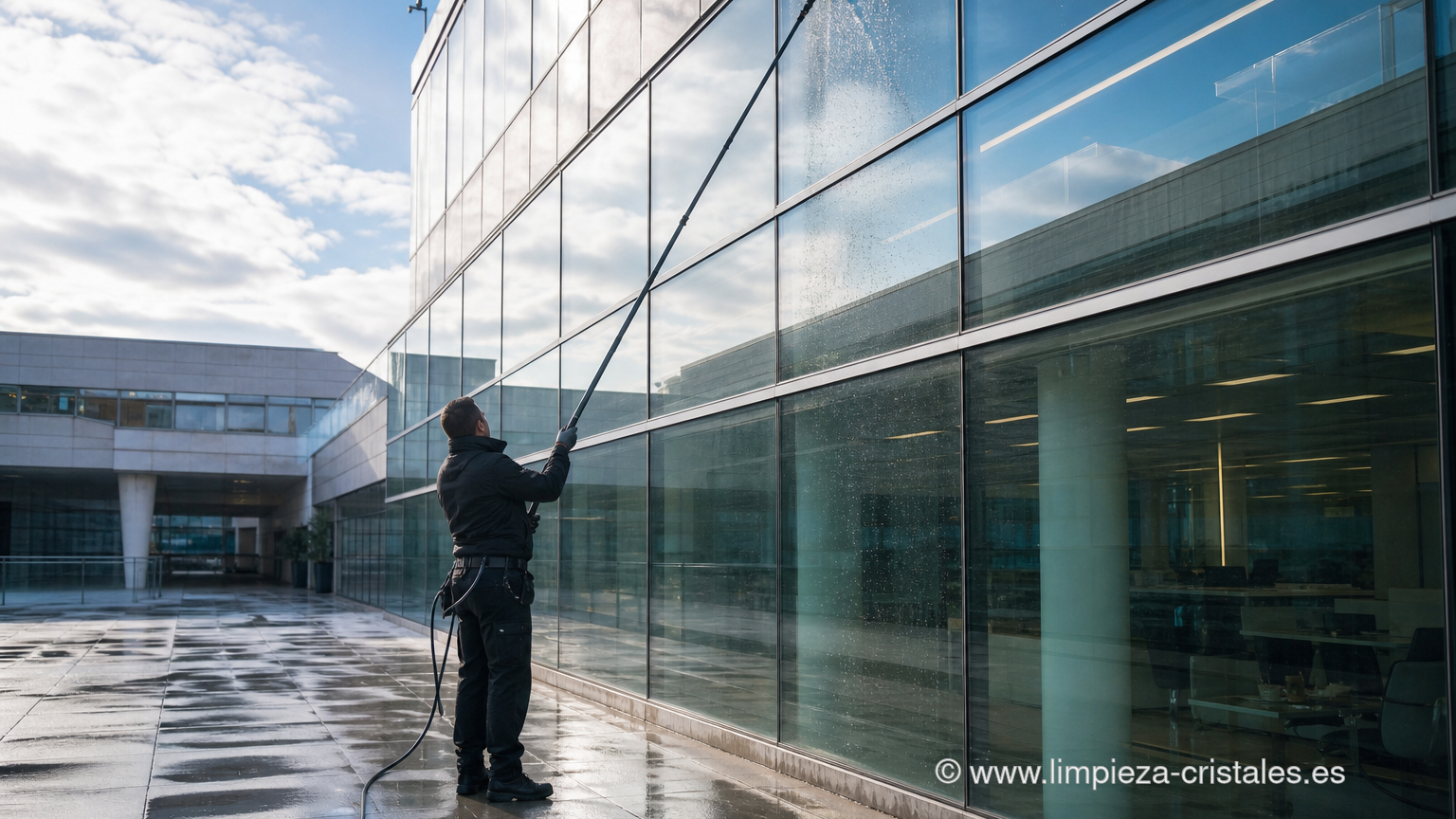
The use of pure water for professional window cleaning will continue to grow in 2026, particularly for façade maintenance, glazed panels, high windows and areas where access with a ladder is inefficient. The advantage is that, in many exterior applications, surfaces can be brushed, rinsed and left to dry without the need for manual finishing.
However, the result depends on correct configuration. The quality of the treated water, the condition of the brushes, the rinsing technique and dirt build-up on frames or seals all affect the finish. Windows with bonded-on residue, heavy contamination or specific deposits may require pre-treatment with manual tools. A pure-water system does not remove the need for professional judgement; it makes the operative more productive when used in the right situation.
Maintenance control is also becoming more important. Filters, connections, hoses, brushes and pole components should be checked as part of the working process. A small loss of system performance can lead to repeated work, spotting or unnecessary movement at the end of a job.
Lighter, stiffer and configurable water-fed poles
A pole is no longer judged solely by its reach in metres. In 2026, purchasing decisions will be more closely linked to the balance between stiffness, weight, control and frequency of use. A pole that is too flexible offers less precision at height and requires more corrections; a solution that is oversized for low-level work can reduce comfort and increase costs without providing a real advantage.
For regular work, the ergonomics of the complete system matter just as much as the pole itself. Consider the type of clamps, how easily sections can be adjusted, hose routing and compatibility with brushes, adaptors and heads. The aim is for the operative to be able to assemble, use and pack away the equipment quickly, without play or improvised accessories.
The practical recommendation is to start with the usual working height, rather than the maximum occasional height. If most jobs are carried out within a particular range, the pole should be optimised for that daily use, with an extension or second configuration available for occasional work. This avoids carrying an unnecessarily oversized system every day.
Ergonomics applied to real productivity
Another window cleaning trend for 2026 is to assess ergonomics by the number of hours a tool is used, rather than by a first impression when holding it. A comfortable handle, a well-balanced window squeegee, a window washer that holds solution effectively and a correctly selected rubber blade reduce repetitive movements and help maintain a consistent technique throughout the working round.
For shop-window and interior work, articulated systems and handles with good control make it easier to deal with corners, frames and restricted-access areas with fewer changes in posture. This does not mean that every articulated tool is necessary. On large, straight surfaces, a simple, well-maintained set with the appropriate width can offer greater speed.
Fine adjustment matters too. The channel width should match the size of the panes; a rubber blade in good condition should glide without jumping; and the window washer should suit the level of dirt. Using a tool that is too small on large surfaces multiplies the number of passes. Using one that is too large in narrow spaces reduces control. Productivity comes from these apparently minor decisions.
Replacement parts and compatibility as part of the system
In a professional environment, equipment is more than what is purchased on the first day. It also includes the ability to replace a rubber blade, washer sleeve, channel, connection piece or pole component when required. The availability of replacement parts will become an increasingly important purchasing criterion for companies that cannot stop a working round because of a simple fault.
This trend favours modular, compatible systems within the same range. When accessories are designed to work together, professionals can replace a wear component without replacing tools that remain in good condition. In the medium term, this continuity helps control costs and maintains a familiar technique across the team.
It is also important to distinguish between a worn rubber blade and a problem caused by bonded-on dirt. The rubber blade is responsible for removing water and finishing the glass; specific scrapers are used to remove stubborn residue or isolated build-up, always with a blade in good condition and the correct technique to avoid damaging the surface. Confusing these two functions often leads to poor results and unnecessary replacements.
How to apply the 2026 window cleaning trends
The most efficient purchasing process starts by analysing the working round. A company cleaning street-level shops needs to prioritise agility, replacement washer sleeves, window squeegees in different widths and an organised bucket. A team dedicated to exterior and high-level work should pay closer attention to the configuration of poles, brushes, hoses and water treatment. If both types of service are carried out, it is usually more useful to create two complementary configurations rather than expect one kit to handle everything.
Standardising work equipment
Standardisation is an operational decision, not an aesthetic one. When operatives use compatible tools and a defined selection of sizes, training is quicker, replacement-parts stock is simpler and errors when preparing equipment are reduced. It is also easier to identify why a finish has failed: when the method and equipment are standardised, the rubber blade, washer, working angle or condition of the surface can be checked more accurately.
However, standardisation does not mean restricting the range. It is worth keeping specific accessories for small panes, large windows, high-level areas and detailed work. The key is for every item to have a clear function within the system, rather than remaining in the vehicle as an accessory with no defined purpose.
Buy for the cost of use, not just the initial price
In 2026, professionals will continue to assess purchases according to their cost of use. A professional-grade tool can be worthwhile if it retains its adjustment, allows wear components to be replaced and delivers consistent performance during intensive working days. The initial cost matters, but it should be compared with the time saved, durability and continuity of service.
Technical advice makes a real difference here. As an Unger after-sales service centre in Spain, a specialist distributor can help identify compatibility, select replacement parts and recommend a configuration based on the type of service. This is particularly useful when water-fed poles, pure-water accessories and manual tools are combined, as an incorrect choice can limit the performance of the entire system.
Maintain equipment before it fails
Prevention will be more cost-effective than urgent replacement. Checking rubber blades, washer sleeves, scraper blades, clamps, hoses and connections before starting the round reduces problems at the customer’s premises. Tools should also be cleaned and dried after use, especially components that come into contact with dirt from frames, particles or exterior residue.
Basic maintenance does not need to complicate operations. Simply include a short check at the end of the working day and keep the usual consumables in stock. The result is more reliable equipment, a more consistent finish and fewer reactive purchases.
The best trend for 2026 will not be one isolated tool, but a well-considered purchasing decision: choosing a system that meets the demands of daily work, supports replacement parts and enables the operative to maintain quality when the pace of service increases.