




Date de publication : 10/10/2026
How to choose the best professional window-cleaning buckets based on the job, capacity, stability and compatible Unger accessories.
You notice a poorly chosen bucket before you have even finished the first floor: it forces you to bend down more often, splashes while being carried, does not accommodate the washer properly or leaves your tools disorganised. The best buckets for professional window cleaners are not necessarily those with the greatest capacity, but those that suit the working method, the amount of glass to be cleaned and the accessories used by each operator.
For a professional, the bucket is part of the cleaning system. It should allow the washer to be loaded quickly, keep the cleaning solution under control and withstand continuous use in premises, residential buildings, offices, shop windows or maintenance rounds. Choosing it carefully avoids small but repeated losses of time throughout the working day.
What a professional window-cleaning bucket should offer
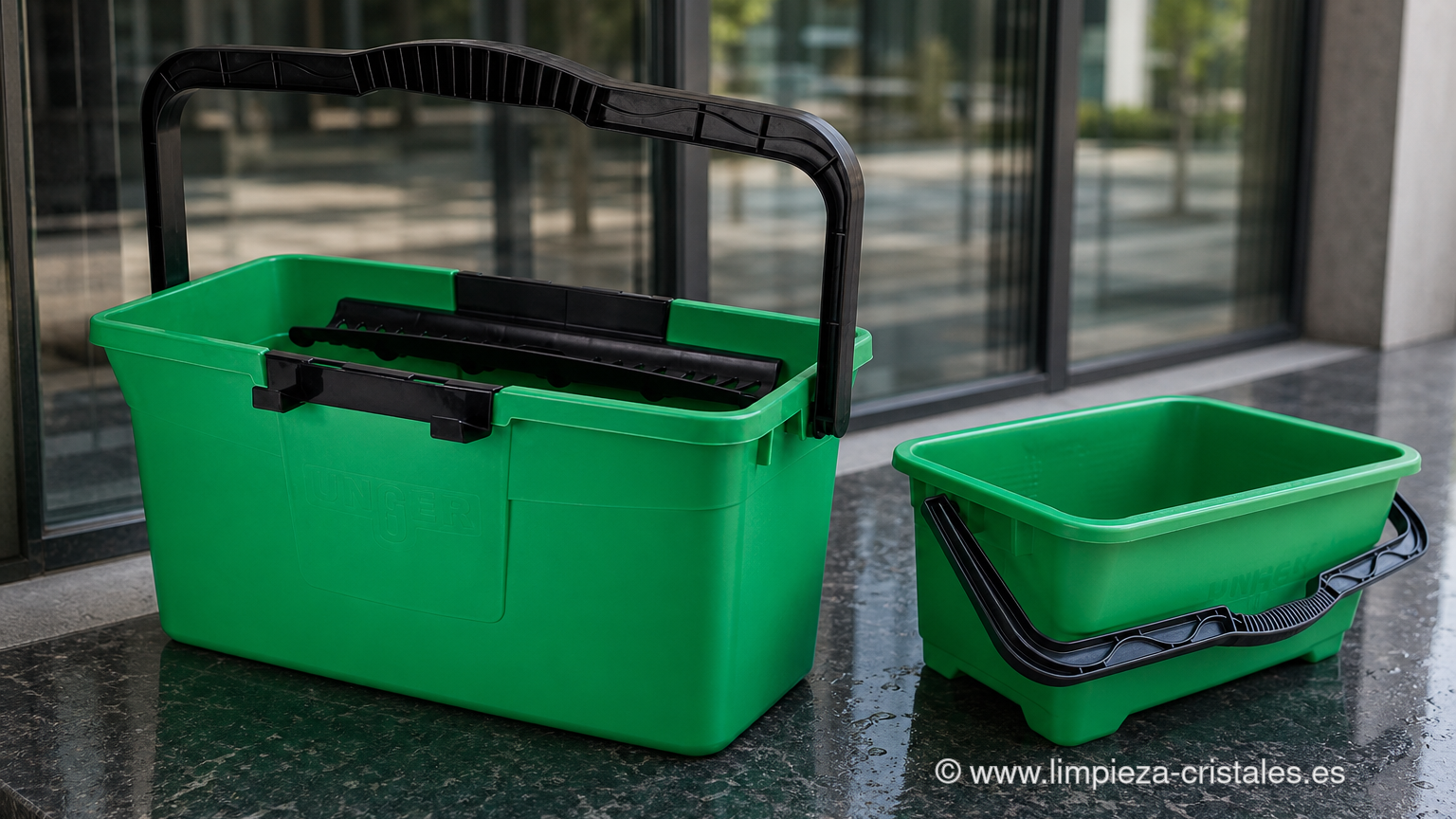
The difference between a basic bucket and one designed for window cleaning lies in how it works in practice. A professional format should allow the washer to be inserted and wrung out comfortably, remain stable when placed on the floor and withstand knocks, dragging and frequent transport.
The usable opening is the first point worth checking. It is not enough to look at the stated capacity: you should make sure that the width and length allow you to use your usual washer without forcing it or spilling liquid. If you use wide supports or large-format sleeves, a narrow bucket can become a constant hindrance.
The base also matters. A bucket with firm support reduces the risk of tipping when loading the washer, particularly on uneven floors, in communal hallways or in busy areas. For recurring services, this stability affects both safety and the professional image presented to the customer.
The handle should be comfortable when the bucket is full and remain securely attached. It may seem like a minor detail, but an operator may walk through a shop, staircase or entire floor many times a day. An uncomfortable bucket makes the hand ache, slows movement and increases the risk of splashing.
The best buckets for professional window cleaners, depending on the job
There is no single bucket that is right for every service. The choice changes depending on whether you mainly work indoors, clean large glazed areas or organise equipment by zones and operators.
Cleaning shop windows, retail premises and offices
For shop windows and offices, a compact bucket, which is stable and easy to move between windows, is usually the most suitable option. The aim is not to carry the maximum amount of solution, but to keep the workstation efficient and tidy. An oversized bucket takes up space, adds unnecessary weight and can make it harder to move through confined areas.
For this type of service, the important factors are compatibility with the washer and the ability to switch quickly between loading, washing and squeegeeing. If the bucket includes areas for resting tools or accepts organisational accessories, the operator can avoid leaving handles, cloths or supports directly on the floor.
Maintenance of communal buildings and cleaning rounds
For rounds involving many work locations, the bucket must balance capacity and mobility. A durable solution, with a good handle and a shape that allows it to be carried without hitting frames, walls or furniture, usually works best.
When carrying out repetitive tasks over several floors, ergonomics make a real difference. Filling an excessively large bucket may seem efficient at first, but it means moving more weight than necessary. If refill points are nearby, a moderate capacity generally provides a more comfortable and controlled working pace.
Large panes and intensive work
For large surfaces, the bucket needs to make it easy to load the washer continuously while holding enough working solution to avoid frequent interruptions. A wide opening becomes more important, particularly when using longer tools.
Even so, greater capacity does not always mean higher productivity. If a full bucket makes it difficult for the operator to move around or causes spills every time it is carried, the time saved on refilling is lost during transport. On extensive jobs, the best results usually come from combining a suitable bucket with well-planned work zones and compatible tools.
Capacity: the mistake of choosing by litres alone
Capacity should reflect the distance between refill points, the size of the windows and the number of operators sharing the equipment. A high-volume bucket may be useful at a fixed workstation, but not necessarily on a mobile cleaning round.
It is worth considering three factors together: how much liquid is actually needed, how much weight will be carried and how much space is available at the workplace. Indoors, where there may be furniture, doors or lifts, a more compact model can be far more practical. By contrast, for cleaning concentrated in one area, a larger reserve avoids interruptions.
In addition, the bucket should not always be filled to the maximum. Leaving some room reduces splashing when inserting the washer and improves control during transport. This simple practice helps to keep floors and access routes clean, which is particularly important in offices, shops and communal areas.
Accessories that improve bucket performance
The bucket should not be assessed in isolation. Its performance improves when it forms part of a coherent set with a washer, squeegee, cloths and transport systems. Compatibility avoids improvised adaptations and allows the operator to work with fewer movements.
A compatible wringer or grid can help regulate how much solution the washer holds and reduce dripping before it reaches the glass. This is useful indoors, near delicate flooring or in services where people are passing through. It does not replace correct technique, but it provides greater control and consistency.
Tool holders and organisational features also deserve attention when cleaning is carried out regularly. Keeping the scraper, cloths and spare items close at hand reduces interruptions and prevents tools from being placed in unsafe locations. In teams with several operators, clear organisation simplifies restocking and maintenance.
If you work with poles or pure-water systems for technical window cleaning, the bucket can still be useful for detail work, interiors, frames or manual finishing. However, it should not be considered a replacement for the main system on façades or surfaces where pole work is the most efficient solution.
Material, cleaning and service life
A professional bucket should withstand repeated use without deforming easily. Material strength is important, but so is ease of cleaning. Residue that builds up in the bottom, corners or accessories eventually affects operational hygiene and can transfer dirt to the washer.
After each service, empty and rinse the bucket and check that no residue remains. It is also advisable to inspect the handle, attachment points and any fitted accessories. This basic maintenance extends the life of the equipment and makes it possible to identify a damaged part before it fails during a job.
The availability of compatible spare parts and accessories is particularly important for tools used every day. At Limpieza Cristales Unger, technical advice and Unger technical service in Spain help businesses configure equipment for continued use, which is important for companies that cannot interrupt a cleaning round because a difficult-to-replace part is unavailable.
How to choose without paying for features you will not use
Before buying, consider one very specific question: where will the bucket spend most of the working day? If it will be moved from one window to another, prioritise a manageable weight, a good handle and stability. If it will remain in one place while cleaning large panes, give greater importance to the opening and usable capacity.
Next, check the size of the washer and the rest of your tools. A bucket that is compatible from the outset avoids buying unnecessary adapters or working with an awkward load. Finally, consider whether you need wringing and organisational accessories or whether a simple format will fully meet your requirements.
Choosing a professional bucket carefully is not about selecting the largest one, but about reducing unnecessary movements during every service. When the bucket, washer and squeegee work together as a system, the operator gains speed, controls dripping more effectively and maintains a more professional image in front of the customer.