



Date de publication : 08/10/2026
Discover Unger innovations for working at height, including water-fed poles, pure water systems and accessories designed to improve safety, reach and professional productivity.
Unger innovations for working at height are not just about reaching further. The real difference lies in being able to clean exterior surfaces with a more controlled system, fewer manual adjustments and a setup suited to the height, type of glass and service frequency. For a cleaning or maintenance company, this directly affects working time, the final result and operator fatigue.
Using manual tools from the ground, a platform or a pole requires technical judgement. An incorrectly sized solution can cause excessive flex, reduced precision, fatigue in the shoulders and wrists, or inconsistent results. That is why the development of Unger systems is based on three aspects that should be assessed together: reach, ergonomics and component compatibility.
Unger innovations for working at height: what they offer
The main benefit of a professional system is not a single tool, but the ability to build a coherent working solution. Telescopic poles, brushes, angle adapters, hoses, connectors and pure water systems must work together. When each element is selected for the same application, operators can work more continuously and reduce interruptions to readjust accessories or correct mistakes.
Unger has developed product ranges for different scenarios: regular maintenance of shop windows and façades, exterior cleaning of communal buildings, sites with large glazed areas and technical jobs where direct access is limited. They do not all require the same pole length or brush head. The choice depends on the effective working height, the horizontal distance from the façade, the presence of obstacles and the required finish.
At height, every additional section makes a difference. A pole that is too long for a straightforward task compromises control, while one that is too short forces the operator to adopt an awkward posture or seek additional access equipment. Useful innovation means having scalable options and accessories that allow the equipment to be adapted without improvisation.
Telescopic poles: reach without losing control
The pole is central to many exterior cleaning jobs. Its value is measured not only by its reach, but also by its rigidity, working weight, locking system and ease of use. As length increases, flex and the balance of the complete assembly become more important. Professionals need the tool to transfer movement accurately to the brush or cleaning accessory positioned at height.
Unger pole ranges allow configurations to be created according to the intended use. For regular work at low and medium height, it is advisable to prioritise agility and rapid deployment. On taller façades, it is worth considering materials and designs that help maintain the stability of the assembly. The longest solution is not always the most cost-effective: if access, frequency of use or site regulations require another method, this should be assessed before purchasing.
Operational details matter too. Locks must withstand repeated use, sections should be kept clean to ensure smooth operation, and connections to accessories must be secure. The availability of spare parts is also crucial. Replacing a worn component in good time is usually more efficient than continuing to use equipment with play or sticking parts that affect daily performance.
Pure water for technical exterior cleaning
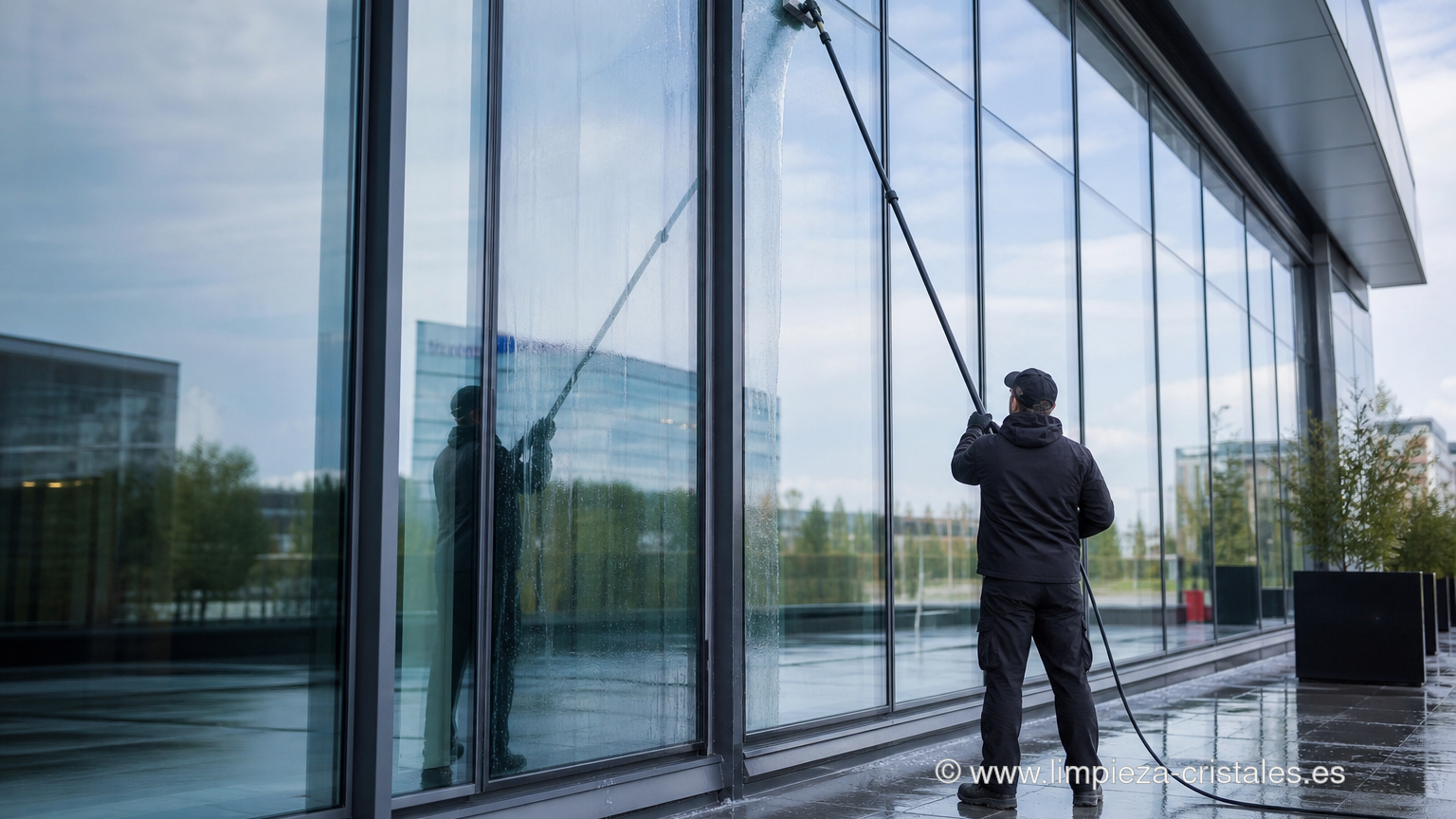
Pure water systems have changed the way exterior glass cleaning at height is approached. By using treated water for professional cleaning, surfaces can be brushed, rinsed and left to dry without having to finish the glass from the ground with a squeegee. This is particularly useful for façades, solar panels, glazed structures and areas where direct access is difficult.
Performance depends on several factors: the quality of the water produced by the system, the condition of the brush, the available flow rate, the operator’s technique and the level of accumulated dirt. For routine maintenance, the method can deliver high productivity. However, bonded-on residue, silicone, paint, heavy pollution or old mineral deposits may require pre-treatment or a specific manual cleaning process.
Innovation does not replace professional judgement. A suitable brush must clean without damaging the surface, and rinsing must be sufficient to remove loosened dirt. Working with a poorly routed hose, an unstable brush head or an oversized pole can cancel out the system’s benefits. It is therefore preferable to configure the complete setup according to the type of service, rather than adding accessories in isolation.
Ergonomics and safety in daily productivity
When working at height, productivity cannot be separated from safety and ergonomics. An operator who has to hold a pole for extended periods needs to vary their position, avoid unnecessary arm elevation and use a length suited to the working area. Technique matters just as much as the tool.
It is advisable to plan the cleaning route before starting. Checking water points, obstacles, changes in level, pedestrian traffic and support areas reduces unproductive movements. Outdoors, wind and surface conditions can completely change the viability of a pole-based operation. If the equipment becomes unstable or the area cannot be properly cordoned off, this is not a question of speed: it is a sign that the working method needs to be reviewed.
Ergonomics also affects the result on the glass. When an operator becomes fatigued, stroke precision decreases and the need for repeat cleaning increases. A well-balanced system helps maintain even brush pressure and a more controlled movement, which is particularly noticeable on high-level glass with localised dirt or complex frames.
Compatibility: the detail that prevents stoppages
Professional equipment must be capable of remaining operational. This is one reason why compatibility between handles, cones, brushes, adapters, hoses and spare parts deserves attention before purchase. An apparently inexpensive accessory can become a problem if it requires unstable adaptations or makes future replacement difficult.
For companies with several operators, standardising a tool family simplifies training, reduces errors and makes it easier to keep useful spares in stock. This does not mean every setup must be identical, but they should follow a common logic. A shop-window configuration can coexist with another for façades, provided consumables and connections are managed sensibly.
Technical support also makes a difference when questions arise about assembly, maintenance or component replacement. Access to Unger after-sales service in Spain helps resolve product queries with brand-specific expertise and guides purchasing towards a viable solution rather than an improvised combination.
How to choose an Unger setup for your service
Before deciding, it is important to define the actual working height rather than simply the height of the building. You need to add the distance between the operator and the façade, assess whether there are planters, fences or changes in level, and allow enough room to handle the pole safely. Next, consider whether the cleaning will be occasional or carried out regularly.
For regular maintenance of exterior glass, a pure water system with a pole, brush and water supply can reduce preparation and travel time. For interior work, lower-level glass or finishes requiring more direct control, the combination of a washer sleeve and squeegee remains a precise and efficient solution. In both cases, choosing the right rubber blades, handles and spare parts prevents a professional tool from performing below its potential.
It is also advisable to consider maintenance from day one. Cleaning brushes, checking connections, avoiding impacts to the pole locks and replacing damaged parts extend the system’s service life. Equipment should not be viewed as a one-off purchase, but as a production tool requiring continuity of supply and support.
The best improvement when working at height often starts with a simple question: which part of the service is costing the most time or affecting quality? From there, a correctly sized Unger setup allows operators to work methodically, maintain control from the ground and turn every job into a more profitable and predictable service.