




Date de publication : 05/10/2026
Discover the best tools for large windows and choose poles, window squeegees and pure water systems based on height, access and professional use.
A large-format window is not cleaned more effectively by accumulating accessories, but by configuring a system that reduces movement, reaches high areas with control and leaves a consistent finish. The best tools for large windows vary according to access, height, the type of dirt and how frequently the service is carried out. The right choice allows you to work faster, with less effort and without compromising operator safety.
Before choosing: access, surface and working method
The size of the glass is only one part of the decision. A large shop window at street level, an internal office glass partition and a multi-storey exterior façade all require very different set-ups. First, establish whether the work will be carried out from the ground, with direct access, using a pole or with a pure water system.
The condition of the glass also matters. For regular maintenance, the traditional method using a washer and window squeegee offers excellent control over the finish. On high exterior surfaces with recurring environmental dirt, a pure water-fed pole can significantly improve productivity. If there are stuck-on residues, paint, adhesives or dried bird droppings, a specific scraper will be needed, and it should only be used when the type of glass and the conditions allow it.
A common mistake is buying a tool solely to solve a particular job. For a cleaning or maintenance company, it is more cost-effective to build a compatible kit: handles, channels, rubbers, washers and poles that can be combined, with replacement parts available when they wear out.
Essential tools for large windows
Window squeegee with a wide channel and professional rubber
The window squeegee is the tool that determines the finish when using the traditional method. On large windows, a wider channel covers more surface area with each stroke and reduces overlaps. However, the longest channel is not always the best solution: where there are narrow frames, profiles, divisions or limited room to manoeuvre, an excessively large size can make control more difficult.
For large, smooth and accessible panes of glass, a wide size is efficient. For finishing work, corners and areas next to frames, it is advisable to carry a second, shorter size. This combination prevents excessive pressure on the tool and helps maintain even pressure on the glass.
The rubber deserves the same attention as the support. It must be clean, correctly fitted and free from cuts or deformation. Worn rubber leaves lines, drags water or forces you to repeat strokes, reducing productivity. Having the right replacement rubbers for the selected channel is an operational decision, not a secondary accessory.
High-absorption washer with interchangeable sleeve
On a large window, the washer must wet the glass evenly without releasing excess solution onto the floor, frames or furnishings. A professional sleeve with good absorption capacity maintains the pace of work and reduces the need to return constantly to the bucket.
The washer width should correspond to that of the window squeegee, although it does not have to be identical in every case. A balanced set-up allows you to wet a large area and remove the water with clean strokes. Interchangeable sleeves make it easier to keep those used for routine maintenance separate from those used on dirtier glass or builders’ cleans.
Washing and replacing sleeves in good time is essential. A sleeve saturated with particles can drag dirt across the glass and compromise the final result, particularly on surfaces exposed to traffic or pollution.
Professional bucket, sieve and detailing accessories
The bucket should provide stability, sufficient capacity and an organised working base. On repetitive jobs involving large surfaces, having a suitable bucket prevents interruptions and helps keep the cleaning solution in better condition. The sieve allows you to wring out the washer quickly and control the amount of liquid applied.
Detailing accessories complete the system. Microfibre cloths for frames and finishing work, a clean chamois for small corrections and a tool holder for moving around safely can resolve issues without returning to the trolley or vehicle. They are not expensive items, but they have a direct impact on the speed of a job.
Telescopic poles for height and difficult-to-reach areas
When the window cannot be accessed safely from the ground or from inside, the telescopic pole is the usual solution. Its purpose is not simply to reach further: it must transmit hand movements accurately. A pole that is too flexible causes the head to oscillate, requires constant correction and increases operator fatigue.
The length should be selected according to the actual working height, taking the operator’s height and the need to maintain a stable posture into account. Buying a pole with more reach than necessary may appear advantageous, but it adds weight and makes manoeuvring more difficult. In applications carried out frequently at considerable height, rigidity, the locking system and weight are more important than a minor difference in length.
For traditional pole work, the head angle and an articulated system make a clear difference around upper edges and frames. For interior work, protecting the surrounding area is essential: control the wetting and use techniques that prevent splashes on walls, floors or equipment.
Pure water systems for exterior glass
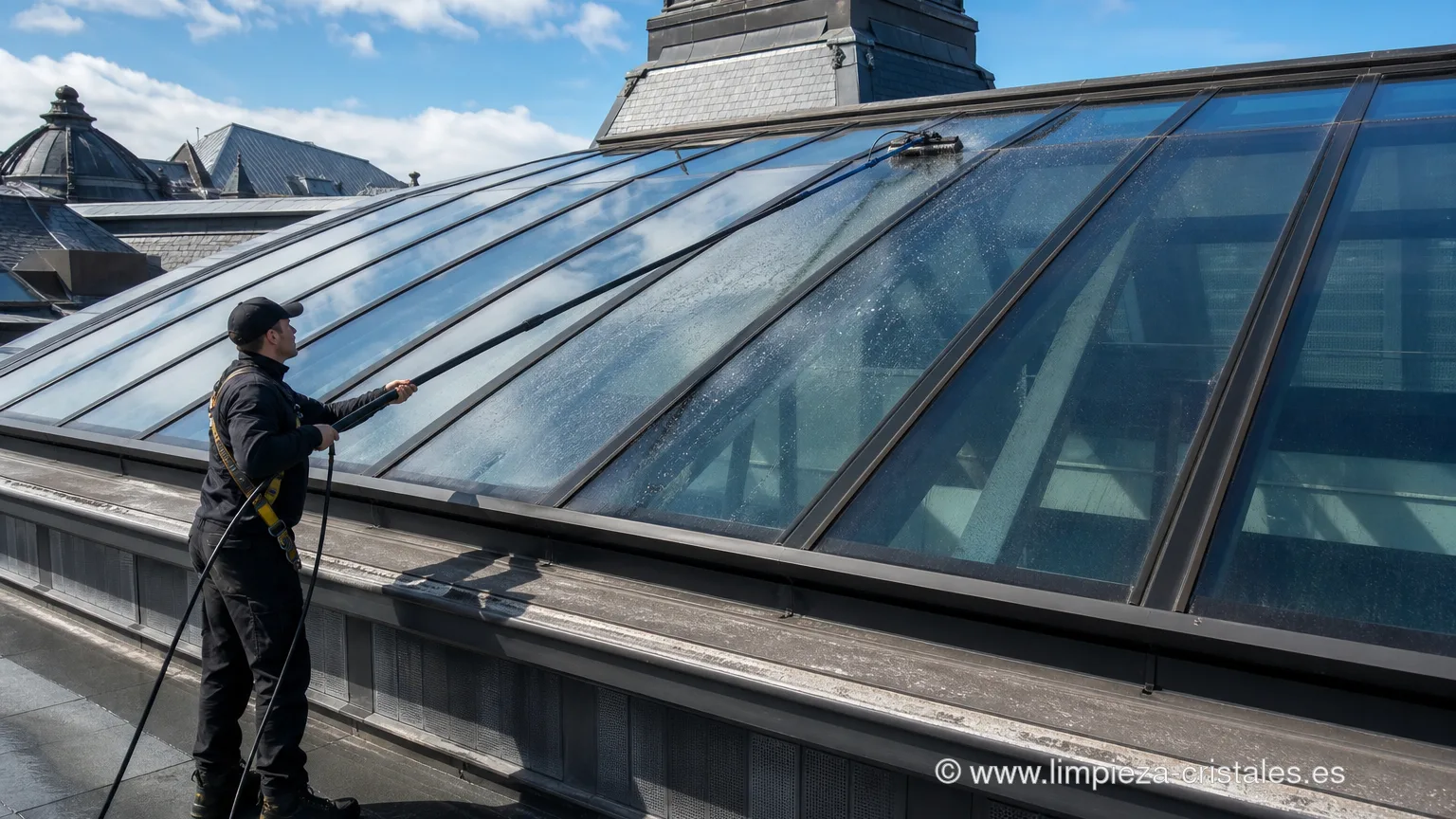
On façades, rooflights and large exterior surfaces, pure water systems for professional cleaning allow you to work with a brush and pole from the ground. The treated water is used to loosen and carry away dirt, and the glass dries without needing to be finished with a window squeegee when the procedure is carried out correctly.
This method is particularly useful for recurring maintenance, buildings with extensive glazing and areas where ladder access is inefficient. Its performance depends on several factors: the quality of the treated water, the correct brush, flow rate, brushing technique and final rinse. A well-chosen system does not replace the operator’s judgement; it extends it.
Not every job justifies this investment. On an internal shop window or low-level glass with localised dirt, the traditional method may be quicker and provide an immediate finish. By contrast, for exterior maintenance rounds involving several high windows, the time saved and reduction in difficult access requirements can more than justify the investment.
How to configure your equipment for the job
For large shop windows at street level, the most effective set-up will usually include an absorbent washer, a wide window squeegee, a second shorter tool for edges and a detailing microfibre cloth. The aim is to cover the surface quickly without neglecting frames, corners or drips.
In offices, residential developments or interiors with high glazing, a lightweight telescopic pole with an adjustable head allows you to keep your feet on the ground and reduce unnecessary set-up. Here, moisture control is just as important as reach, as the surroundings often include delicate flooring, furnishings and walkways.
For façades and elevated exterior windows, it is worth considering a pole specifically designed for pure water, compatible brushes and a treatment system sized for the workload. The choice should reflect how many jobs are carried out, which heights need to be covered and whether the equipment will be transported frequently.
Mistakes that reduce performance and finish quality
Working with worn rubber is one of the costliest mistakes, even though it may seem minor. It creates additional strokes, wastes time and gives the impression of a poor finish. You should also avoid mixing replacement parts without checking their sizes and compatibility: a poorly fitted set can perform inconsistently and shorten the tool’s working life.
Another common mistake is using a long pole without considering its rigidity. The operator ends up compensating for the flex with greater force in the shoulders and wrists, resulting in poorer accuracy and increased fatigue. Productivity depends not only on reach, but also on maintaining controlled movement throughout the working day.
Finally, a scraper should not be used automatically on every type of glass. First identify the residue, check the condition of the surface and apply the correct technique. Professional cleaning also means knowing when not to force a tool.
Technical support and ongoing availability of replacement parts
Cleaning equipment should be chosen as a long-term working system. Specialist advice helps you select sizes, handles, channels, sleeves, poles and replacement parts that reflect each customer’s actual requirements. Limpieza Cristales Unger, as an Unger authorised service centre in Spain, provides this technical knowledge to guide professional configurations and maintain equipment continuity after purchase.
Before adding a tool, think about the next hundred jobs, not just the first large window. When the system is correctly sized, every stroke becomes more predictable, the operator works with greater control and the finish no longer depends on improvisation.